
Electricity powers modern society. Hospitals rely on it to sustain life-saving equipment. Transportation systems depend on it to operate safely. Entire economies can stall within hours if energy delivery is interrupted.
And because of this, national energy grids have become one of the most attractive targets for sophisticated cyber attackers. State-sponsored threat groups increasingly focus on energy providers, looking for ways to disrupt infrastructure, collect intelligence, or destabilize entire regions.
In this environment, communication systems used by grid operators, engineers, and field technicians must be designed with extreme resilience and security in mind.
Traditional cloud messaging tools and consumer communication platforms simply were not built for these risks.
Energy providers now recognize the need for sovereign communication for critical infrastructure—secure communication environments that operate under national control and remain functional even when public networks fail.
MailSPEC provides precisely this type of solution.
Through secure messaging platforms, encrypted communications, and sovereign infrastructure deployment, MailSPEC enables energy providers to coordinate complex operations while maintaining full control over sensitive information.
Many organizations rely on commercial cloud platforms for everyday communications. But for ordinary business workflows, this approach may be sufficient.
For energy grid operators, however, shared cloud environments introduce significant risks.
Operational communications often include highly sensitive information, such as:
When these communications travel through shared cloud systems, several vulnerabilities emerge.
Cloud providers often distribute data across multiple geographic regions. This makes it difficult for energy providers to maintain clear legal control over where operational data is stored.
If communication data is stored on infrastructure owned by foreign entities, it may be subject to legal requests from external governments.
Shared cloud environments host many different organizations on the same infrastructure. This can increase the risk of lateral cyber attacks.
Energy providers may not have full visibility into how cloud vendors manage encryption keys, administrative access, or internal security procedures.
And for critical infrastructure operators, these uncertainties are unacceptable.
This is why the conversation has shifted toward sovereign communication channels that operate under direct national or organizational control.
A sovereign communication environment is one where the entire messaging system operates within a controlled jurisdiction and infrastructure.
Here, instead of relying on third-party cloud providers, organizations maintain their own communication networks either on private infrastructure or within a national cloud environment.
For energy providers, sovereign communication for critical infrastructure offers several advantages:
✔️ complete control over operational communication data
✔️ protection against foreign legal interference
✔️ reduced risk of data exposure through shared platforms
✔️ stronger compliance with national infrastructure protection laws
This approach then ensures that the systems responsible for coordinating grid operations remain secure and under domestic authority.
In the context of national energy systems, communication sovereignty becomes part of national security strategy.
Energy grids must function under the most challenging circumstances imaginable.
Natural disasters, geopolitical conflict, and cyber attacks can all disrupt normal communication channels. When this happens, grid operators still need reliable systems to coordinate emergency responses.
Sovereign messaging for energy grids provides resilience by ensuring that communication infrastructure does not depend on the public internet.
In sovereign environments, messaging systems can operate through:
And because these systems operate independently of public networks, they remain functional even during large-scale internet disruptions.
This capability dramatically improves national resilience during emergencies.
One of the most effective methods for protecting sensitive operational systems is the use of air-gapped communication networks.
An air-gapped network operates separately from the public internet. It prevents external systems from directly accessing critical operational environments.
For energy providers, this architecture can protect operational control systems while still allowing secure communication between field teams and central command.
Air-gapped sovereign communication channels provide several benefits:
MailSPEC supports deployments that allow energy providers to maintain secure messaging environments even when operational systems must remain isolated from public networks.
When severe weather strikes or major infrastructure incidents occur, the ability to communicate quickly can determine whether power outages are resolved within hours or escalate into widespread disruptions.
Emergency coordination often requires rapid messaging between:
These communications must remain operational even if primary internet infrastructure becomes unavailable.
Effective secure communication for critical infrastructure requires redundant messaging channels capable of functioning during outages.
Essential capabilities include:
MailSPEC messaging systems are designed with these requirements in mind, ensuring that energy providers can maintain communication continuity even during large-scale disruptions.
Communication security is not only about where messages are stored. It is also about how they are transmitted.
Energy grid operators frequently communicate across wide geographic areas. Field technicians may be working hundreds of miles away from central command facilities.
Each communication link represents a potential vulnerability.
End-to-end encryption protects these connections by ensuring that messages remain unreadable to unauthorized parties during transmission.
For energy grid secure messaging, this means:
Now, without strong encryption, attackers could potentially intercept operational communications or inject malicious instructions into the grid control environment.
Encryption ensures that only authorized personnel can read or respond to operational messages.
National energy systems are enormous. Utility providers may coordinate thousands of employees and contractors across vast regions.
Thus, communication platforms supporting these operations must be capable of handling extremely large deployments.
MailSPEC infrastructure is designed for precisely this level of scale.
The CommuniGate SPEC sovereign email server platform supports communication networks capable of serving up to one hundred million user accounts. This makes it suitable not only for enterprise utilities but also for national infrastructure communication systems.
Large-scale deployments allow energy providers to integrate multiple communication channels within a unified secure platform, including:
By centralizing communication across these channels, energy providers can maintain both operational efficiency and security.
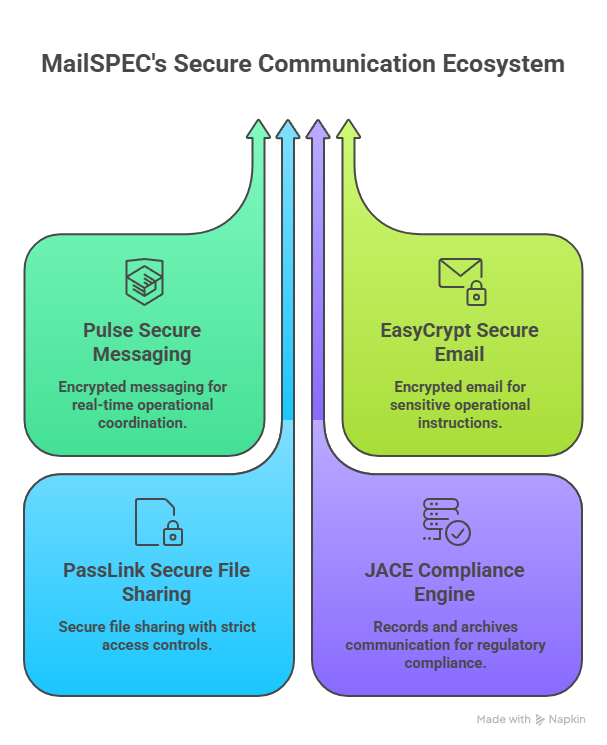
MailSPEC provides a complete communication ecosystem designed for industries where uptime, security, and regulatory compliance are critical.
Several components support critical infrastructure cybersecurity communication for energy providers.
Pulse provides encrypted messaging for operational teams, allowing real-time coordination between field technicians and grid operators.
Messages are securely archived and preserved for regulatory review.
EasyCrypt enables encrypted email communication directly within widely used enterprise email environments. Sensitive operational instructions remain protected without changing employee workflows.
Energy infrastructure diagrams, maintenance plans, and engineering documents can be exchanged securely using encrypted file links with strict access controls using PassLink.
JACE records and archives all communication activity, ensuring that grid operators maintain accurate documentation for regulatory inspections and post-incident analysis.
Together, these technologies create a secure communication framework capable of supporting modern energy infrastructure.
Energy infrastructure has always been critical to national stability. Today, the cyber dimension of infrastructure protection has become equally important.
Communication platforms used by grid operators must be designed with the assumption that adversaries will attempt to intercept, disrupt, or manipulate operational messages.
Sovereign communication channels then provide the level of control and resilience required to defend against these threats.
The future of critical infrastructure protection will depend heavily on secure communication systems.
Energy providers must ensure that operational messaging platforms remain resilient against cyber attacks, legal interference, and large-scale network disruptions.
MailSPEC provides sovereign communication for critical infrastructure that allows energy operators to maintain full control over messaging environments while supporting the scale and complexity of national energy networks.
So, if your organization is responsible for protecting critical energy infrastructure, MailSPEC can help you implement secure communication platforms designed to support both operational coordination and national resilience.
Because when it comes to energy systems, secure communication is not just a technical requirement. It is a cornerstone of national security.


In many organizations, the push for stronger security and compliance has created an unintended side effect: complexity.
A new secure messaging platform is deployed. Another portal appears for encrypted email. A separate system is introduced for file sharing. Before long, your employees are juggling several different communication environments just to do their daily work.
At first glance, yes, these tools appear to improve security. In reality, they often introduce something else entirely—portal fatigue.
Employees become frustrated when forced to switch between systems. Important messages are missed. Sensitive files are shared through unofficial channels because the “approved” system feels too slow or inconvenient.
And this is exactly the kind of environment where compliance problems begin.
Modern organizations need secure communication platforms that work where employees already operate. That is why enterprise messaging integration has become a critical requirement for businesses managing regulated data and complex operations.
MailSPEC addresses this challenge by enabling enterprise messaging integration with Outlook and NetSuite, allowing companies to introduce powerful compliance protections without forcing employees to abandon the tools they already trust.
Meaning, instead of adding another communication portal, MailSPEC transforms existing workflows into secure, compliant communication environments.
Employees today rely on a wide range of digital tools. Email systems, accounting platforms, customer management software, and collaboration tools all play a role in daily operations.
But when security teams introduce new messaging portals that operate outside these systems, productivity often declines.
Workers experience what many technology leaders now call portal fatigue.
This occurs when employees must:
The result is predictable. Employees bypass the system.
Sensitive information ends up in unsecured communication channels simply because the approved tools are too cumbersome to use.
This is why organizations increasingly demand native enterprise messaging tools that operate inside existing productivity platforms rather than outside them.
From a compliance perspective, fragmentation is dangerous.
When communication occurs across multiple disconnected platforms, organizations lose visibility and control over how information flows internally.
Compliance teams may struggle to answer basic questions:
And without clear answers, regulatory exposure increases.
Enterprise messaging integration solves this problem by centralizing communication activity inside existing business systems.
When secure messaging operates directly within widely used platforms such as Outlook or NetSuite, organizations gain:
Here, security becomes part of everyday operations rather than a separate process employees must remember to follow.
One of the most powerful features of integrated communication platforms is the unified inbox. A unified inbox allows users to receive both standard messages and encrypted communications within the same interface.
Employees do not need to check multiple messaging systems. Everything appears in the same familiar workspace.
And for organizations, this creates several benefits.
When employees work within a single inbox, they are less likely to miss critical messages or respond through the wrong system.
Teams can exchange information quickly without navigating multiple communication environments.
Centralized communication makes it easier for compliance teams to monitor messaging activity and maintain complete records.
MailSPEC supports this approach through EasyCrypt, which integrates encrypted messaging directly into existing enterprise email systems.
With EasyCrypt, secure communication becomes a natural extension of everyday email use.
Outlook remains one of the most widely used communication platforms in enterprise environments. Many organizations rely on it as the central hub for internal and external messaging.
However, traditional email systems often struggle to meet modern compliance requirements.
Organizations handling sensitive financial, healthcare, or personal information must ensure that messages remain protected and auditable.
This is where enterprise messaging integration with Outlook becomes essential.
MailSPEC EasyCrypt enables encrypted communication directly inside the Outlook interface. Employees continue using the same inbox they have always used, but messages gain additional protection automatically.
This approach eliminates the need for secondary messaging portals.
Employees can:
And because the user interface remains unchanged, adoption becomes almost effortless!
Communication does not occur only within email systems. Many organizations rely heavily on enterprise resource planning platforms to manage financial data, customer records, and operational workflows.
Oracle NetSuite is widely used for this purpose.
Finance teams, procurement managers, and operations staff frequently exchange sensitive information directly through this platform.
But without secure messaging integration, these communications may require separate systems or manual processes.
Outlook NetSuite messaging integration streamlines this workflow by allowing secure communication to occur directly inside the operational environment where business decisions are made.
This integration provides several advantages:
Thus, by connecting secure messaging with enterprise operations platforms, organizations reduce friction while strengthening compliance oversight.
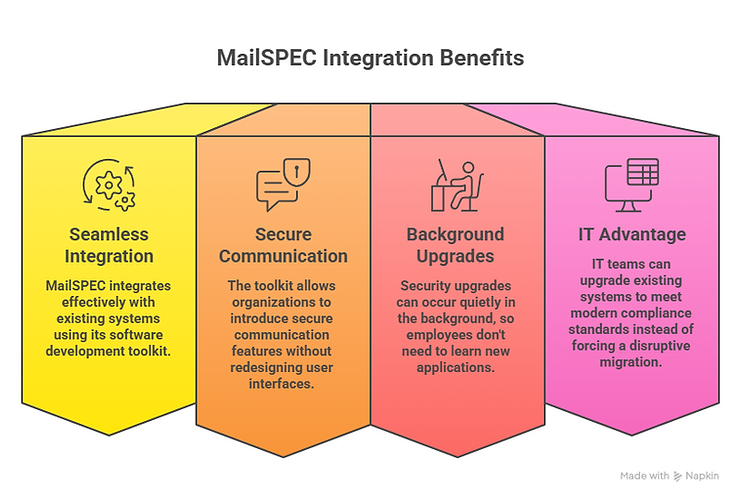
One of the key reasons MailSPEC solutions integrate so effectively with existing systems is the MailSPEC software development toolkit.
This technology framework allows organizations to introduce secure communication features without redesigning their user interfaces.
In practical terms, this means that security upgrades can occur quietly in the background.
Employees do not need to learn a new application. They simply continue using their familiar tools.
The software development toolkit enables:
For information technology teams, this represents a major advantage.
Instead of forcing a disruptive migration to new communication platforms, organizations can upgrade their existing systems to meet modern compliance standards.
Consider the experience of a technology leader responsible for implementing a new security policy across a global organization.
The company had recently undergone a regulatory audit. Investigators recommended stronger controls over internal communication and file sharing.
The chief technology officer knew that deploying another messaging platform would likely create resistance from employees.
In previous years, attempts to introduce separate secure portals had failed. Staff members continued using traditional email and messaging tools because they were faster and more familiar.
This time, the strategy was different.
Instead of introducing a new portal, the technology team implemented MailSPEC EasyCrypt within the existing Outlook environment. Secure messaging appeared directly inside the standard inbox that employees used every day.
At the same time, communication workflows inside NetSuite were enhanced with secure messaging capabilities.
And the result was immediate.
Employees did not feel that anything had changed. They continued sending messages and sharing documents exactly as before. The difference was that every communication was now encrypted, archived, and monitored for compliance.
The security mandate succeeded without pushback because the user experience remained unchanged.
This example illustrates the real power of integrated business communication platforms.
Regulatory expectations for corporate communication continue to increase.
Organizations must now demonstrate that they maintain secure communication channels, preserve accurate records, and prevent unauthorized data exposure.
Meeting these expectations requires systems capable of enforcing policies across all communication channels.
Integrated business communication platforms provide this capability.
By combining secure messaging, file sharing, and compliance oversight within a single infrastructure, organizations gain:
MailSPEC enhances these capabilities through the JACE Compliance System, which automatically records and archives communication activity.
This then ensures that organizations maintain complete audit trails while preserving the integrity of communication records.
Security systems only work when employees use them. So, if secure messaging platforms feel inconvenient or unfamiliar, employees will inevitably look for faster alternatives.
That is why native enterprise messaging tools are so important.
When secure communication operates inside the platforms employees already use, adoption becomes natural.
There is no need for:
Security simply becomes part of the workflow rather than an obstacle. This approach reduces the risk of shadow communication channels emerging within the organization.
As organizations continue to navigate complex regulatory environments, the importance of integrated communication infrastructure will only grow.
Companies must balance two critical priorities:
Solutions that force employees into separate portals cannot achieve both goals simultaneously.
The future belongs to enterprise messaging integration that blends seamlessly into everyday business tools.
Security upgrades should not slow down your workforce.
MailSPEC provides integrated communication solutions that allow organizations to introduce encryption, compliance oversight, and secure messaging without changing how employees work.
So, if your organization is exploring how enterprise messaging integration can strengthen compliance while preserving efficiency, the MailSPEC team can help you.
Build a secure communication environment that works exactly where your employees already operate.

Corporate cyber risk insurance used to focus primarily on firewalls, antivirus software, and breach response planning. Today, the landscape looks very different.
Insurance underwriters have begun examining something many companies once overlooked: internal communication systems.
Every email, file transfer, chat message, and shared document represents potential legal exposure.
If sensitive information moves through insecure systems or crosses jurisdictions without oversight, the consequences can extend far beyond a technical incident. Regulatory penalties, civil lawsuits, and reputational damage can quickly escalate into a multi-million-dollar liability.
As a result, insurers are tightening their evaluation criteria. Increasingly, companies are being asked a new set of questions during the cyber risk underwriting process:
These questions reveal a growing trend. Insurance providers now view sovereign messaging systems as a critical indicator of organizational risk.
MailSPEC helps enterprises meet this new standard by providing secure sovereign messaging platforms designed specifically for compliance-driven environments.
By keeping communications under sovereign control and providing auditable records of every interaction, MailSPEC helps organizations reduce legal exposure and strengthen their cyber risk posture.
Cyber insurance underwriting has evolved dramatically over the past decade.
Initially, insurers focused on obvious technical vulnerabilities such as outdated software or weak network defenses. But as cyber incidents became more complex, insurers realized that many breaches originate from communication failures rather than system failures.
A misdirected email containing financial data.
A chat message that reveals confidential information.
A file shared through an unsecured platform.
All these everyday actions can trigger regulatory investigations, contractual disputes, and shareholder lawsuits.
As a result, insurance providers now evaluate communication infrastructure as part of the cyber risk assessment process.
Underwriters commonly review:
And organizations that rely on uncontrolled consumer tools or globally distributed cloud messaging platforms may be flagged as high risk.
By contrast, companies using enterprise sovereign communication systems demonstrate stronger governance and a lower likelihood of regulatory complications.

One of the biggest concerns facing multinational organizations is the possibility of a multi-jurisdictional legal crisis.
When corporate communications are stored across multiple countries, several complications arise:
This situation can quickly become a nightmare during litigation or a regulatory investigation.
Sovereign messaging systems address this challenge by ensuring that communication infrastructure operates within a clearly defined legal jurisdiction.
When organizations maintain sovereign control over messaging environments, they gain several advantages:
In other words, sovereign messaging compliance reduces legal ambiguity.
And for insurers evaluating corporate risk, fewer jurisdictions involved means fewer potential legal disputes.
When a regulatory investigation or lawsuit occurs, the ability to reconstruct communication history becomes essential.
Attorneys, compliance officers, and investigators will often request detailed records of internal communications. These records help determine whether policies were followed, whether instructions were misunderstood, or whether wrongdoing occurred.
Without reliable communication logs, organizations face serious problems.
Messages may have been deleted.
Files may have been altered.
Chat records may no longer exist.
This is where tamper-proof audit trails become critical.
Secure sovereign messaging systems provide:
These features allow organizations to demonstrate exactly what happened and when.
In legal terms, this documentation can be the difference between successfully defending a case and facing severe financial penalties.
Insurance companies operate on evidence.
When a cyber insurance claim is filed, insurers conduct extensive investigations before approving payouts. Now, if an organization cannot provide reliable communication records, insurers may question whether the company followed proper procedures.
For example, insurers may ask:
Again, without verifiable communication records, these questions become difficult to answer.
Secure enterprise sovereign communication systems provide immutable archives that establish a reliable chain of evidence. This capability protects organizations during:
The result? Greater legal clarity and stronger insurance coverage protection.
MailSPEC provides a comprehensive communication platform designed for organizations that operate under strict regulatory oversight. And one of the most powerful components of this platform is the JACE Compliance System.
JACE stands for Journaling, Archival, Compliance Metadata, and Escrow. It acts as the central compliance engine across the MailSPEC communication environment.
This system ensures that every communication interaction is securely recorded and preserved.
Through JACE, organizations gain:
The escrow function is particularly valuable during legal investigations.
Escrow storage creates a single source of truth that cannot be altered or deleted by individual users. This ensures that communication records remain intact for regulatory review, insurance discovery, or legal proceedings.
For enterprises seeking sovereign messaging compliance, this level of transparency is essential.
Many organizations assume cyber insurance will cover any digital incident. However, claims are often denied when companies fail to demonstrate responsible data management practices.
Several communication-related vulnerabilities frequently appear in denied claims.
Employees may share business information through consumer messaging tools that lack compliance oversight.
Sensitive documents sent through public file-sharing services may expose confidential data to unauthorized parties.
Organizations that cannot produce communication records during an investigation may struggle to prove that proper procedures were followed.
Data stored on international cloud platforms may trigger legal complications involving multiple jurisdictions.
Messaging systems without strong authentication controls may allow unauthorized users to access sensitive information.
Each of these vulnerabilities increases legal and regulatory risk.
But by adopting secure sovereign messaging platforms, organizations can address these weaknesses before they become costly problems.
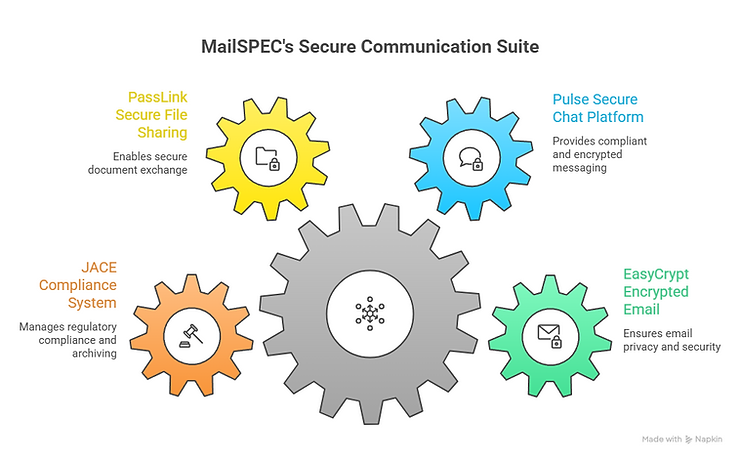
MailSPEC offers an integrated suite of communication technologies designed to support sovereign messaging systems for enterprises operating in regulated industries.
Several core products work together to provide a secure and compliant communication ecosystem.
EasyCrypt ensures that email communications remain encrypted and protected from interception. The system integrates directly with widely used enterprise tools while maintaining sovereign control over sensitive information.
Pulse replaces consumer chat applications with a secure messaging environment designed for compliance oversight. All messages are encrypted, archived, and monitored for policy compliance.
PassLink allows organizations to exchange sensitive documents through encrypted channels with detailed access logs and expiration controls.
JACE provides the compliance backbone for the entire communication environment. It ensures that every interaction is properly recorded, archived, and preserved for regulatory and legal review.
Together, these technologies form a unified enterprise sovereign communication system capable of supporting highly regulated industries such as finance, healthcare, government, and defense.
The relationship between cybersecurity and financial liability is becoming increasingly clear.
Regulators expect organizations to demonstrate strong communication governance. Courts require reliable documentation during disputes. Insurance providers demand evidence of responsible risk management.
In this environment, sovereign-based messaging systems provide several strategic advantages:
Organizations that adopt these systems not only improve compliance but also strengthen their negotiating position with insurers, too.
Lower legal risk often translates into more favorable insurance terms.
Communication infrastructure has become a central element of corporate risk management.
Every message, document, and conversation contributes to an organization’s legal exposure. Companies that rely on unsecured messaging tools may unknowingly create vulnerabilities that surface during regulatory investigations or insurance disputes.
The shift toward secure sovereign messaging platforms reflects a broader change in how enterprises approach digital governance.
Forward-thinking organizations are moving toward communication systems designed with compliance, security, and legal accountability built in from the start.
Corporate liability insurance providers are raising the bar for cyber risk evaluation.
Organizations that want to maintain strong coverage must demonstrate that their communication systems protect sensitive data, maintain reliable audit records, and operate under clear sovereign control.
MailSPEC helps enterprises meet these expectations through secure communication infrastructure designed for regulated industries.
So, if your organization is evaluating how sovereign messaging systems can reduce cyber risk exposure and strengthen compliance posture, the MailSPEC team can help you build a communication environment that supports both operational efficiency and legal resilience.
Because in today’s regulatory landscape, secure communication is no longer just a technology decision. It is a business survival strategy.

Japan has long placed a high value on trust, responsibility, and long-term reputation. And these cultural principles are reflected clearly in the nation’s data protection laws.
Today, the Japanese Act on the Protection of Personal Information places strict legal expectations on how organizations handle customer and employee data.
For global manufacturing leaders, technology companies, and public institutions, compliance is not simply about encryption or storage policies. It is about ensuring domestic control over sensitive data and protecting personal information within the jurisdiction of Japan.
Companies with global footprints face a growing challenge. Modern communication tools often rely on international cloud platforms that store or process information outside the country. While convenient, these tools can expose organizations to serious regulatory risk under Japan’s privacy laws.
That is why many enterprises operating in Japan are now rethinking how their communication systems work. Meeting APPI data sovereignty requirements increasingly means adopting infrastructure that keeps sensitive information securely within Japanese jurisdiction.
MailSPEC Japan provides the tools and infrastructure that help organizations achieve this level of control. By enabling sovereign communication environments hosted within Japan, MailSPEC helps enterprises protect their most sensitive conversations while maintaining full regulatory compliance.
The Japanese Act on the Protection of Personal Information is one of the most comprehensive privacy frameworks in Asia. It regulates how organizations collect, store, process, and share personal information.
At its core, the law focuses on protecting individuals from unauthorized use or disclosure of personal data.
One of the most important aspects of the framework involves APPI data sovereignty requirements, which emphasize careful control over where personal data resides and how it is transmitted.
Organizations operating in Japan must ensure that:
These obligations then extend beyond traditional databases. They also apply to everyday communication tools such as email, messaging platforms, and services.
If sensitive information travels through systems that store or process data outside Japan, organizations may face compliance challenges.
This is where domestic control over sensitive data becomes essential.

Japanese companies often operate internationally. Automotive manufacturers, electronics producers, and technology firms exchange information across borders every day.
However, the expectations surrounding Japan data sovereignty law are particularly strict for organizations that handle sensitive personal information.
And for large global brands, protecting customer trust is just as important as meeting regulatory requirements.
Companies that represent Japan on the world stage must demonstrate that they handle data responsibly.
This includes ensuring that:
Even accidental exposure of data can damage a brand’s reputation.
For high-profile manufacturers and technology companies, protecting privacy is not only a compliance issue. It is a matter of corporate honor and long-term credibility.
Legal obligations are only part of the story.
Japanese society places strong cultural importance on respect, discretion, and responsibility.
Meaning, organizations are also expected to treat personal information with the same level of care they apply to financial or intellectual property assets.
Customers assume their information will be handled carefully. Employees expect internal systems to protect sensitive records. Government regulators expect corporations to demonstrate transparency and accountability.
And because of this environment, APPI data protection requirements often influence how companies design their communication systems.
For example:
Meeting these expectations requires more than traditional email systems. It requires communication infrastructure built specifically for regulated environments.
One of the most significant elements of the Japanese privacy framework involves APPI cross-border data restrictions.
When personal information leaves Japan, organizations must demonstrate that the receiving environment provides an equivalent level of protection. This requirement can become complex when communication systems rely on global cloud providers.
Many popular software platforms process data across multiple countries automatically. Even if the user is located in Japan, data may travel through international servers during routine communication.
From a compliance perspective, this creates uncertainty.
If organizations cannot clearly identify where their data is stored or processed, maintaining compliance with Japan APPI compliance becomes more difficult.
This is why many enterprises are turning toward sovereign communication environments that keep information within national boundaries.
Government agencies and regulated industries in Japan increasingly favor the concept of a national cloud.
A national cloud is an infrastructure environment designed to keep sensitive data within the legal jurisdiction of a specific country. It ensures that data remains subject to local laws and oversight rather than foreign legal frameworks.
For Japanese institutions, this approach offers several advantages:
Public sector organizations often require national cloud environments because they manage highly sensitive information.
Private sector companies are now adopting similar strategies to meet APPI data sovereignty requirements and protect their corporate reputation.
One of the biggest risks facing modern organizations is not malicious activity. It is simple human error.
Employees communicate quickly through email, chat platforms, and file-sharing tools. And in many cases, they may not realize that sensitive information is being transmitted through systems that route data outside the country.
To maintain domestic control over sensitive data, organizations must implement technical safeguards that prevent accidental export.
Effective systems include:
These protections help organizations maintain control over how sensitive information moves through their internal communication channels.
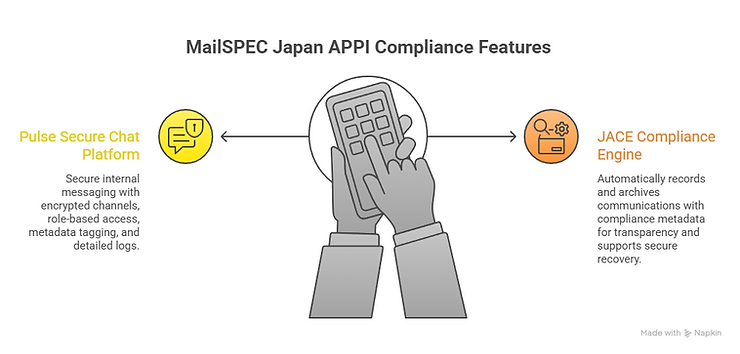
MailSPEC Japan provides a communication environment designed specifically for organizations operating under strict regulatory frameworks.
Instead of relying on international cloud platforms, MailSPEC allows companies to maintain domestic control over sensitive data through infrastructure hosted within Japan.
This architecture helps enterprises meet APPI data protection requirements while maintaining operational efficiency.
Several core technologies work together to achieve this…
Pulse provides secure internal messaging designed for regulated environments. Employees can communicate quickly without relying on consumer messaging applications.
The platform offers:
By replacing informal chat applications, Pulse ensures that sensitive conversations remain within controlled environments.
JACE serves as the compliance backbone of the MailSPEC ecosystem.
This system automatically records and archives communications while attaching compliance metadata to each interaction. These records allow organizations to demonstrate full transparency during regulatory inspections.
JACE also supports secure recovery and retention processes that align with Japan APPI compliance requirements.
Meeting APPI data sovereignty requirements requires more than policy documents. It requires a technical architecture designed for data protection.
Organizations that manage sensitive information should consider implementing the following safeguards:
Data must remain protected both during transmission and while stored on servers. Encryption ensures that unauthorized parties cannot access sensitive records.
Only authorized personnel should be able to view regulated information. Role-based access systems help ensure that employees see only the data relevant to their responsibilities.
Communication records should be preserved in tamper-resistant storage environments. This allows organizations to provide accurate documentation during regulatory audits.
Communication platforms must ensure that personal information remains within approved jurisdictions.
Together, these safeguards create a secure communication environment that supports Japan's data sovereignty law while protecting sensitive information.
As organizations continue to expand internationally, the complexity of privacy regulation continues to grow.
Companies operating in Japan must carefully balance global collaboration with national compliance obligations. Communication tools that route data through international infrastructure may introduce unnecessary risk.
Adopting sovereign communication systems helps organizations:
And for many enterprises, the transition to sovereign communication infrastructure is becoming an essential part of their digital strategy.
The Japanese Act on the Protection of Personal Information represents more than a legal framework. It reflects a national commitment to protecting personal privacy and maintaining trust between organizations and the individuals they serve.
And meeting APPI data sovereignty requirements means ensuring that personal information remains protected throughout every communication channel.
Organizations that operate in Japan cannot afford uncertainty when it comes to data protection.
So, if your enterprise needs secure communication systems that meet Japan APPI compliance, MailSPEC Japan can help you build a sovereign infrastructure that protects your most sensitive information.
Learn how secure messaging, compliant communication platforms, and domestic infrastructure can help your organization meet the evolving requirements of Japan’s privacy laws while preserving the trust of your customers and partners.
.jpg)
Healthcare professionals live in a world where speed matters.
A physician might need to send a photograph of a wound to a specialist. A nurse may need to confirm laboratory results with a colleague. A hospital administrator might forward a patient record to a consulting physician for urgent review.
In moments like these, convenience often wins. Sure, a quick message on a familiar mobile application seems harmless. It feels efficient. It feels necessary.
But that “quick text” can quietly expose an entire medical institution to regulatory violations.
Healthcare regulations such as the Health Insurance Portability and Accountability Act in the United States, the General Data Protection Regulation in Europe, and the Act on the Protection of Personal Information in Japan all require that patient data is protected at every stage of communication.
The challenge is that most everyday messaging tools were never built with these standards in mind.
This is where MailSPEC comes in. As a regulatory solution company focused on secure, compliant communication, MailSPEC helps healthcare organizations replace risky tools with secure messaging platforms that protect both speed and compliance.
Because in healthcare, protecting patient data is not optional. It is the foundation of trust.
Applications such as Signal or WhatsApp have become widely used because they are simple, familiar, and quick. They allow doctors and nurses to communicate instantly across departments or even across cities.
From a usability perspective, these tools feel ideal. But from a regulatory perspective? They fall short.
The risks of non-healthcare messaging begin with the absence of administrative control. Consumer messaging tools generally lack:
Also, even if messages are encrypted, encryption alone does not guarantee healthcare messaging compliance.
⚠️ Here, healthcare organizations must be able to prove who accessed patient information, when it was shared, and whether it was retained according to regulatory guidelines. Normal consumer messaging platforms rarely offer this level of visibility or control.

It usually starts with urgency.
A doctor sends a quick photo of a laboratory report to a colleague.A specialist receives an image of a patient scan for consultation.A nurse confirms medication details with a quick message.
In each of these cases, patient information may be included. Under the law, that information is classified as protected health data.
⚠️ And when that data is transmitted through non-compliant messaging channels, several risks arise:
These risks are amplified in multinational healthcare environments, where patient data may cross borders and become subject to European or Japanese data sovereignty laws.
Also, note that regulators do not distinguish between accidental and intentional exposure. If patient information is transmitted outside secure systems, institutions can face significant financial penalties.
Again, the risks of non-healthcare messaging are not hypothetical. They have resulted in major enforcement actions and costly fines across the healthcare industry.
Healthcare communication requires more than privacy. It requires governance.
Secure messaging for healthcare must include several layers of protection beyond encryption.
These include:
Without these safeguards, even well-intentioned professionals may unknowingly expose patient data.
Remember, a secure messaging environment must feel as convenient as consumer tools while providing the administrative controls required for healthcare compliant communication tools.
While regulations in the United States often get the spotlight, healthcare compliance is not limited to one region.
In Europe, the General Data Protection Regulation enforces strict requirements for handling personal health data. Organizations must demonstrate lawful processing, limit data exposure, and maintain full traceability of communications.
In Japan, the Act on the Protection of Personal Information emphasizes secure handling of personal data, employee accountability, and strict limitations on third-party sharing.
Despite differences in legal language, the expectations are strikingly similar:
This creates a clear reality for healthcare providers operating across borders. They need secure messaging for healthcare that aligns with multiple regulatory frameworks—not just one.
Healthcare professionals are increasingly mobile. Physicians consult across hospital networks. Specialists review cases remotely. Nurses coordinate care across multiple departments.
Mobile communication is essential.
But mobile devices introduce additional security challenges. Phones are easily lost, stolen, or shared among family members outside the workplace. And if patient data resides on an unsecured device, exposure becomes a real possibility.
This is why modern healthcare compliant messaging platforms must include a mobile-first design without compromising security.
MailSPEC addresses this need through its Pulse Chat App, which allows healthcare professionals to communicate quickly while maintaining full compliance oversight.
Healthcare communication frequently involves images and documents.
Doctors may share:
When these files move through consumer messaging platforms, institutions lose control over how the information is stored and distributed.
MailSPEC enables secure messaging for healthcare professionals through encrypted communication channels that allow images and records to be shared safely.
Pulse Chat App provides:
Healthcare teams can collaborate efficiently without exposing sensitive information to uncontrolled systems.
One of the most overlooked risks in healthcare communication is device loss.
A physician’s phone may be misplaced during a shift. A tablet used for rounds may be stolen from a vehicle. A mobile device may simply disappear during travel.
And if patient information is stored locally on that device, exposure can occur instantly.
This is why healthcare compliant messaging platforms must include remote device management capabilities.
Remote wipe functionality allows administrators to:
Without this capability, institutions remain vulnerable long after the device has disappeared.
MailSPEC’s communication environment supports administrative control over device access, helping organizations maintain continuous protection of sensitive medical information.

One reason healthcare organizations hesitate to adopt new communication platforms is concern about disruption. Hospitals rely on complex administrative systems that manage scheduling, billing, electronic medical records, and patient records.
And again, introducing a new communication platform must not interrupt daily operations.
MailSPEC addresses this concern by integrating secure messaging tools directly into existing enterprise environments. The platform can connect with systems already used in healthcare settings, allowing staff to continue working within familiar workflows.
Integration ensures that:
This smooth transition helps healthcare organizations strengthen compliance without slowing down patient care.
Even the most experienced professionals make mistakes. Healthcare environments are fast-paced, high-pressure, and often unpredictable.
MailSPEC’s JACE Compliance System helps prevent errors before they occur. It acts as an automated compliance layer that monitors communication activity and enforces regulatory policies.
JACE can:
So, instead of relying on staff to remember every compliance rule, the system reinforces governance automatically.
This approach then allows healthcare professionals to focus on patient care while the platform safeguards communication.
Replacing consumer messaging tools may feel inconvenient at first. But the long-term benefits are substantial.
Healthcare compliant communication tools provide:
✔️ Centralized control over patient data
✔️ Secure messaging designed for healthcare environments
✔️ Compliance-ready audit logs
✔️ Protection against device loss or theft
✔️ Seamless integration with existing hospital systems
Most importantly, they protect the trust patients place in healthcare institutions.
Patients expect their information to remain private. That expectation must extend to every message, image, and file shared among medical professionals.
Healthcare professionals should never have to choose between speed and security.
The reality is that patient care depends on fast communication. But fast communication must still be protected by strong governance and regulatory safeguards.
Consumer messaging applications may appear convenient, but they lack the administrative controls required for healthcare messaging compliance. Even a single message sent outside approved systems can expose institutions to serious legal consequences.
MailSPEC provides healthcare organizations with healthcare compliant messaging platforms designed for modern medical workflows.
With secure mobile communication, encrypted file sharing, remote device management, and automated compliance oversight, healthcare teams can collaborate quickly without compromising patient privacy.
Because in healthcare, communication is more than a conversation. It is a responsibility.

In aerospace and defense, communication is never just operational. It is legal. It is strategic. And in many cases, it is regulated at the highest level.
An engineer sharing a design update.
A supplier receiving a manufacturing specification.
A program manager forwarding a test result.
Each of these moments may involve technical data regulated under the International Traffic in Arms Regulations. And under this framework? A single uncontrolled message can be treated as an illegal export, even if it was sent with good intentions and never left the country.
This is why regulated organizations are moving away from improvised tools and toward ITAR-compliant secure communications built on sovereign communication platforms.
MailSPEC works with aerospace and defense organizations to ensure that every message, file, and conversation is protected, controlled, and compliant by design.
Before addressing technology, it is important to understand what ITAR actually regulates.
Technical data under the ITAR framework includes far more than classified documents or finished blueprints. It covers any information required to design, develop, manufacture, operate, or maintain defense-related articles.
This includes:
Also, even informal explanations or internal messages can qualify as technical data if they reveal controlled knowledge.
The consequences of illegal export are severe. Penalties can include significant financial fines, criminal liability, loss of export privileges, and long-term damage to government contracting eligibility. This is why ITAR communication compliance must be treated as a core operational requirement, not a legal afterthought.
Many organizations assume that mainstream cloud email platforms are “secure enough” because they advertise encryption and compliance certifications.
But the problem here is not basic encryption. The problem is control.
Cloud-based email systems often struggle with ITAR because:
Under ITAR, allowing a non-United States person to access technical data is considered an export, even if the data never leaves the country physically. That means infrastructure design itself can create violations.
This is why secure transmission of ITAR technical data cannot rely on consumer-grade or cloud-first communication tools.

Encryption is essential, but not all encryption models are equal.
End-to-end encryption ensures that data is protected from the moment it leaves the sender until it reaches the authorized recipient. No intermediary, including service providers or administrators, can view the content.
For compliant secure communications under ITAR, end-to-end encryption must be paired with:
This ensures that only authorized United States persons can access sensitive data, and that access can be demonstrated during audits or investigations.
Email is not the only risk area.
In fast-moving environments, teams often rely on chat applications to collaborate quickly. Engineers ask questions. Program leads share updates. Files move informally between teams.
Without proper controls, this creates serious compliance exposure:
This is why ITAR secure messaging must be purpose-built for regulated environments.
Secure messaging under ITAR must feel intuitive to users while enforcing strict policy controls behind the scenes. If compliance tools slow people down, they will be bypassed. The system itself must make compliance the default.
Encryption protects data in transit. Sovereignty protects data in law.
A sovereign communication platform ensures that infrastructure, administration, and data storage remain under a single legal authority. For ITAR-regulated organizations, this is not optional.
Sovereignty helps prevent:
By keeping infrastructure under domestic control, organizations reduce the risk of accidental export through system design alone.
And this is why sovereign communication platforms' ITAR strategies are becoming standard across aerospace and defense programs.
MailSPEC provides a unified communication platform designed specifically for regulated industries that require precision, control, and auditability.
Rather than forcing teams to adapt their behavior, MailSPEC embeds compliance directly into daily workflows.
EasyCrypt integrates with existing email environments while ensuring that messages containing technical data are encrypted, journaled, and stored under sovereign control. Sensitive content is protected end-to-end without requiring new tools or training.
Pulse replaces consumer chat tools with secure messaging designed for defense teams. Messages are encrypted, logged, and governed by role-based policies. Conversations remain accessible to compliance teams without exposing content to unauthorized users.
PassLink allows aerospace organizations to share specifications, drawings, and contracts securely with subcontractors. Access is authenticated, time-limited, and fully logged, ensuring traceability at every step.
JACE provides journaling, archival, and compliance enforcement across all communication channels. Every interaction is stored immutably, supporting audits without disrupting day-to-day work.
Together, these tools form a secure communication platform engineered for ITAR communication compliance.
One of the most overlooked ITAR risks is indirect access.
A subcontractor support engineer.
A cloud administrator.
A third-party service provider.
And even if no one intends to violate regulations? Infrastructure design can expose technical data to unauthorized individuals.
Sovereign platforms mitigate this risk by ensuring:
Again, this is not about limiting collaboration. It is about eliminating uncertainty.
Collaboration is unavoidable in aerospace programs. The challenge is enabling it without compromising compliance.
Best practices for ITAR-compliant secure communications include:
These practices ensure that collaboration remains efficient while protecting the organization legally and operationally.
Many organizations treat ITAR as a training problem. In reality, it is an architecture problem.
If communication systems are not designed for control, people will inevitably use the fastest available tool. No amount of policy training can overcome poor system design.
By implementing compliant secure communications through sovereign platforms, organizations remove the opportunity for accidental violations. Compliance becomes automatic, not enforced after the fact.
The International Traffic in Arms Regulations do not allow for ambiguity.
Every message, file, and conversation involving technical data must be protected, auditable, and shielded from unauthorized access. Public cloud tools and consumer chat applications introduce risks that are increasingly unacceptable in defense programs.
MailSPEC helps aerospace and defense organizations implement ITAR-compliant secure communications through sovereign communication platforms built for real-world collaboration.
Because when technical data defines national security, communication must be engineered with the same precision as the systems it supports.
Talk to MailSPEC about building a secure, sovereign communication platform that protects your technical data without slowing your teams down.
May 5th, 2026: MailSPEC today officially released EasyCrypt 3, the groundbreaking client-side encryption and AI governance platform engineered for organizations that must repatriate sensitive data into full sovereign control while continuing to communicate securely with external parties on consumer email systems.
EasyCrypt 3 is not another email encryption tool. It is a comprehensive compliance engine that runs 100% on-device and on-client, classifying data in real-time using an AI policy engine tailored for national regulations or organizational rules. It applies quantum-safe end-to-end encryption and enables secure external sharing without ever transmitting raw data to foreign clouds. The result: regulated enterprises and government agencies can finally repatriate thousands of sensitive emails and attachments from Microsoft 365, keep everything under local jurisdiction, and still exchange documents safely with customers, partners, and citizens using ordinary Gmail, Yahoo, or Hotmail addresses.
The Problem: Legacy Email Encryption and Consumer Systems Are Breaking Sovereignty and Compliance
For decades, organizations in finance, healthcare, and national security have tried to use legacy email encryption (PGP, S/MIME, or Microsoft 365 encryption) and public cloud storage. These approaches create three fatal flaws that regulators now punish aggressively.
First, traditional encryption happens without data classification, and the keys are managed on the user’s desktop, or worse, in a gateway device that is subject to attack. The endpoint (laptop, phone, or server) holds the keys, and key management becomes a nightmare for compliance teams. Auditors cannot prove who had access or when the data was decrypted.
Second, most situations result in plaintext or encrypted copies at rest on foreign clouds (Microsoft, Google, Yahoo), exposing organizations to CLOUD Act requests, GDPR international transfer violations, and “harvest now, decrypt later” quantum risks.
Third, when organizations need to repatriate data from Office 365 or consumer platforms, they face months of manual effort with no automated classification or audit trail.
Real-world consequences are severe. In 2025–2026 alone, GDPR enforcement generated more than €1.2 billion in fines, many tied to insecure email transfers and loss of control over personal data. HIPAA violations involving email transmission of PHI (Personal Healthcare Information) have produced settlements in the millions, including a $9.76 million penalty against one provider for repeated unsecured email failures. Japanese APPI enforcement now carries penalties up to ¥100 million for improper handling or transfer of personal data outside approved jurisdictions.
Government agencies using Microsoft 365 face the same crisis. Emails and attachments containing classified information, citizen records, or proprietary intelligence often sit in U.S.-controlled clouds with no guarantee of sovereignty. When these agencies need to share documents with citizens on Gmail or partners on Yahoo, the data immediately leaves national jurisdiction, creating unacceptable breaks in the chain of custody.
EasyCrypt 3 solves these problems at the source. The platform’s revolutionary on-device AI Governance Engine performs data classification and policy enforcement before any transmission occurs. The AI-powered policy engine allows compliance teams to create country-specific or organization-specific rules that run entirely on the client device, Mac, Windows, iOS, or web, with zero raw data ever leaving the sovereign perimeter.
Unlike legacy technology that only encrypts content after it has already been typed or attached, EasyCrypt 3’s Local AI Governance and classification engine scans every message or draft in real time using locally stored models. It detects sensitive patterns (PHI elements, trade secrets, classified keywords, export-controlled references) and applies the correct data classification and policy instantly. No cloud AI calls. No data exfiltration. Full explainability logs for regulators.
This on-client approach is fundamentally different from legacy systems. Traditional encryption tools hand control to the endpoint or cloud provider. EasyCrypt 3 keeps control of the organization at every step.
EasyCrypt 3 uses NIST-approved post-quantum algorithms combined with a patented hybrid encryption scheme protecting data both in transit and at rest. This eliminates the “harvest now, decrypt later” threat that security leaders now rank as a board-level priority. Even if an attacker captures encrypted traffic today and waits for quantum computers in 2035 or beyond, the data remains unreadable.
The system’s patent-pending key management architecture ensures that decryption keys never leave the sovereign environment. Compliance officers retain full control, with automated rotation and escrow that satisfies the strictest audit requirements.
Government agencies and regulated enterprises using Office 365 can now repatriate years of sensitive emails and attachments in weeks instead of years. EasyCrypt 3’s desktop client (Windows, macOS) and Outlook add-in scan existing mailboxes on-device, classify every message and attachment according to custom policies, apply quantum-safe encryption, and migrate the data to the organization’s on-premise or sovereign-cloud archive, all without ever sending raw content outside the jurisdiction. One European government ministry recently completed the repatriation of 1.2 million classified emails and attachments in 38 days, achieving full NIS2 and sovereign compliance with zero foreign-risk findings.
Secure External Sharing Without Foreign Cloud Exposure
When sending to external recipients on Gmail, Yahoo, or Hotmail, EasyCrypt 3 creates a secure, authenticated portal link. The recipient authenticates once (no app download required) and views the message and attachments in a browser session that never stores data on foreign servers. The entire session is encrypted end-to-end, logged with tamper-proof receipts, and can be revoked or expired at any time. The raw data never leaves the sender’s sovereign infrastructure, solving the impossible dilemma that has plagued regulated organizations for years.
An insurer sends policy documents containing medical history to a claimant using Gmail. The claimant clicks the secure link, authenticates, views the watermarked document, and uploads required ID scans back through the same session. Everything
remains inside the insurer’s jurisdiction and is fully auditable.
A tax authority sends benefit verification requests or passport scan instructions to citizens via consumer email. Citizens upload documents through the authenticated portal; all files stay encrypted and under government control.
Full Integration Across the Enterprise Ecosystem
EasyCrypt 3 is natively integrated into:
The new EasyCrypt SDK allows seamless embedding into Oracle NetSuite, SAP, and other ERP/CRM systems. Finance teams can trigger classified communications directly from billing workflows; healthcare providers can release lab results from EHR systems; legal departments can attach contracts from case-management platforms, all with automatic classification, quantum-safe encryption, and audit trail journaling.
Banks and investment firms must comply with MiFID II, SEC rules, and Japanese FSA requirements while protecting proprietary trading strategies. EasyCrypt 3 enables safe repatriation from Office 365 and secure sharing with clients on consumer email, all while feeding classified conversations into private AI models for KYC/AML analysis without leakage.
Providers can repatriate years of PHI-laden emails, classify new messages on-device, and share lab results or discharge summaries with patients on Gmail without breaking HIPAA or GDPR chains of custody.
Agencies repatriate sensitive Office 365 mailboxes, maintain air-gapped archives, and communicate securely with external partners or citizens while keeping every byte under sovereign control.
“EasyCrypt 3 is the missing link for regulated markets,” said Chukri, Senior Technical Lead, Protocols, SDK, and Compliance Technologies at MailSPEC. “For the first time, organizations can repatriate sensitive data into true sovereign control while continuing to operate with the tools their people already know. The new SDK will drive wider adoption across financial services, allowing teams to embed sovereign classification directly into KYC/AML workflows. Compliance stops being a burden and becomes a strategic advantage that powers innovation without risk.”
The convergence of the EU AI Act (full enforcement August 2026), Japan’s updated Cybersecurity Strategy and Active Cyber Defense Law, NIS2, DORA, APPI amendments, and U.S. quantum-readiness mandates has created an urgent requirement: organizations must prove they control their data, can classify it automatically, and can share it securely without foreign exposure.
EasyCrypt 3 delivers exactly that capability in a single, intuitive platform. It repatriates what is already in the cloud, protects what is being created today, and enables safe external collaboration tomorrow, all with on-device AI governance, quantum-safe cryptography, and seamless integration across the tools organizations already use.
Contact MailSPEC today for a sovereign repatriation TestFlight. Stop sending sensitive information into the unknown.
[1] Cogent Information Technologies – “Quantum-Safe Cryptography: The 2026 Mandate to Future-Proof Enterprise Data” (January 2026)
[2] Level.io – “Quantum-Safe Encryption Explained for MSPs and IT Teams” (March 2026)
https://level.io/blog/quantum-safe-encryption
[3] World Economic Forum – “Why quantum security is a question leaders cannot ignore right now” (February 2026)
https://www.weforum.org/stories/2026/02/quantum-security-question-leaders-cannot-ignore/
[4] DLA Piper – “GDPR Fines and Data Breach Survey: January 2026” (aggregate €1.2 billion in 2025)
[5] HIPAA Journal – “What are the Penalties for HIPAA Violations? 2026 Update” (including $9.76M settlement example)
https://www.hipaajournal.com/what-are-the-penalties-for-hipaa-violations-7096/
[6] Endpoint Protector – “Data Protection in Japan: All You Need to Know about APPI” (¥100M maximum fines)
https://www.endpointprotector.com/blog/data-protection-in-japan-appi/
[7] Databalance – “Microsoft Cloud sovereignty in 2026: ambition and reality” (M365 Local repatriation and sovereignty trends)
https://www.databalance.eu/en/microsoft-cloud-sovereignty-2026/
[8] MDaemon Blog – “Migration Case Studies: Moving Email from Microsoft 365 back on-premises” (sovereignty and compliance drivers)
https://blog.mdaemon.com/migration-case-studies-moving-email-from-microsoft-365-back-on-premises
[9] Deloitte – “2026 Global Insurance Outlook: Digital Transformation and Data Sovereignty” (secure external sharing and compliance in insurance)
[10] SDK.finance – “Integrations” (SDK examples for KYC/AML and ERP systems)

In regulated industries, the smallest mistake can become the largest liability.
A trader sends a message with confidential financial details to the wrong recipient.A healthcare administrator includes personal medical information in an unsecured email.A compliance officer forgets to archive a conversation that later becomes the subject of an investigation.
These are not malicious acts. They are human errors. But regulators do not measure intent. They measure control.
That is why organizations subject to strict oversight are rethinking how artificial intelligence should function inside their communication systems. Sending sensitive data to an external public cloud model for analysis may seem convenient.
But convenience and compliance rarely travel together.
MailSPEC developed JACE as an AI compliance engine that operates entirely on deck, meaning it processes policy and compliance logic within your controlled environment. It never transfers sensitive data to the public cloud for processing.
And in a world of escalating regulatory expectations, that distinction matters.
The term “on-deck” refers to where intelligence operates.
Traditional cloud-based artificial intelligence models work like this:
This workflow creates exposure. Even if encrypted in transit, the data is still transferred to an external system for processing.
An on-premise AI compliance engine, by contrast, performs analysis directly within the organization’s own infrastructure. JACE processes policy rules and compliance logic inside the communication environment itself. Sensitive data never leaves the sovereign boundary.
This creates an AI compliance engine without public cloud dependency. The intelligence lives where the data lives.

Many vendors advertise artificial intelligence features. Few explain how those systems operate.
JACE was built as a private AI compliance platform with one priority: data sovereignty.
Key differences include:
✔️ No transfer of message content to external artificial intelligence models
✔️ No reliance on third-party cloud training environments
✔️ Full control over encryption and data residency
✔️ Policy logic customizable through a secure development interface
Meaning, instead of sending communication data outward for inspection, JACE brings compliance logic inward. It is a sovereign AI compliance solution designed for organizations that cannot afford jurisdictional ambiguity.
For regulated enterprises, that architectural distinction eliminates a major source of risk.
Compliance is most effective when it happens before harm occurs.
JACE operates as an AI compliance engine that performs real-time policy enforcement.
It analyzes content while the message is being composed, not after it has already been transmitted.
For example:
The result is prevention, not remediation.
Instead of cleaning up after mistakes, organizations stop errors at the point of creation. Now, that is the power of AI compliance without data transfer.
Regulated industries must maintain detailed records of communication. In financial services, for example, rules require firms to preserve electronic communication in a non-rewritable, non-erasable format for defined retention periods.
JACE automates this process through:
By functioning as an on-premise AI compliance engine, JACE ensures that:
✔️ Every transaction is logged
✔️ Every communication is indexed
✔️ Every compliance attribute is attached automatically
This supports strict recordkeeping obligations without requiring employees to manually categorize or archive messages.
Here, compliance becomes systemic rather than dependent on memory.
Human error is one of the most common causes of regulatory violations.
A busy financial advisor may copy the wrong client into an email.
A nurse may include more personal information than necessary.
An administrator may overlook a required disclosure notice.
These mistakes happen under pressure. Artificial intelligence can help. But only if it is deployed responsibly.
JACE analyzes communication for predefined policy triggers such as:
So, when an issue is detected, JACE intervenes immediately.
This AI compliance engine without public cloud processing, acts as a digital compliance officer working silently in the background. It does not replace human judgment. It reinforces it.
Sending sensitive communication to external artificial intelligence providers introduces risk:
JACE then eliminates this exposure by ensuring artificial intelligence processing occurs entirely within the organization’s controlled infrastructure.
AI compliance without data transfer means:
✔️ Message content remains encrypted and sovereign
✔️ No third-party artificial intelligence model analyzes confidential information
✔️ Organizations maintain complete visibility into processing logic
And for enterprises operating under strict privacy, financial, or healthcare regulations, this is not just a luxury. It is a necessity.
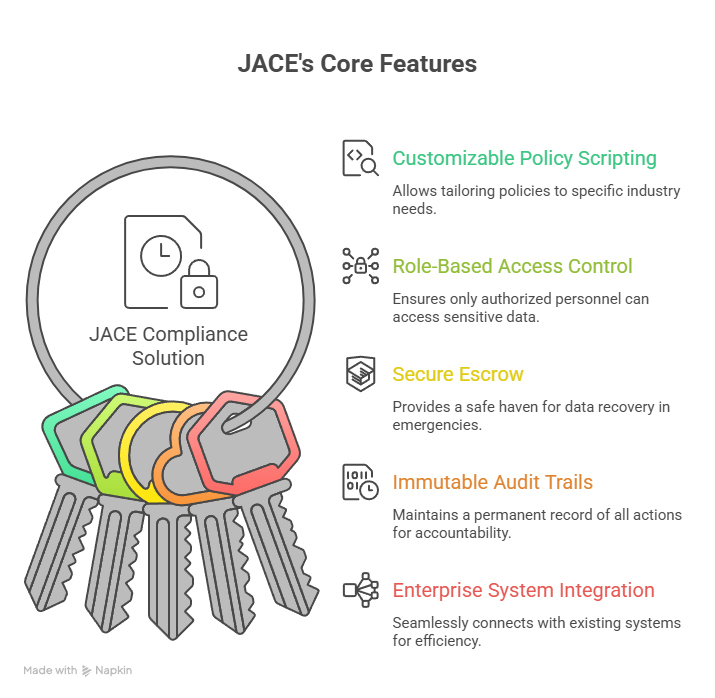
JACE was built for environments where communication cannot be casual.
Its architecture supports:
By functioning as a sovereign AI compliance solution, JACE aligns technology with legal accountability.
Remember: Artificial intelligence does not override policy. It enforces it.
Regulators do not simply ask whether communication occurred. They ask how it was governed.
JACE automatically attaches compliance-related metadata to messages, including:
This metadata simplifies electronic discovery and regulatory reporting.
Instead of scrambling to reconstruct communication trails during an investigation, organizations can retrieve precise records instantly.
The AI compliance engine operates quietly but thoroughly, ensuring that governance is embedded from the start.
Artificial intelligence development often focuses on predictive accuracy or automation efficiency. Here at MailSPEC, the guiding principle is different.
Data sovereignty comes first.
Every feature within JACE is designed to ensure that:
The goal is not simply intelligent automation. It is controlled intelligence.
One reason compliance systems fail is friction. If tools are cumbersome, users find ways around them.
JACE integrates seamlessly with enterprise communication environments across web, mobile, and desktop applications. Employees do not need to learn a new system or navigate separate portals.
Behind the scenes, the AI compliance engine operates continuously:
From the user perspective, the workflow remains natural. From the compliance perspective, governance is airtight.
Artificial intelligence is increasingly embedded in enterprise systems. But how it is deployed will determine whether it reduces risk or amplifies it.
Organizations must ask:
Well, JACE provides clear answers.
It is an AI compliance engine that strengthens regulatory posture without compromising confidentiality. It is an on-premise AI compliance engine that keeps data where it belongs. It is a sovereign AI compliance solution built for organizations that understand the cost of exposure.
Regulated communication demands precision. Artificial intelligence can provide that precision, but only if it respects jurisdictional and privacy boundaries.
JACE delivers a private AI compliance platform that enforces policy, automates journaling, prevents human error, and supports strict regulatory requirements without ever transferring sensitive data to the public cloud.
Because the true measure of compliance is not how much data you analyze. It is how carefully you protect it.

For many European companies, the move to public cloud platforms felt like a logical step. Scalable infrastructure, lower operational costs, global collaboration, and seamless integration with office productivity tools.
But beneath that convenience sits a legal tension that has not disappeared. And in fact, it has intensified.
The United States Cloud Act allows United States federal authorities to compel United States-based technology companies to provide access to data under their control, even if that data is stored physically outside the United States.
Now, for European companies subject to strict data protection frameworks, this creates a direct US Cloud Act data sovereignty conflict. And it is not just theoretical. It is structural.
MailSPEC works with European enterprises, public agencies, and critical infrastructure operators to address this conflict by providing sovereign communication environments that remove exposure to foreign legal demands.
Because compliance is no longer just about encryption. It is about jurisdiction.
To understand the US Cloud Act data sovereignty conflict, we must first understand what the law permits.
The United States Cloud Act allows federal authorities to demand access to data held by United States service providers, regardless of where that data is stored geographically. If a company is headquartered or legally incorporated in the United States, it can be compelled to provide data in its “possession, custody, or control.”
This means:
For European companies operating under strict privacy frameworks, this creates tension. They may be required by local law to protect personal data from unauthorized access, while simultaneously relying on service providers subject to foreign legal demands.
This is the core of the US Cloud Act compliance risks facing European businesses.
The debate, often framed as the US Cloud Act vs. General Data Protection Regulation, reflects two fundamentally different legal philosophies.
The European General Data Protection Regulation prioritizes:
The United States Cloud Act prioritizes lawful access for criminal and national security investigations.
Now, when a European company stores sensitive personal or strategic data in a public cloud operated by a United States provider, the question becomes:
If a United States authority issues a demand, can the provider legally refuse?
In many cases, the answer is no.
This then creates legal risks of the US Cloud Act for EU companies, particularly those handling sensitive data in finance, healthcare, energy, telecommunications, and government services.
French companies face a particularly sensitive environment.
France has strong data protection oversight, strategic sector regulations, and increasing emphasis on national digital sovereignty. Yet many organizations still rely on platforms such as Office 365 or Gmail for email and collaboration.
The risks include:
Also, even if the physical servers are located in Europe, control may still reside with a United States parent company.
For French companies operating in regulated sectors, this can create compliance ambiguity and reputational risk.
Data sovereignty in public cloud Europe concerns are no longer abstract policy debates. They affect procurement decisions and risk assessments today.
Many providers respond to sovereignty concerns by emphasizing encryption.
Encryption is important, yes. But it is not sufficient if:
If a provider can technically access or decrypt the data, it may be compelled to do so under United States law.
True sovereignty requires more than encryption. It requires architectural independence.
A sovereign-controlled private cloud differs fundamentally from public cloud models.
It is designed to ensure that:
In France, this means a French-first infrastructure where:
This model eliminates the structural conflict created by foreign extraterritorial legislation.
Critical infrastructure operators in France face heightened scrutiny.
Energy networks, transportation systems, healthcare institutions, financial markets, and telecommunications providers must demonstrate operational resilience and control over strategic data.
French authorities increasingly expect:
For these sectors, reliance on foreign-controlled public cloud platforms can raise red flags during audits or regulatory reviews.
A French-first approach is not protectionism. It is risk management.
The legal risks of US Cloud Act for EU companies include:
And even if no data is ever accessed, the mere possibility of compelled disclosure can create uncertainty.
Here, for boards and compliance officers, uncertainty itself is a risk.

MailSPEC addresses the US Cloud Act data sovereignty conflict by combining legal clarity with technical architecture.
And rather than relying on foreign-owned public cloud infrastructure, MailSPEC enables:
✔️ Sovereign deployment within national borders
✔️ Full control over encryption keys
✔️ On-premise or private infrastructure options
✔️ End-to-end encrypted communication channels
✔️ Immutable journaling and audit controls
Together, these tools create a legal and technical buffer against foreign surveillance exposure.
MailSPEC does not simply encrypt communication. It ensures that jurisdictional control remains where it belongs.
The debate around data sovereignty public cloud in Europe is often reduced to a political argument. And in reality, it is a governance issue.
European companies must answer:
Now, if the answer depends on foreign corporate structures, compliance risk remains.
A sovereign communication platform resolves that ambiguity.
Organizations should evaluate their current environment carefully:
If answers are uncertain, the US Cloud Act compliance risks deserve immediate review.
The US Cloud Act was not designed to undermine European sovereignty. It was designed to extend lawful access within the United States legal system.
But its extraterritorial reach creates unavoidable friction with European data protection frameworks.
And for French companies and other European enterprises storing sensitive data in public cloud environments, the US Cloud Act data sovereignty conflict is immediate and structural.
Encryption alone is not enough. Location alone is not enough.
Only sovereign control eliminates the ambiguity.
MailSPEC provides European organizations with secure, compliant communication platforms that maintain jurisdictional integrity while preserving operational efficiency.
Because in a world of overlapping laws and digital interdependence, true compliance begins with control.
Artificial intelligence is no longer experimental in Europe. It is operational. It filters resumes, monitors transactions, flags suspicious messages, automates reporting, and increasingly governs how organizations communicate.
But as artificial intelligence systems move deeper into regulated industries, Europe has drawn a clear line in the sand.
The European Union Artificial Intelligence Act introduces a risk-based regulatory framework that changes how organizations design, deploy, and govern artificial intelligence tools. For businesses operating in finance, healthcare, defense, public services, and digital infrastructure, this is not abstract policy. It directly affects the development of AI-enabled communication tools used every day.
MailSPEC works with regulated enterprises to build compliant AI-enabled communication tools that align with EU AI Act high-risk system compliance expectations. Because in today’s regulatory climate, artificial intelligence cannot simply be powerful.
It must be explainable, accountable, and sovereign by design.

At the heart of the EU AI Act, high-risk system compliance is a risk-based model.
The regulation categorizes artificial intelligence systems into four tiers:
Communication platforms that integrate artificial intelligence for compliance monitoring, content classification, regulatory reporting, or decision-making can fall within the high-risk category depending on how they are used.
For example, an artificial intelligence engine that flags financial communications for regulatory review or monitors employee conversations for policy violations may qualify as a high-risk AI system under high-risk AI system regulations, EU standards.
This classification triggers significant EU AI Act compliance requirements, including:
Communication platforms can no longer treat artificial intelligence as an invisible feature. It must be governed intentionally.
Communication tools today often rely on artificial intelligence to:
Now, when these capabilities influence regulatory decision-making or impact individuals in professional settings, they enter the sphere of EU AI Act governance for AI tools.
That means AI-enabled communication compliance must address:
Here, artificial intelligence cannot operate as a black box. Organizations must understand how it reaches its conclusions.
One of the most important pillars of EU AI Act compliance requirements is transparency.
Say, if artificial intelligence interacts with humans in a business context, users must understand that it is doing so. When automated systems influence compliance decisions, individuals must be able to question outcomes.
In the context of AI-enabled communication tools, this means:
Transparency builds trust. But more importantly, it builds defensibility during audits.
Organizations that rely on artificial intelligence to monitor communication must be prepared to explain, not just deploy.
Regulators do not simply accept “the system decided” as an explanation.
Under the EU AI Act high-risk system compliance standards, organizations must ensure that artificial intelligence outputs are explainable and documented.
Explainable artificial intelligence means:
And when artificial intelligence is used to support financial reporting, healthcare data governance, or cross-border compliance monitoring, explainability becomes essential.
Without it, organizations risk regulatory scrutiny not because they misused artificial intelligence, but because they cannot demonstrate how it operates.
There is a tension at the center of modern compliance.
Artificial intelligence must analyze communication to enforce regulations. But it must do so without violating privacy laws or data sovereignty principles.
MailSPEC addresses this challenge by integrating artificial intelligence directly into its communication architecture without exporting sensitive data to external processing engines.
Instead of sending messages to third-party cloud models, MailSPEC deploys policy-driven artificial intelligence at the infrastructure level, preserving:
This approach allows AI-enabled communication tools to enhance compliance without undermining privacy.
In a European regulatory environment shaped by both the EU Artificial Intelligence Act and data protection frameworks, that balance is critical.
The EU Artificial Intelligence Act is not only about risk mitigation. It is about digital sovereignty, too.
Europe’s regulatory direction reflects a desire to ensure that critical technologies remain aligned with European values, legal standards, and jurisdictional authority.
For communication platforms, this means:
A sovereign approach to AI-enabled communication compliance ensures that organizations are not exposed to conflicting legal regimes or opaque data practices.
In this context, compliant AI-enabled communication tools must be:
Sovereignty is no longer a political slogan. It is an architectural requirement.
Organizations subject to EU AI Act compliance requirements should evaluate their communication systems carefully.
Ask:
Now, if answers are unclear, risk exposure may be higher than expected.
Artificial intelligence should enhance compliance, not introduce new uncertainty.
MailSPEC develops AI-enabled communication tools specifically for regulated environments.
And rather than embedding opaque machine learning features, MailSPEC prioritizes:
This ensures that artificial intelligence functions as a compliance assistant, not just an uncontrolled authority.
By integrating artificial intelligence into secure communication architecture, MailSPEC supports EU AI Act high-risk system compliance while protecting both confidentiality and operational continuity.
The EU Artificial Intelligence Act signals a broader shift. Organizations can no longer treat artificial intelligence as a purely technical upgrade. It is now a regulated capability.
High-risk AI system regulations EU frameworks require:
Communication systems that integrate artificial intelligence will increasingly be viewed through this regulatory lens.
The companies that prepare now will avoid costly retrofits later.
Artificial intelligence is transforming communication. It can detect fraud, prevent data leaks, streamline audits, and automate governance at scale.
But power without oversight creates risk.
The EU Artificial Intelligence Act ensures that innovation moves forward responsibly. For organizations deploying AI-enabled communication tools, the path forward is clear:
MailSPEC helps enterprises design compliant AI-enabled communication tools that meet EU AI Act high-risk system compliance standards without sacrificing usability or performance.
Because in Europe’s evolving regulatory landscape, the future of artificial intelligence is not just intelligent. It is accountable, sovereign, and secure.
Subject related to Cybersecurity, whether that be MailSPEC products and services, or the industry.
When it comes to mergers and acquisitions (M&A), the stakes are high—and so are the risks. From all your financial projections and legal documents to those personnel decisions and proprietary data, the information shared during these deals is some of the most sensitive information an organization like yours can hold.
Yet, despite the critical nature of this process, many still rely on unsecured or inconsistent communication methods during M&A activity. That leaves them wide open to data breaches, compliance violations, and even deal cancellations.
So that’s where MailSPEC comes in.
As a regulatory solution company specializing in secure communication channels, we empower enterprises to communicate confidentially, efficiently, and in full compliance with legal and industry standards—even when two (or more) organizations with different security postures need to collaborate.
Let's break down nine practical ways to protect sensitive information during mergers and acquisitions with secure, compliant communication strategies.
When two companies start sharing data, their respective security standards rarely align perfectly. And that mismatch introduces vulnerabilities like:
Here, MailSPEC helps neutralize these risks by establishing secure communication protocols designed specifically for high-stakes, cross-organizational exchanges.
During M&A activity, teams often spin up new collaboration tools or rely on ad-hoc communication methods, which introduces risk and reduces accountability at the same time.
A better approach? Establish a secure, centralized policy for communication that includes:
This ensures everyone is on the same page—literally and digitally.
It may not be feasible to fully integrate both organizations' platforms during M&A discussions. And that’s also why MailSPEC offers temporary, secure messaging environments that:
This setup ensures that once the deal closes (or falls through), access can still be shut down with a single click.
Data shared during mergers and acquisitions may be subject to:
MailSPEC helps organizations meet these mandates by providing:
When parties from two or more organizations come together, verifying identities is critical. Using shared credentials or generic login links just will not cut it here.
Hence, to ensure integrity:
MailSPEC enables all of this through its secure user provisioning framework.
Encryption needs to be more than just "at rest" and "in transit." So, during M&A deals, every message and attachment MUST be end-to-end encrypted.
That means:
MailSPEC’s architecture is built around this level of encryption, ensuring the highest standards of M&A data protection.
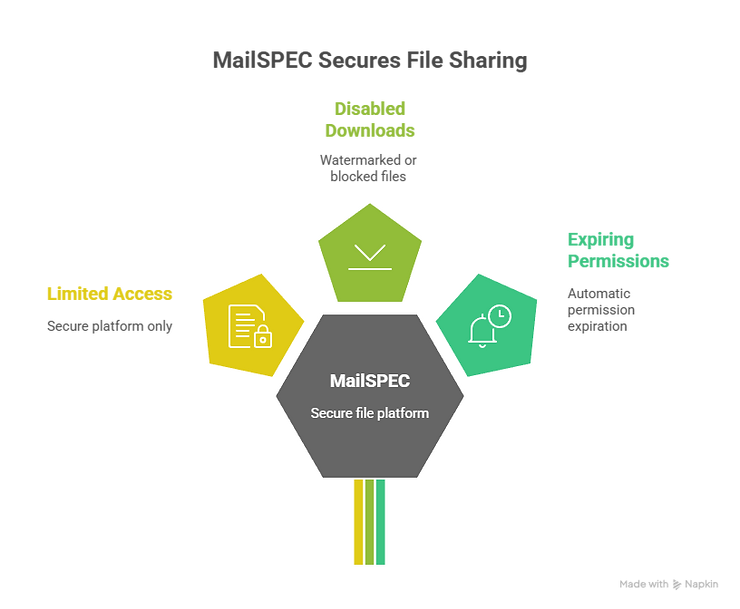
Many data breaches happen when sensitive files are:
But with MailSPEC:
✔️ File access can be limited to the secure platform
✔️ Downloads can be disabled or watermarked
✔️ Sharing permissions can expire automatically
This locks down file access before, during, and after the deal.
You cannot protect what you can’t monitor. And that’s why communication transparency is essential.
MailSPEC provides:
These features help organizations detect anomalies early and as well as maintain a strong enterprise communication security posture throughout the M&A process.
The risks of poor communication security during M&A are very real. Here are two scenarios that could happen:
Imagine a healthcare organization sharing unencrypted patient data with a potential buyer via email. If that data were leaked, the deal could collapse, leaving the seller exposed to regulatory fines and even reputational damage, too.
Picture a tech merger where sensitive product roadmap discussions take place on a consumer messaging app. Say, if an employee were to leak that data, it could compromise their competitive edge and severely impact the merger's success as well.
Don’t let these risks become your reality. Secure your communication channels upfront.
MailSPEC is not just another secure messaging tool. It is a regulatory-focused communication solution that enables:
And whether you are initiating a merger, acquiring another firm, or simply preparing for due diligence, MailSPEC keeps your sensitive conversations safe and compliant.
Mergers and acquisitions are complicated enough. So do not let unsecured communication make them even riskier.
By establishing secure communication channels from day one, you:
✔️ Prevent unauthorized data access
✔️ Satisfy compliance requirements
✔️ Protect the value of the deal
And with MailSPEC, you can do it all without compromising usability or slowing down the process.
Let MailSPEC show you how to protect sensitive data, meet regulatory standards, and communicate confidently throughout the M&A lifecycle.
Contact us today for a tailored walkthrough of how our platform can secure your next big deal.
Ransomware attacks affect businesses no matter the size. You really don't want to know the average cost for recovering from a malicious ransomware attack... So what is a ransomware attack? A ransomware attack happens when malware (a virus) is deployed and then hold's the victim's information (on their own computer!) at ransom. This could be an individual user or an organization's valuable data; but made inaccessible by the owner! The hacker encrypts that data or holds it hostage and threatens the individual or organization with a ransom in order to either unlock the data or promise not to expose the hacked data.
Ransomware has experienced rapid growth because it's evolved from one-time attacks into a modern software-as-a-service business. Ransomware "organizations" have copied popular SaaS tech vendors and offer a highly polished product that relies on distributors to push the malware onto other people and machines in order for a cut of the ransom reward. Incredible as it sounds, real. An example of this is "phishing emails", which have embedded web links or attachments that infect your computer when you click on them. Ransomware is the fastest-growing malware hazard in the 21st century and in this article we are going to discuss three ways you can prevent a ransomware attack.
Did you know that it is estimated that nearly 3 out of 4 companies infected with ransomware suffer two days or more without access to their files.
Why should you continually update your software? Hackers love security flaws and spend time finding software vulnerabilities in programs. Software updates often include security patches that helps to cover known flaws or breeches in the programs that you and your employees use every day. In many ways, the learn by others mistakes so you do not have to do it yourself applies. So, be sure you are not left with vulnerable software that has already been compromised.Another risk from outdated software is the fact that security updates are not released after a product becomes obsolete. If a program you are using is obsolete, you may want to consider finding an alternative and removing that software program. The key takeaway is to make sure you or a cybersecurity expert assess the software programs you are using to make sure there are no known security vulnerabilities. Update or remove that outdated software.
Sometimes despite your best efforts at prevention, a breach is going to happen. Having a strong backup strategy, and a good restoration process in place ensures more protection against ransoms. Backups should always include offsite, that do not have direct connections to the network that might become infected. This allows restoration at a disaster recovery site, or replacement on the infected site, when the malware has been removed. As well as protecting against ransomware attacks, backups help protect your company against: - human errors, - hardware failures, - and power failures.
Humans are the most vulnerable point in your security system. Humans are lazy with passwords. A good way to check your password health is to use a service like NordPass to check the health of your passwords. NordPass will scan all your passwords saved in your vault and check how vulnerable they are. If you don't use a password vault like LastPass then you will have to manually ask yourself these questions.
💣 How complex are my passwords?
💣 Have I reused any passwords multiple times?
💣
Are any passwords over 90 days old?If you answered yes to any of these questions, you may need to look at changing some passwords. Another good thing to do is use multifactor authentication. The last blog post we wrote highlighted the importance of 2FA and MFA and would be good for you to review.
>> What is 2FA? A helpful Guide.
Did you know that 92% of malware attacks are delivered via email? A large % of those malware attacks are ransomware attacks first carried out through an email. Check out this list of trending CyberSecurity Statistics from 2021 for more details on that:
2021 Cyber Security Statistics Links and attachments are the two main ways a ransomware attack is carried out via email. It is a good idea for companies to train their employees to be aware of issues such as these and to fully audit their email and communications systems to see just how secure their company practices are.
Perhaps your email and communications systems need an audit to determine just how secure they are? MailSPEC offers System Audits where we review and provide recommendations for your email and voice communication systems. We provide honest reports, no matter the vendor or topologies used. Get in touch with us today at contact@mailspec.com for more information.
Two Factor Authentication or (2FA) shouldn't be overwhelming or something to be afraid of. 2FA simply makes your online accounts much more secure when you log in to them. You need to possess the password for your account as well as a means of verifying who you are.Simple right?Believe it or not, Two Factor Authentication first emerged in 1986 in the form of a key fob... Now things have certainly changed a bit since those days and in this blog post, we are going to break down 2FA for you and make it easy to understand.
Let's start at the very beginning. In order to create an account online, whether that's email, social media, subscription or a bank account, you need to create a log in. This login generally requires a username, password, and/or an email address. This is the first layer of security.
Seeing as how you don't want anyone else to have access to your account, you create a username and a password unique enough so only you can log in. Here are two big reasons why the first layer is not good enough for security purposes. 1 - You use the same password for multiple accounts. This is a security risk because hackers LOVE password recycling. Security breaches happen all the time and if you re-use the same password everywhere all it takes is one account to be hacked and all your accounts will give the hacker access. 2 - Humans get tired and lazy. It takes effort to create unique passwords and remember them. You either need to find something like LastPass or have an amazing memory. When you get annoyed with remembering passwords you get lazy in order to make it easier on yourself. This sets you up to be hacked easier. Two Factor Authentication is an extra layer of security that makes it that much harder for hackers to access your private accounts. Microsoft shared an incredible report from 2019 that concluded 2FA blocks 99.9% of automated hacker attacks. A similar report from Google had the same conclusion.
The following forms are the most common 2FA methods.

It really isn't that difficult to set up two factor authentication. As mentioned previously the first layer is your password. The most common second layer of security is your smartphone. In 2022 almost everybody owns a smartphone making it pretty straightforward to set up 2FA.
Your smartphone assists with the second layer of security in one of two ways.
Sounds pretty simple right?
"True Cybersecurity is preparing for what's next, not what was last." – Neil Rerup
Let's break down which service you should protect with 2FA.
You probably have hundreds of accounts across the internet, anything from Amazon to Google to Facebook to your local pizza shop. Which accounts need 2FA? Well let's get this right out of the way, any account that supports 2FA would be a good one to protect! We'd recommend starting with the following accounts. 1 - Bank / Finance Related2 - Password Managers3 - Google, Microsoft, and Apple Accounts4 - Social Media Accounts5 - Shopping and Commerce Accounts
Yes, that's quite a few accounts... So how do you actually set up 2FA with your smartphone?
Here's the good news, setting up your second layer of security via 2FA with a smartphone is very very easy.
-- Method 1 -- SMS Messages
Let's use Twitter as an example. 1 - Select MORE (three dots in a circle in the bottom left of your screen)2 - Select Security and account access3 - Select Security You'll see this screen.
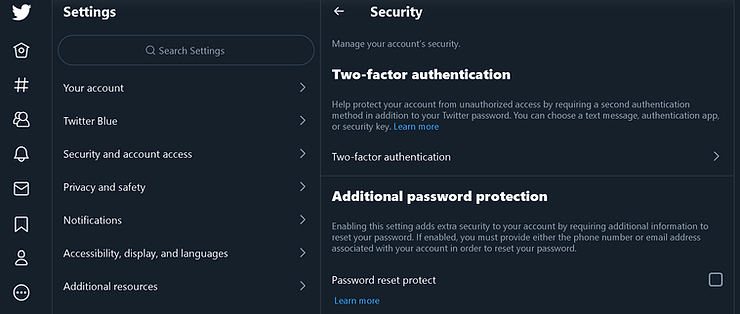
Now select Two Factor Authentication.You will see the following screen.
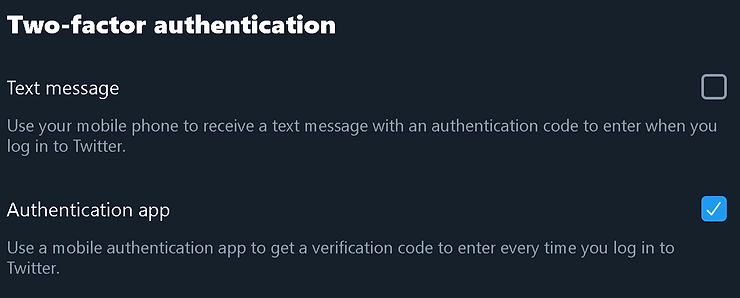
You can choose either text message(SMS) or use an Authentication app. In this method, we are using SMS so select that. Now you just need to input your mobile number and tap OK. You will now receive an SMS message from Twitter with a six-digit code. Enter the code into Twitter and viola your 2FA setup is DONE! Now in order for someone to access your Twitter account, they'd need your password as well as your 2FA 6 digit code.
-- Method 2 -- Authenticator App
To make use of an authenticator app you will need to still an app on your smartphone. There are a few options for you depending on the device you use. Here are a few. Google & Microsoft Authenticator - both highly used and reliableAuthy - very easy to useLast Pass Authenticator App - if you use LastPass for your passwords this is a great optionandOTP - open-source alternativeactiveauth - a MailSPEC product! 2FA and MFA or Multi-Factor Authentication is native to our core products. We provide biometric control over web access for our users and activeauth is integrated to 3rd party applications with OTP support. The mobile experience is seamless for a transition to higher security on a private system that is easy to use and onboard.
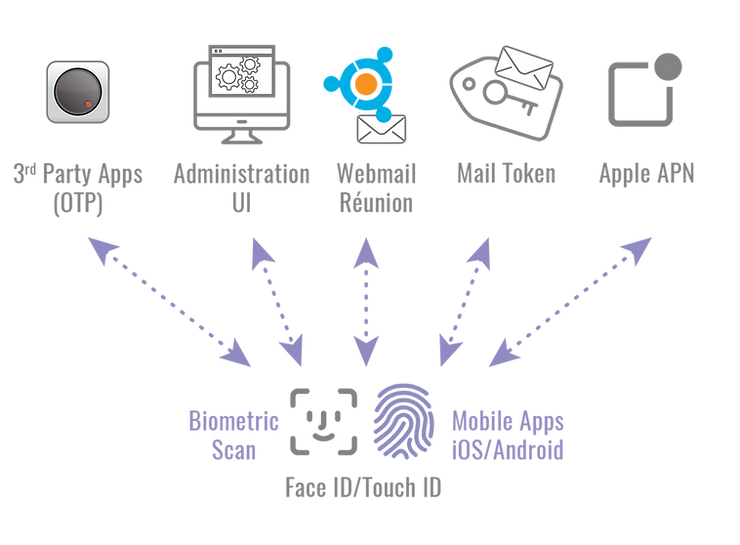
Once you've downloaded the app you are ready to use the authenticator app as a form of 2FA. Let's use Twitter again as an example. 1 - Select MORE (three dots in a circle in the bottom left of your screen)2 - Select Security and account access3 - Select Security You'll see the same screen as the last steps. Select Two Factor Authentication again. This time though, select Authentication App. This popup will appear.
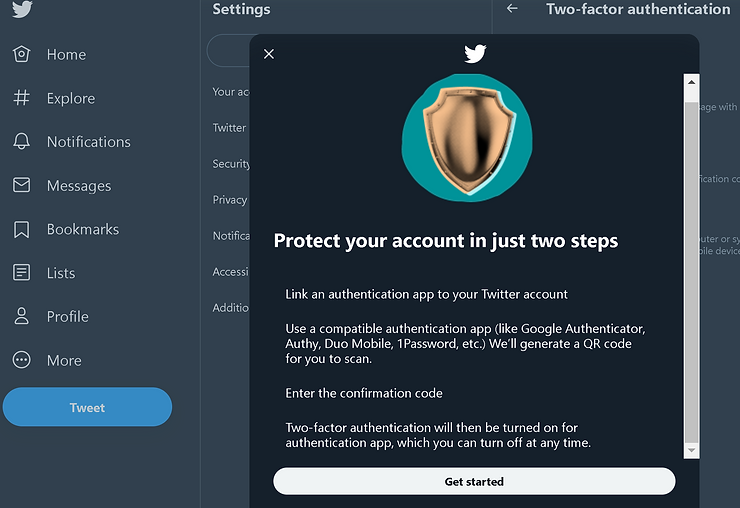
Select get started.
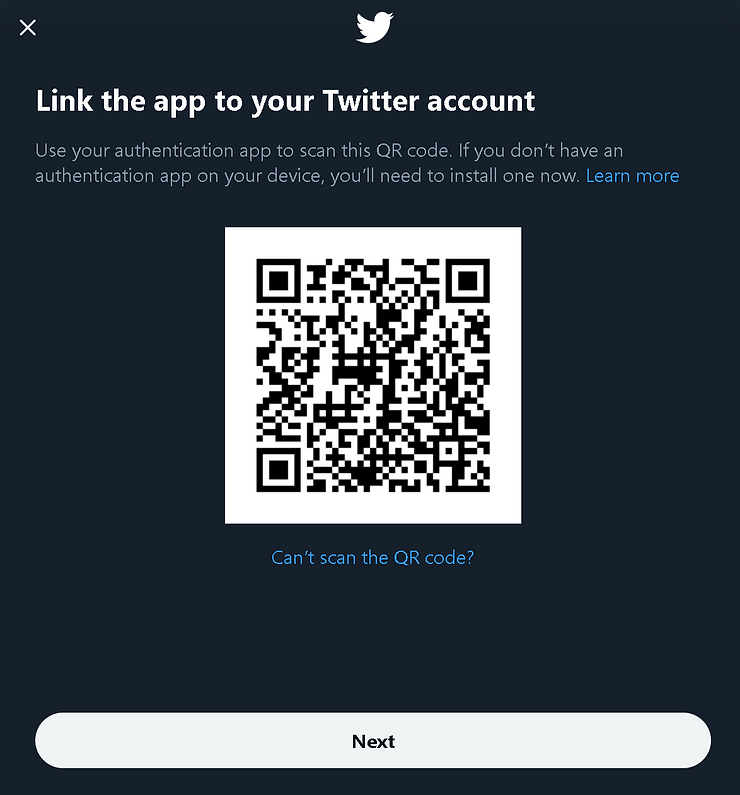
Now using your authentication app, select add a new account and then scan this code using your smartphone camera! The app will do the rest. Once the account is setup it will begin generating codes for you every so often. This randomization really ups the security with 2FA!Now there's one last step! You need to enter the current 6 digit code from the authenticator app into Twitter. Simply enter it below and viola, you have set up 2FA with an authentication app.
Two Factor Authentication increases your online security by adding a second layer of security to keep hackers at bay. We hope this blog post has been helpful for you, follow us on LinkedIn and Twitter for all things Cybersecurity, and stay tuned for more helpful blog posts from the Cybersecurity world.
News about new releases of MailSPEC products and services.

June 2nd, 2026: MailSPEC today officially released PassLink 3, the enterprise-grade, on-premises secure file-sharing platform purpose-built for organizations that must exchange sensitive documents with customers, partners, suppliers, and citizens while maintaining full sovereign control and regulatory compliance.
Designed for finance, healthcare, insurance, government agencies, legal practices, and critical infrastructure, PassLink 3 delivers military-grade quantum-safe encryption, authenticated access receipts, automated audit trails, time-limited expiration, and seamless SDK integration into CRM, ERP, and billing systems, all without forcing users to abandon the familiar email workflows they already use.
In 2026, the majority of regulated organizations still rely on ordinary email or free consumer cloud links (Google Drive, Dropbox, WeTransfer, OneDrive) to send invoices, lab results, insurance claims, passport scans, legal contracts, and government notices. This practice is now a documented regulatory and security disaster.
A doctor emails lab results containing patient names, diagnoses, and test values to a patient’s personal Yahoo or Gmail account. The email is unencrypted, stored indefinitely on foreign servers, and can be forwarded, intercepted, or subpoenaed without the healthcare provider’s knowledge. This instantly violates HIPAA’s Security Rule (transmission security) and Privacy Rule (minimum necessary standard). U.S. Department of Health and Human Services (HHS) Office for Civil Rights (OCR) has repeatedly fined organizations for exactly this behavior. One recent settlement reached $9.76 million for repeated email security failures involving protected health information (PHI). Another provider was hit with a $3 million penalty after unencrypted PHI emails were sent to the wrong recipients.
An insurance company emails policy documents or claims forms to a customer’s Gmail address. The attachment contains personally identifiable information (PII) and protected health information. The email sits in the recipient’s inbox forever, can be downloaded by anyone with access to that account, and creates an untraceable chain of custody. When regulators or auditors request proof of secure transmission and receipt, the company has none.
A tax authority or social services agency emails sensitive benefit letters, ID verification requests, or passport scan requirements to citizens using Yahoo or Hotmail. The files leave sovereign jurisdiction the moment they are sent, violating national data-localization laws and exposing citizens to foreign government access requests under laws like the U.S. CLOUD Act.
These are not theoretical risks. They are daily occurrences that regulators are now punishing aggressively.
In Europe, GDPR enforcement in 2025 alone generated over €1.2 billion in fines, with many stemming from insecure data transfers and email-based sharing failures. In Japan, the Act on the Protection of Personal Information (APPI) now carries penalties up to ¥100 million per violation for improper handling or transfer of personal data outside approved jurisdictions.
The core problem is simple: consumer email and cloud services were never built for regulated file sharing. They offer zero control over:
The result is broken chains of custody, massive regulatory exposure, and constant risk of industrial espionage or data breaches.
PassLink 3 solves every one of these problems by keeping 100 % of the file lifecycle inside the organization’s sovereign perimeter (on-premises or approved sovereign cloud). No data ever touches foreign consumer services.
Every file is encrypted end-to-end with post-quantum cryptography before it leaves the sender’s system. Even if an attacker intercepts the transmission or compromises the recipient’s device years from now, the file remains unreadable. This directly addresses “harvest now, decrypt later” threats that regulators and security agencies are now mandating protection against.
Recipients must authenticate (via secure link + one-time code or organizational credentials) before they can even see the attachment. Upon opening, PassLink 3 instantly generates a tamper-proof receipt that logs:
All activity is recorded in an immutable WORM archive on the sender’s sovereign infrastructure. Auditors and regulators can retrieve a complete, court-admissible trail in seconds.
Legal and compliance teams create branded templates with automatic disclaimers (“This document contains personal data protected under GDPR/APPI/HIPAA – unauthorized forwarding prohibited”), return receipt requirements, and jurisdiction-specific warnings. Templates are stored centrally and applied automatically via the SDK.
One of PassLink 3’s most powerful innovations is “Reverse Onboarding.” Legal firms, insurance adjusters, government agencies, and healthcare providers can send a one-click secure link to clients using ordinary Gmail or Yahoo addresses. The recipient clicks, authenticates once, and gains a temporary, fully controlled portal to upload or view documents, without ever needing to install anything or change their email habits.
This is revolutionary for:
Claims adjusters request medical records, accident photos, or ID scans from policyholders. The policyholder uploads directly into the secure session; everything is encrypted, audited, and stays inside the insurer’s sovereign environment. No more “please email us your passport scan” disasters.
Lawyers handling divorce, estate planning, or corporate transactions send sensitive contracts and identification documents to clients via consumer email. Clients upload passport scans or financial statements through the authenticated portal. Everything remains under the law firm’s jurisdiction and audit control.
Tax offices or benefits administrators send citizens secure links to upload supporting documents. The citizen authenticates, uploads, and receives an instant receipt. All files stay inside the government’s sovereign infrastructure, satisfying strict localization requirements in Japan, the EU, and the GCC.
PassLink 3’s SDK allows developers and IT teams to embed secure file exchange directly into existing CRM, ERP, billing, and case-management platforms. No separate portal. No user training.
Under the Economic Security Promotion Act and APPI, organizations must keep critical personal and business data inside Japanese jurisdiction. PassLink 3’s on-premises deployment ensures files never leave Japanese soil or approved sovereign clouds. Companies in manufacturing, fintech, and healthcare can now safely share technical drawings, patient records, or supply-chain contracts without risking foreign jurisdiction exposure.
NIS2, the EU AI Act, and GDPR require demonstrable control over data transfers. PassLink 3 provides the missing piece: sovereign encryption + immutable audit trails that satisfy supervisory authorities in Germany, France, and Ireland. Organizations avoid the €20 million+ fines that have become routine for unsecured data sharing.
Vision 2030 programs and national data-localization laws demand that citizen and corporate data remain under local control. PassLink 3 enables government agencies and private enterprises to distribute benefits documents, insurance policies, or legal notices while keeping every byte inside approved borders.
Every file transaction generates a complete, cryptographically signed audit log that includes:
Compliance officers and external auditors can export reports in seconds, turning what was previously a months-long forensic nightmare into an instant regulatory checkbox.
Consumer email and free cloud buckets were convenient yesterday. Today, compliance time bombs can expose organizations to billion-dollar fines, data breaches, and loss of sovereign control. PassLink 3 removes the risks with a secure, auditable, quantum-safe pipeline that works exactly where your staff and customers already are. Your data. Your jurisdiction. Your control.
Contact MailSPEC today for a no-risk TestFlight. Stop sending sensitive documents into the unknown.
[1] HIPAA Journal – “Is it a HIPAA Violation to Email Patient Names?” (2026 Update)
https://www.hipaajournal.com/is-it-a-hipaa-violation-to-email-patient-names/
[2] LuxSci – “Can You Send PHI Through HIPAA Email?”
https://luxsci.com/can-you-send-hipaa-through-email/
[3] Paubox – “HIPAA Compliant Email: The Definitive Guide (2026 Update)” – Solara $9.76M settlement
https://www.paubox.com/blog/hipaa-compliant-email
[4] HIPAA Times – Top HIPAA email violations including Solara $3M fine
https://hipaatimes.com/top-5-hipaa-email-violations-and-how-to-avoid-them
[5] Surfshark – “GDPR breaches led to over €1B in fines in 2025”
https://surfshark.com/research/study/gdpr-fines-2025
[6] Endpoint Protector – “Data Protection in Japan: All You Need to Know about APPI” – ¥100M maximum fines
https://www.endpointprotector.com/blog/data-protection-in-japan-appi/
[7] UnitedLayer – “Sovereign Cloud Explained” – data residency and quantum-safe controls
[8] OPSWAT – “The Future of Secure File Transfer – AI, Quantum & Zero Trust”
https://www.opswat.com/blog/the-future-of-secure-file-transfer-ai-quantum-and-zero-trust
May 5th, 2026: MailSPEC today officially released EasyCrypt 3, the groundbreaking client-side encryption and AI governance platform engineered for organizations that must repatriate sensitive data into full sovereign control while continuing to communicate securely with external parties on consumer email systems.
EasyCrypt 3 is not another email encryption tool. It is a comprehensive compliance engine that runs 100% on-device and on-client, classifying data in real-time using an AI policy engine tailored for national regulations or organizational rules. It applies quantum-safe end-to-end encryption and enables secure external sharing without ever transmitting raw data to foreign clouds. The result: regulated enterprises and government agencies can finally repatriate thousands of sensitive emails and attachments from Microsoft 365, keep everything under local jurisdiction, and still exchange documents safely with customers, partners, and citizens using ordinary Gmail, Yahoo, or Hotmail addresses.
The Problem: Legacy Email Encryption and Consumer Systems Are Breaking Sovereignty and Compliance
For decades, organizations in finance, healthcare, and national security have tried to use legacy email encryption (PGP, S/MIME, or Microsoft 365 encryption) and public cloud storage. These approaches create three fatal flaws that regulators now punish aggressively.
First, traditional encryption happens without data classification, and the keys are managed on the user’s desktop, or worse, in a gateway device that is subject to attack. The endpoint (laptop, phone, or server) holds the keys, and key management becomes a nightmare for compliance teams. Auditors cannot prove who had access or when the data was decrypted.
Second, most situations result in plaintext or encrypted copies at rest on foreign clouds (Microsoft, Google, Yahoo), exposing organizations to CLOUD Act requests, GDPR international transfer violations, and “harvest now, decrypt later” quantum risks.
Third, when organizations need to repatriate data from Office 365 or consumer platforms, they face months of manual effort with no automated classification or audit trail.
Real-world consequences are severe. In 2025–2026 alone, GDPR enforcement generated more than €1.2 billion in fines, many tied to insecure email transfers and loss of control over personal data. HIPAA violations involving email transmission of PHI (Personal Healthcare Information) have produced settlements in the millions, including a $9.76 million penalty against one provider for repeated unsecured email failures. Japanese APPI enforcement now carries penalties up to ¥100 million for improper handling or transfer of personal data outside approved jurisdictions.
Government agencies using Microsoft 365 face the same crisis. Emails and attachments containing classified information, citizen records, or proprietary intelligence often sit in U.S.-controlled clouds with no guarantee of sovereignty. When these agencies need to share documents with citizens on Gmail or partners on Yahoo, the data immediately leaves national jurisdiction, creating unacceptable breaks in the chain of custody.
EasyCrypt 3 solves these problems at the source. The platform’s revolutionary on-device AI Governance Engine performs data classification and policy enforcement before any transmission occurs. The AI-powered policy engine allows compliance teams to create country-specific or organization-specific rules that run entirely on the client device, Mac, Windows, iOS, or web, with zero raw data ever leaving the sovereign perimeter.
Unlike legacy technology that only encrypts content after it has already been typed or attached, EasyCrypt 3’s Local AI Governance and classification engine scans every message or draft in real time using locally stored models. It detects sensitive patterns (PHI elements, trade secrets, classified keywords, export-controlled references) and applies the correct data classification and policy instantly. No cloud AI calls. No data exfiltration. Full explainability logs for regulators.
This on-client approach is fundamentally different from legacy systems. Traditional encryption tools hand control to the endpoint or cloud provider. EasyCrypt 3 keeps control of the organization at every step.
EasyCrypt 3 uses NIST-approved post-quantum algorithms combined with a patented hybrid encryption scheme protecting data both in transit and at rest. This eliminates the “harvest now, decrypt later” threat that security leaders now rank as a board-level priority. Even if an attacker captures encrypted traffic today and waits for quantum computers in 2035 or beyond, the data remains unreadable.
The system’s patent-pending key management architecture ensures that decryption keys never leave the sovereign environment. Compliance officers retain full control, with automated rotation and escrow that satisfies the strictest audit requirements.
Government agencies and regulated enterprises using Office 365 can now repatriate years of sensitive emails and attachments in weeks instead of years. EasyCrypt 3’s desktop client (Windows, macOS) and Outlook add-in scan existing mailboxes on-device, classify every message and attachment according to custom policies, apply quantum-safe encryption, and migrate the data to the organization’s on-premise or sovereign-cloud archive, all without ever sending raw content outside the jurisdiction. One European government ministry recently completed the repatriation of 1.2 million classified emails and attachments in 38 days, achieving full NIS2 and sovereign compliance with zero foreign-risk findings.
Secure External Sharing Without Foreign Cloud Exposure
When sending to external recipients on Gmail, Yahoo, or Hotmail, EasyCrypt 3 creates a secure, authenticated portal link. The recipient authenticates once (no app download required) and views the message and attachments in a browser session that never stores data on foreign servers. The entire session is encrypted end-to-end, logged with tamper-proof receipts, and can be revoked or expired at any time. The raw data never leaves the sender’s sovereign infrastructure, solving the impossible dilemma that has plagued regulated organizations for years.
An insurer sends policy documents containing medical history to a claimant using Gmail. The claimant clicks the secure link, authenticates, views the watermarked document, and uploads required ID scans back through the same session. Everything
remains inside the insurer’s jurisdiction and is fully auditable.
A tax authority sends benefit verification requests or passport scan instructions to citizens via consumer email. Citizens upload documents through the authenticated portal; all files stay encrypted and under government control.
Full Integration Across the Enterprise Ecosystem
EasyCrypt 3 is natively integrated into:
The new EasyCrypt SDK allows seamless embedding into Oracle NetSuite, SAP, and other ERP/CRM systems. Finance teams can trigger classified communications directly from billing workflows; healthcare providers can release lab results from EHR systems; legal departments can attach contracts from case-management platforms, all with automatic classification, quantum-safe encryption, and audit trail journaling.
Banks and investment firms must comply with MiFID II, SEC rules, and Japanese FSA requirements while protecting proprietary trading strategies. EasyCrypt 3 enables safe repatriation from Office 365 and secure sharing with clients on consumer email, all while feeding classified conversations into private AI models for KYC/AML analysis without leakage.
Providers can repatriate years of PHI-laden emails, classify new messages on-device, and share lab results or discharge summaries with patients on Gmail without breaking HIPAA or GDPR chains of custody.
Agencies repatriate sensitive Office 365 mailboxes, maintain air-gapped archives, and communicate securely with external partners or citizens while keeping every byte under sovereign control.
“EasyCrypt 3 is the missing link for regulated markets,” said Chukri, Senior Technical Lead, Protocols, SDK, and Compliance Technologies at MailSPEC. “For the first time, organizations can repatriate sensitive data into true sovereign control while continuing to operate with the tools their people already know. The new SDK will drive wider adoption across financial services, allowing teams to embed sovereign classification directly into KYC/AML workflows. Compliance stops being a burden and becomes a strategic advantage that powers innovation without risk.”
The convergence of the EU AI Act (full enforcement August 2026), Japan’s updated Cybersecurity Strategy and Active Cyber Defense Law, NIS2, DORA, APPI amendments, and U.S. quantum-readiness mandates has created an urgent requirement: organizations must prove they control their data, can classify it automatically, and can share it securely without foreign exposure.
EasyCrypt 3 delivers exactly that capability in a single, intuitive platform. It repatriates what is already in the cloud, protects what is being created today, and enables safe external collaboration tomorrow, all with on-device AI governance, quantum-safe cryptography, and seamless integration across the tools organizations already use.
Contact MailSPEC today for a sovereign repatriation TestFlight. Stop sending sensitive information into the unknown.
[1] Cogent Information Technologies – “Quantum-Safe Cryptography: The 2026 Mandate to Future-Proof Enterprise Data” (January 2026)
[2] Level.io – “Quantum-Safe Encryption Explained for MSPs and IT Teams” (March 2026)
https://level.io/blog/quantum-safe-encryption
[3] World Economic Forum – “Why quantum security is a question leaders cannot ignore right now” (February 2026)
https://www.weforum.org/stories/2026/02/quantum-security-question-leaders-cannot-ignore/
[4] DLA Piper – “GDPR Fines and Data Breach Survey: January 2026” (aggregate €1.2 billion in 2025)
[5] HIPAA Journal – “What are the Penalties for HIPAA Violations? 2026 Update” (including $9.76M settlement example)
https://www.hipaajournal.com/what-are-the-penalties-for-hipaa-violations-7096/
[6] Endpoint Protector – “Data Protection in Japan: All You Need to Know about APPI” (¥100M maximum fines)
https://www.endpointprotector.com/blog/data-protection-in-japan-appi/
[7] Databalance – “Microsoft Cloud sovereignty in 2026: ambition and reality” (M365 Local repatriation and sovereignty trends)
https://www.databalance.eu/en/microsoft-cloud-sovereignty-2026/
[8] MDaemon Blog – “Migration Case Studies: Moving Email from Microsoft 365 back on-premises” (sovereignty and compliance drivers)
https://blog.mdaemon.com/migration-case-studies-moving-email-from-microsoft-365-back-on-premises
[9] Deloitte – “2026 Global Insurance Outlook: Digital Transformation and Data Sovereignty” (secure external sharing and compliance in insurance)
[10] SDK.finance – “Integrations” (SDK examples for KYC/AML and ERP systems)
Paris - April 14, 2026 — MailSPEC today officially released CommuniGate SPEC 8.1, the next-generation on-premise sovereign email and unified messaging platform engineered specifically for organizations that demand complete jurisdictional control, regulatory compliance, and ironclad security.
Built from the ground up for finance, healthcare, government agencies, intelligence services, defense contractors, and critical infrastructure operators, CommuniGate SPEC 8.1 delivers enterprise governance, true sovereign data control, advanced security protections, immutable audit trails, and full support for air-gapped topologies, all while providing the reliability, scalability, and familiar user experience that organizations require.
CommuniGate SPEC 8.1 introduces several powerful enhancements focused on security, usability, compliance, and secure collaboration:
Across regulated industries, employees have migrated sensitive communications to unauthorized consumer messaging apps and public-cloud email services. What began as convenience has become a systemic vulnerability.
In the United States alone, the Securities and Exchange Commission (SEC) and Commodity Futures Trading Commission (CFTC) have imposed more than $3.5 billion in cumulative fines on Wall Street firms since 2021 for failing to preserve records of business communications conducted on unauthorized messaging apps and non compliant email platforms.
The landmark case that set the tone was JPMorgan Chase’s $200 million penalty in December 2021 for widespread use of WhatsApp and personal devices. Subsequent waves hit 16 major firms with $1.1 billion in September 2022, followed by another $549 million in 2023 and $81 million in 2024. The message from regulators is unmistakable: using non-compliant tools is no longer a minor policy violation; it is a multi-million-dollar regulatory landmine.
In Europe, the risks are equally severe. Ireland’s Data Protection Commission (DPC) levied a €225 million GDPR fine on WhatsApp itself in 2021 for transparency violations, a penalty upheld through multiple appeals and one of the largest data protection fines in history. European banks and public-sector bodies face mounting pressure under NIS2, the EU AI Act, and national sovereignty mandates.
In Japan, regulators have taken a hard line. The Financial Services Agency (FSA) has conducted raids and issued business-improvement orders on apps like LINE for compliance failures involving customer data. Japanese banks and government agencies are under strict obligations to prevent foreign jurisdiction exposure under the Economic Security Promotion Act and the Society 5.0 framework.
These cases reflect a global pattern: consumer messaging apps and foreign cloud email services were never designed for regulated or classified environments. They store metadata and content on external clouds, lack immutable audit trails under your control, cannot guarantee jurisdictional sovereignty, and expose organizations to CLOUD Act requests, GDPR violations, and national-security breaches.
Enforcing a minimum (“floor”) TLS version combined with post-quantum cryptographic algorithms protects against downgrade attacks and future quantum computing threats. Quantum computers are expected to eventually break current public-key encryption algorithms (such as RSA and ECC) using Shor’s algorithm. Post quantum cryptography ensures long-term confidentiality of sensitive data that must remain secure for decades, especially critical for defense contractors and national security agencies handling classified information.
This feature directly counters “harvest now, decrypt later” strategies, where adversaries collect encrypted traffic today with the intent of decrypting it once quantum computers become available. It aligns with NIST’s finalized post-quantum standards and U.S. national security requirements for protecting data with decades long sensitivity.
The new auto-blacklist capability automatically detects and blocks IP addresses showing suspicious behavior such as repeated failed logins, spam patterns, or brute force attempts. This proactive defense significantly reduces inbound spam, lowers the risk of phishing and malware delivery, improves server performance, and helps maintain a clean reputation for outbound email, all without manual intervention.
For organizations handling classified information or operating in high-security environments, running your own on-premises or air-gapped email infrastructure like CommuniGate SPEC 8.1 is often the only acceptable option. Key strategic advantages include:
In Europe, the NIS2 Directive raises cybersecurity requirements across 18 critical sectors and emphasizes data sovereignty and risk management for network and information systems. On-premises solutions help organizations achieve the directive’s goals of enhanced resilience and reduced dependence on foreign cloud providers.
In Japan, the Economic Security Promotion Act treats data protection as a matter of national security, imposing strict screening and localization requirements for critical infrastructure and sensitive information. Self-hosted systems provide the jurisdictional independence and control demanded by these frameworks.
Industry analysis confirms that self-hosted sovereign email infrastructure provides the tighter control, auditability, and isolation essential for defense, intelligence, critical national infrastructure, and regulated sectors under NIS2 or Japan’s Economic Security Promotion Act.
CommuniGate SPEC 8.1 integrates seamlessly with Office 365, Oracle NetSuite, SAP, and other systems. Repatriation tools scan U.S.-cloud data, apply policy classification, and transfer it to sovereign infrastructure while maintaining integrity at rest.
The era of outsourcing critical digital infrastructure is over. France’s sovereign mandates, Japan’s Economic Security Act, GCC localization laws, and U.S. defense requirements mark the beginning of a global shift. MailSPEC’s CommuniGate SPEC 8.1 lets you keep the intuitive email and messaging experience users love while adding invisible governance, quantum-safe security, sovereign integrity, and instant compliance tools.
Contact MailSPEC today for a test flight in Europe, Japan, the GCC, or North America.
[1] LeapXpert – Electronic Messaging Compliance and Regulatory Fines Summary (2023–2025 updates)
https://www.leapxpert.com/electronic-messaging-compliance-investigation-and-regulatory-fines summary/
[2] CNBC – JPMorgan fined $200 million for WhatsApp use (December 2021)
https://www.cnbc.com/2021/12/17/jpmorgan-agrees-to-125-million-fine-for-letting-employees-use whatsapp-to-evade-regulators.html
[3] The New York Times – Texting on Private Apps Costs Wall Street Firms $1.8 Billion (September 2022)
https://www.nytimes.com/2022/09/27/business/banks-fined-texting-sec.html
[4] Reuters – Big banks expected to rack up more than $1 billion in fines for WhatsApp use (2022) https://www.reuters.com/business/finance/big-banks-expected-rack-up-more-than-1-bln-fines whatsapp-use-2022-08-22/
[5] Termly – 61 Biggest GDPR Fines (WhatsApp €225 million Ireland DPC, 2021, upheld 2026) https://termly.io/resources/articles/biggest-gdpr-fines/
[6] EFF – After Years of Controversy, the EU’s Chat Control Nears Its Final Hurdle (December 2025) https://www.eff.org/deeplinks/2025/12/after-years-controversy-eus-chat-control-nears-its-final hurdle-what-know
[7] Business Times Singapore – Japan regulators raid messaging app Line (historical context of FSA scrutiny)
https://www.businesstimes.com.sg/startups-tech/technology/japan-regulators-raid-messaging-app line-over-use-payment-tokens
[ 8] Spamhaus – Six advantages to running your own email server (control over data, privacy, and jurisdiction)
https://www.spamhaus.com/resource-center/six-advantages-to-running-your-own-email-server/
[9] Federal News Network – Why a self-hosted collaboration platform is essential for digital sovereignty and incident response (air-gapped, government use cases)
https://federalnewsnetwork.com/commentary/2023/07/why-a-self-hosted-collaboration-platform-is essential-for-digital-sovereignty-incident-response/
[10] MailSPEC – Why Self-Hosting Your Email Server is Essential for Sovereignty (2025) https://www.mailspec.com/post/why-self-hosting-your-email-server-is-essential-for-sovereignty
[11] Huntress – What Is On-Prem Security and Why It Still Matters (defense, data sovereignty, compliance)
https://www.huntress.com/cybersecurity-101/topic/what-is-on-prem
[12] Spectro Cloud – Sovereign compute infrastructure for defense & government (air-gapped environments)
https://www.spectrocloud.com/government/sovereign-compute
[13] Cisco – Sovereign Critical Infrastructure Portfolio (air-gapped on-prem for Europe and defense) https://newsroom.cisco.com/c/r/newsroom/en/us/a/y2025/m09/cisco-announces-sovereign-critical infrastructure-portfolio.html
[14] Oracle – Sovereign Air-Gapped Cloud Offering for national security
https://www.oracle.com/news/announcement/oracle-advances-national-security-with-new-sovereign air-gapped-cloud-offering-2025-06-17/
[15] European Commission – NIS2 Directive: securing network and information systems https://digital-strategy.ec.europa.eu/en/policies/nis2-directive
[16] METI Japan – Economic Security Promotion Act and data protection requirements https://www.meti.go.jp/english/report/data/wp2023/pdf/2-1-2.pdf
MailSPEC Unveils JACE Version 3: Sovereign Client-Side AI Delivers Unmatched Compliance, Data Sovereignty, and Audit Readiness for Regulated Industries
April 7, 2026 – MailSPEC, the innovator in governance and intelligent compliance technology for communications today announced the general availability of JACE Version 3, its compliance classification AI engine engineered exclusively for the world’s most regulated sectors. Built as an on-client (End to End Encryption), zero-cloud data transfer, and multi-channel (email, chat, video, file classifier) solution, JACE solves the dilemma for strong regulatory compliance, while protecting privacy in Sovereign deployment.
JACE 3 (Journaling, Archival, Compliance, and Escrow) provides a new SDK, with a programming interface powered by “JACE Policy Script” to enable Compliance officers and CISO’s to fine tune the policy for each business process or regulatory requirement. Seamless integrations with Office365, Oracle NetSuite, SAP, Finance application and National Security software are unique, and set the Compliance platform apart in its ability to adapt to different regulatory policy or industry applications.
JACE 3 empowers banks, healthcare providers, governments, and multinational enterprises to harness AI without compromising the confidentiality of their most valuable asset: internal proprietary data and business “know how”. Internal communications contain the “secret sauce” of the organization for competitive advantage and privacy,; especially that of the customer data sets entrusted.
In an era of escalating regulatory scrutiny and geopolitical data risks, JACE 3 stands as the definitive solution for organizations that refuse to send sensitive information to Cloud or public LLMs. The platform processes every AI task entirely on-deck or “client-side”, ensuring end-to-end encryption and complete data sovereignty from ingestion to audit trail.
“Internal communication data is the crown jewel of any organization, its intellectual property, customer records, trading strategies, patient histories, and strategic plans,” said Tanguy Godquin Phd, Director of Research and Development at MailSPEC. “JACE 3 does not just protect that data; it actively discovers, classifies, and governs it using policy-driven metadata indexing. No other solution delivers enterprise-grade AI compliance with zero risk of exfiltration.”
At the heart of the release is sovereign client-side AI governance engine. Unlike “cloud dependent” compliance tools that require uploading sensitive documents to remote servers, JACE 3 runs its advanced policy models directly on the organization’s infrastructure or end-user devices. Sensitive information never leaves the client environment. This architecture eliminates the single greatest compliance risk in regulated industries: unintended data transfer to foreign jurisdictions or third-party LLMs.
JACE 3 introduces a powerful Software Development Kit (SDK) that enables frictionless integration with mission-critical systems, including:
Developers can embed JACE intelligence into existing workflows in days, not months, using secure APIs that maintain full encryption boundaries.
JACE 3 employs proprietary detection algorithms to identify proprietary and regulated data in real time; whether in emails, attachments, chat logs, ERP entries, or document repositories. Once detected, the classification engine applies organization specific policies to automatically:
This capability transforms compliance from a reactive burden into a proactive strategic advantage. Financial institutions can now prove adherence to MiFID II, SOX, SEC rule 17a and Japanese requirements with click-of-a-button reports. Healthcare organizations achieve effortless HIPAA , GDPR, APPI and National healthcare alignment while accelerating clinical research workflows.
The demand for sovereign AI solutions is no longer niche, it is a strategic necessity. Geopolitical tensions, extraterritorial laws such as the U.S. CLOUD Act, and stringent regional regulations have accelerated the adoption of data localized technologies. According to Grokipedia’s [1] comprehensive “2026 in Information Technology” entry, organizations are increasingly prioritizing data sovereignty and private AI deployments to process sensitive information without relinquishing control to third-party infrastructure. Deloitte forecasts nearly US$100 billion in global investment in sovereign AI compute during 2026 alone, driven by the need to build localized infrastructure outside major hyperscaler dominance.
In the European Union, the EU AI Act [2] (fully enforceable August 2026) and the EU Data Act [3] have made digital sovereignty a cornerstone of industrial policy. Enterprises face fines up to 7% of global turnover for non-compliance, while initiatives like Gaia-X [4] promote federated, EU-centric infrastructure. Over 75% of enterprises in Europe and the Middle East are projected to adopt “geo repatriation strategies, shifting workloads to sovereign or regional clouds, by 2030, per Gartner projections [5] cited in industry analyses.
The GCC region is following suit. National strategy vision in the Kingdom of Saudi Arabia, UAE, and Qatar now mandate localization for government, healthcare, and financial data. As PwC’s 2026 economic outlook notes [6], data sovereignty will increasingly shape AI deployment, with regulators expected to require domestic infrastructure for sensitive workloads.
Japan continues its steady push toward technological self-reliance under the Act on the Protection of Personal Information(APPI) [7] and growing emphasis on secure AI infrastructure. Collaborative efforts such as the EU-Japan Digital Week [8] between the European Union and Japan highlight data sovereignty and FAIR data principles as foundational for trusted cross-border partnerships. The EU-Japan Digital Partnership [9] (launched in 2022) serves as a major platform for collaboration; bringing together stakeholders from government, industry, academia, research, and policymaking agencies.
For Japan, the adoption of sovereign client-side AI solutions such as MailSPEC’s JACE Version 3 is not merely a technological upgrade, it is a strategic necessity for national security, regulatory compliance, and economic resilience. In December 2025, Japan’s Cabinet adopted a new five-year Cybersecurity Strategy [10], which explicitly recognizes state-sponsored cyberattacks from adversaries as “serious security threats” and shifts toward proactive defense and deterrence, including active cyber defense (ACD) measures implemented through joint public-private efforts and international cooperation (National Cybersecurity Office, Cabinet Secretariat, Outline of the Cybersecurity Strategy, December 23, 2025) [10]. This builds directly on the landmark Active Cyber Defense Law [10], enacted on May 16, 2025, and set for phased full implementation by 2027, which empowers authorities, including police and Self-Defense Forces to neutralize threats preemptively, utilize communications data under safeguards, strengthen public-private collaboration via a new Cyber Council, and reorganize structures for enhanced response capabilities (Japan Active Cyberdefense Law enactment reports, May-August 2025; Baker McKenzie analysis, January 22, 2026) [10].
At the same time, Japan continues to tighten data protection frameworks under the Act on the Protection of Personal Information (APPI). Ongoing reviews and anticipated amendments in 2026 focus on strengthening individual rights, enhancing enforcement (including potential administrative monetary penalties), refining cross-border data transfer rules, and addressing AI-related risks, all while promoting responsible data use amid growing concerns over extraterritorial exposure and supply-chain vulnerabilities (Personal Information Protection Commission Policy Direction for Amendment of the APPI, January 9, 2026) [11].
Japan’s most valuable assets, financial trading data, healthcare records, intellectual property, and government secrets, must remain under absolute Japanese control to mitigate risks from foreign subpoenas, geopolitical coercion, or industrial espionage breaches. Cloud-based AI systems inherently require uploading sensitive information to external systems, creating unacceptable vectors for exfiltration. JACE’s on-deck or fully client-side architecture eliminates this: no sensitive data ever leaves the organization’s perimeter, while end-to-end encryption and policy-driven metadata indexing automatically detect proprietary content, apply retention and audit rules, and generate immutable trails for eDiscovery and regulatory audit trails. JACE 3 is fully aligned with APPI restrictions and the new cybersecurity mandates.
This imperative is further evidenced by industry actions, such as Fujitsu’s February 2026 announcement of manufacturing “Made in Japan” sovereign AI servers at its Kasashima Plant, starting in March 2026, featuring leading-edge processors and confidential computing for mission-critical operations under domestic jurisdiction (Fujitsu Group press release, February 12, 2026). In regulated sectors like banking, healthcare, and national defense, only client-side AI delivers powerful intelligence without surrendering Sovereignty. As Japan accelerates technological self-reliance amid rising AI-driven cyber risks and state-level threats, JACE provides the secure, auditable foundation that safeguards the nation’s data crown jewels while enabling responsible AI innovation; precisely the balance demanded by Tokyo’s evolving cybersecurity, data-protection, and economic security framework.
In regulated industries, government agencies, and national security contexts, performing AI on the client with true end-to-end encryption is not optional, it is the only responsible architecture. Cloud-based AI inherently creates a vector for data exfiltration, whether through subpoenas, breaches, or insider threats. Client-side processing keeps plaintext data within the organization’s security perimeter at all times.
End-to-end encryption ensures that even the AI model itself cannot be compelled to reveal content. This approach directly addresses the “sovereignty crisis” described in forward-looking analyses: centralized cloud architectures force organizations to surrender control of their most sensitive assets. By contrast, JACE 3 delivers powerful intelligence while preserving absolute confidentiality; critical for national security agencies handling classified information, healthcare providers protecting patient privacy rights, and financial institutions safeguarding client and competitive data.
Industry experts agree. As Grokipedia documents [13], the importance of private AI deployments and data sovereignty intensifies in 2026 precisely because organizations seek to mitigate risks associated with public cloud dependencies and regulatory requirements. Client-side encryption, confidential computing, and customer-managed keys have become baseline expectations in high-security and regulated industries.
Early adopters of JACE 3 report dramatic outcomes:
JACE Version 3 is available immediately for on-premises, air-gapped, and hybrid sovereign deployments. The SDK supports common programming languages and includes comprehensive documentation, reference implementations, and enterprise support packages.
MailSPEC delivers AI governance and compliance technology for communication channels, trusted by the world’s most security conscious and regulated organizations. With a relentless focus on sovereignty, data privacy, and regulatory excellence, MailSPEC empowers enterprises and public service agencies to innovate confidently in an increasingly complex regulatory landscape.
For more information, visit www.mailspec.com
Sarah Linden
Director of Investor relations and public communications, MailSPEC
+1 (415) 569-2280
1. Grokipedia. (2026). 2026 in Information Technology. Retrieved March 14, 2026, from https://grokipedia.com/page/2026_in_information_technology
Deloitte. (2025). Technology, Media & Telecommunications Predictions 2026: A new era of self-reliance – Navigating technology sovereignty. Deloitte Insights. https://www.deloitte.com/us/en/insights/industry/technology/technology-media-and-telecom-predictions/2026/tech-sovereignty.html
Deloitte Global. (2025). Deloitte 2026 Technology, Media & Telecommunications Predictions. Press release, November 2025. https://www.deloitte.com/global/en/about/press-room/2026-tmt-predictions.html
2. EU AI Act text (eur-lex.europa.eu), Article 99.
3. (2023). Regulation (EU) 2023/2854 of the European Parliament and of the Council of 13 December 2023 on harmonised rules on fair access to and use of data (Data Act). Official Journal of the European Union. https://eur-lex.europa.eu/eli/reg/2023/2854/oj
4. Gaia-X European Association for Data and Cloud AISBL. (n.d.). Gaia-X: A Federated Secure Data Infrastructure. Official website. https://gaia-x.eu/
5. Gartner, Inc. (2025, November 12). Gartner Survey Reveals Geopolitics Will Drive 61% of CIOs and IT Leaders in Western Europe to Increase Reliance on Local Cloud Providers. Press release. https://www.gartner.com/en/newsroom/press-releases/2025-11-12-gartner-survey-reveals-geopolitics-will-drive-61-percent-of-cios-and-information-technology-leaders-in-western-europe-to-increase-reliance-on-local-cloud-providers
6. PwC. (2026, January 6). Five GCC economic themes to watch in 2026. PwC Middle East. https://www.pwc.com/m1/en/blog/five-economic-themes-to-watch-2026-gcc.html
7. https://www.japaneselawtranslation.go.jp/en/laws/view/4241/en
8. EURAXESS (European Commission). EU-Japan Digital Week events listing: https://euraxess.ec.europa.eu/worldwide/japan/events/eu-japan-digital-week-2025 (for the 2025 edition, with similar framing).
9. Factsheet on the Japan-EU Digital Partnership (from the launch in 2022): https://digital-strategy.ec.europa.eu/en/library/japan-eu-digital-partnership-factsheet
Joint Statement of the Third Meeting of the EU-Japan Digital Partnership Council (May 12, 2025): https://digital-strategy.ec.europa.eu/en/library/joint-statement-third-meeting-european-union-japan-digital-partnership-council
10. National Cybersecurity Office (NCO), Cabinet Secretariat, Japan. (2025, December 23). Outline of the Cybersecurity Strategy (Tentative English translation). https://www.cyber.go.jp/pdf/policy/kihon-s/cs_strategy2025_abstract_english.pdf
Cabinet Secretariat, Japan. (2025, December 23). サイバーセキュリティ戦略 [Cybersecurity Strategy]. https://www.cyber.go.jp/pdf/policy/kihon-s/cs_strategy2025.pdf
House of Representatives, National Diet of Japan. (2025). Bill on the Development of Active Cyber Defense (Enacted May 16, 2025). https://www.shugiin.go.jp/internet/itdb_gian.nsf/html/gian/honbun/houan/g21306007.htm
Cabinet Secretariat, Japan. (2025). サイバー安全保障に関する取組(能動的サイバー防御の実現に向けた検討など). https://www.cas.go.jp/jp/seisaku/cyber_anzen_hosyo_torikumi/index.html
Baker McKenzie – Connect On Tech. (2026, January 22). Japan’s New Active Cyber Defense Law: Impact on Businesses. https://connectontech.bakermckenzie.com/japans-new-active-cyber-defense-law-impact-on-businesses
11. Personal Information Protection Commission (PPC), Japan. (2026, January 9). System Reform Policy under the Triennial Review of the Act on the Protection of Personal Information Has Been Decided (January 9, 2026). https://www.ppc.go.jp/en/topix/triennial_review_2026_02/
12. Fujitsu Limited. (2026, February 12). Fujitsu Group starts manufacturing sovereign AI servers in Japan to enhance digital sovereignty. Fujitsu Global. https://global.fujitsu/en-global/pr/news/2026/02/12-01
13. Grokipedia. (2026). 2026 in Information Technology. Retrieved [current date, e.g., March 14, 2026], from https://grokipedia.com/page/2026_in_information_technology
MailSPEC, a leader in compliance technology for communications, today announced the launch of PassLink 2.0, an innovative encrypted file-sharing tool designed to protect the sovereign integrity of sensitive data. In an era where data breaches and unauthorized surveillance pose constant threats, PassLink empowers organizations to share files securely without compromising jurisdictional control or exposing information to external risks.
PassLink addresses a critical challenge, especially so for Regulated Industries that are restricted from transporting sensitive data beyond national borders or jurisdictional boundaries. By enabling the creation of encrypted links for file access, it ensures that proprietary or confidential information remains under the sender's control, even when transmitted through potentially vulnerable channels. Recipients authenticate with their existing identity (Microsoft, Google, or OTP). This is particularly vital for sectors such as defense, finance, and government, where regulations prohibit data from leaving territorial confines to prevent espionage, compliance violations, or loss of sovereignty.
In healthcare, for instance, PassLink allows providers to securely share patient records, medical images, or treatment plans directly with individuals. Files can be shared via everyday email services such as Yahoo, Gmail, or Office 365; platforms hosted on global cloud systems that often scan content for user profiling, advertising, or other nefarious purposes. With PassLink, files are strongly encrypted end-to-end, rendering them inaccessible to intermediaries or unauthorized parties. The services are self-hosted, placed in a private cloud, national cloud, or on-premises of the enterprise. This means healthcare professionals can maintain patient privacy and comply with data sovereignty requirements, all while using familiar, convenient communication tools without the need for outsourcing to vulnerable shared infrastructure.
"PassLink is a game-changer for organizations navigating stringent data
protection laws”, said Tanguy Godquin - PhD, Research & Development director at MailSPEC. "It eliminates the burdens of traditional secure file transfer methods, offering seamless integration that meets policy requirements without added complexity."
Key to PassLink's appeal is its robust compliance framework. The solution supports adherence to major international regulations, including Japan's Act on the Protection of Personal Information (APPI), Europe's Markets in Financial Instruments Directive II (MiFID II), and the U.S. Securities and Exchange Commission's Rule 17a-4. Businesses can remain compliant with these policies, ensuring data retention, auditability, and privacy, while avoiding operational hurdles, such as restricted workflows.
PassLink's features include:
Available now, PassLink is poised to transform how Regulated Industries handle file sharing. For more information or to schedule a demo, visit
MailSPEC specializes in compliance technology for communications that prioritize data privacy and sovereignty. With a focus on innovation, the company serves clients across healthcare, finance, and government sectors worldwide.

The healthcare industry is undergoing a massive digital transformation. Telehealth, electronic health records (EHRs), and remote patient monitoring have revolutionized patient care. But with these advancements comes a serious challenge—keeping patient data secure.
Cyber threats targeting healthcare organizations are at an all-time high, with data breaches leading to financial loss, legal consequences, and—most importantly—compromised patient trust. That’s why secure communication for healthcare professionals isn’t just a best practice; it’s a necessity.
At MailSPEC, we understand the unique security challenges healthcare professionals face. Our solutions offer HIPAA-compliant communication tools, secure messaging, and encryption technologies that ensure medical teams can collaborate without compromising patient privacy.
Healthcare organizations have embraced technology to improve efficiency, patient outcomes, and collaboration. However, this digital shift has also increased the risks of data breaches, ransomware attacks, and unauthorized access to sensitive patient information.
Does this sound familiar? If so, you’re not alone.
Despite the strict requirements of regulations like HIPAA (Health Insurance Portability and Accountability Act) to protect electronic health information (ePHI), too many healthcare organizations still rely on outdated or insecure communication tools. These tools not only put patient data at risk but could also lead to costly compliance violations.
So, what’s the solution? Updating your communication systems to be secure, user-friendly, and made specifically for healthcare is a great place to start. It’s time to leave behind risky practices and step into a safer, smarter future for healthcare communication.

Let’s face it: traditional communication methods like unencrypted email or text message (or SMS) just don’t cut it anymore. They leave sensitive patient data vulnerable to hackers and breaches. As a healthcare provider, keeping your patients’ information safe isn't just a priority—it’s a responsibility.
And that is where secure messaging for healthcare professionals comes in. By using encryption, you can send messages with confidence, knowing they’ll stay private.
MailSPEC’s EasyCrypt technology makes email encryption seamless and hassle-free, so you can communicate securely without adding extra steps to your busy workflow. It is security you can count on—without slowing you down.
Sharing patient records, test results, and treatment plans is an integral part of providing quality care. But did you know that using consumer-grade file-sharing apps can put that information at risk? And when it comes to healthcare, secure file sharing isn’t just a “nice-to-have”—it’s a must-have.
MailSPEC’s Réunion platform gives you everything you need to share files safely, including:
With Réunion, your team can collaborate easily while keeping patient data fully protected. It’s peace of mind for both you and your patients.
HIPAA compliance is no joke. Following the Health Insurance Portability and Accountability Act rules is very important. We’ve all heard the horror stories of organizations facing hefty fines and lawsuits for failing to meet the required standards for protecting patient information. So, how do you make sure your communication tools are up to the task?
MailSPEC’s HIPAA-compliant communication tools are designed to keep you on the right side of the law while making your job easier. With features like:
You can focus on what you do best—caring for your patients—without worrying about compliance risks.
Telehealth has revolutionized the way healthcare professionals connect with patients. But let’s be honest: using generic video conferencing apps for virtual consultations is risky. They lack the security features needed to protect sensitive conversations.
MailSPEC’s Réunion platform is built for secure collaboration for medical teams, offering:
Whether you’re checking in with patients remotely or hosting team meetings, you can trust Réunion to keep your conversations secure.
Remote patient monitoring (RPM) is a game-changer for tracking patients outside the clinic, but it comes with its own set of security challenges. Sharing RPM data must be done securely to protect patient privacy and comply with regulations.
MailSPEC’s CommuniGate SPEC platform ensures that RPM data, alerts, and updates are shared securely within your team. It’s designed to keep communication smooth, efficient, and fully compliant, so you can focus on delivering the best care possible.
Did you know that healthcare organizations are one of the top targets for cybercriminals? From phishing scams to ransomware attacks, the risks are real—and the consequences can be devastating.
MailSPEC’s MailToken technology is here to help. By adding biometric authentication to critical email communications, it offers an extra layer of protection against phishing attacks and credential theft.
It’s like having a digital shield for your emails, ensuring that sensitive information stays out of the wrong hands.
It’s not just healthcare providers who need secure communication—administrators play a crucial role in protecting sensitive information related to insurance, billing, and patient records. Using insecure communication channels can put that data at risk.
MailSPEC’s ActiveAuth technology ensures that only the right people have access to sensitive information. And with features like multi-factor authentication and robust account protection, you can rest easy knowing your administrative operations are secure.
At the end of the day, secure communication isn’t just about ticking boxes—it’s about building trust. When your patients know their information is safe, they can focus on their care. And when your team has the right tools, they can work more efficiently and confidently.
With MailSPEC, healthcare organizations benefit from:
✔️ Encrypted messaging for patient confidentiality
✔️ HIPAA-compliant communication tools for secure telehealth and collaboration
✔️ Secure file sharing for medical professionals
✔️ Multi-factor authentication to prevent unauthorized access
✔️ Phishing protection to safeguard against cyber threats
MailSPEC provides a complete suite of secure communication tools tailored for healthcare professionals. Our solutions enable medical teams to collaborate effectively while maintaining compliance with HIPAA and other regulations.

Healthcare professionals cannot afford to take risks when it comes to patient data security. Whether you are running a hospital, a private practice, or a telehealth service, secure communication for healthcare professionals is non-negotiable.
Ready to upgrade your healthcare communication security? Contact MailSPEC today and take the first step toward safer, compliant, and more efficient collaboration.
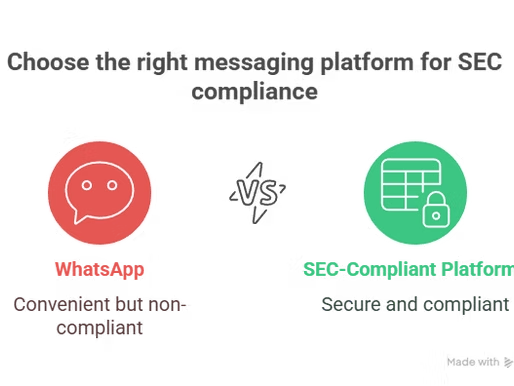
While WhatsApp is convenient and widely used, it simply doesn’t meet the rigorous standards required by regulatory bodies like the SEC (Securities and Exchange Commission). This seemingly helpful app could end up exposing your business to unnecessary compliance risks.
Thankfully, there are messaging platforms specifically designed to handle the complexities of regulated industries. These solutions not only meet but often exceed the SEC’s requirements for secure and compliant communication tools.
At MailSPEC, we specialize in helping organizations switch seamlessly to SEC-compliant messaging solutions that address both security needs and business workflows.
Keep reading to learn five compelling reasons why your business needs a WhatsApp alternative for SEC compliance.
Let’s be honest—WhatsApp is great for chatting with friends. But for industries like finance, healthcare, or legal services, it’s not the right tool. These sectors have strict rules to follow, and using WhatsApp for sensitive business communication brings hefty compliance risks.
The good news? You don’t have to stick with consumer apps that don’t meet your needs. Switching to an enterprise messaging platform designed for compliance removes the guesswork.
Tools like MailSPEC offer encrypted communication, detailed logs, and features tailored to meet the demands of industries like yours. The result? Your business stays compliant with far less stress.
While WhatsApp may promise end-to-end encryption, that’s not enough to meet the broader security requirements of regulated industries. Security breaches can happen more easily on platforms like WhatsApp, which weren’t designed with enterprise needs in mind.
Replacing WhatsApp with a secure, SEC-compliant messaging solution like MailSPEC means you can confidently protect your data. These tools provide enterprise-grade encryption, role-based access control, and system-wide oversight to ensure every message stays secure at every step.
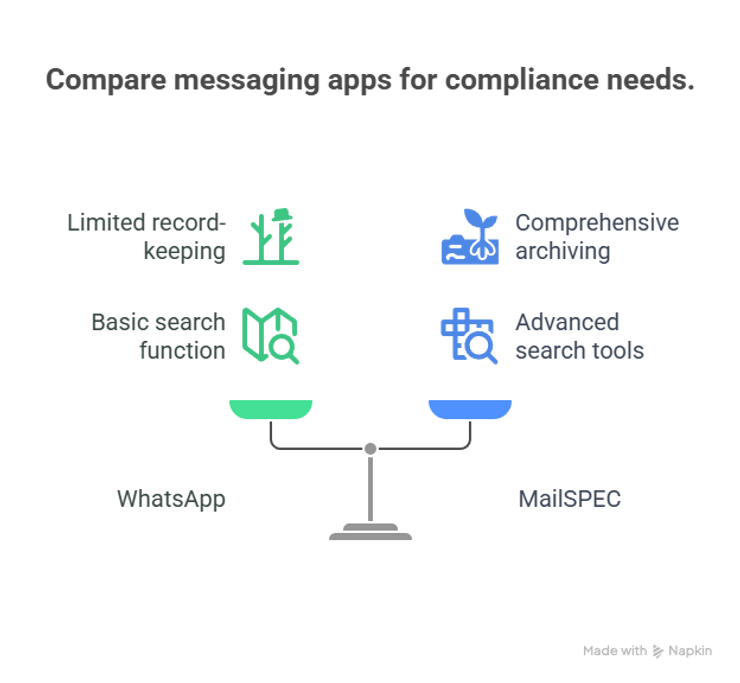
Keeping detailed records is a must for messaging apps for regulated industries, especially when it comes to audits or legal compliance. Unfortunately, WhatsApp doesn’t make record-keeping easy—or even possible in some cases.
An SEC-compliant messaging app like MailSPEC does the heavy lifting for you. Messages are automatically archived and stored securely, making them tamper-proof and easy to retrieve during audits. Plus, you’ll save time with built-in search tools that simplify the process of finding specific interactions.
Every business is unique, and enterprise messaging compliance requirements can vary across industries. Unfortunately, WhatsApp’s “one-size-fits-all” design doesn’t allow for the customization businesses need to meet specific regulatory demands.
Switching to a customizable messaging platform like MailSPEC gives you full control over your communication channels. From user permissions to compliance monitoring, these tools are tailored to meet your specific regulatory needs, ensuring you stay in control and on top of compliance.
Compliance isn’t just about avoiding fines—it’s about showing clients, stakeholders, and regulators that you take data security and transparency seriously. Using non-compliant tools like WhatsApp can quickly damage your reputation.
By adopting an SEC-compliant messaging solution, you’re not just protecting your data—you’re showing clients and regulators that you value integrity and professionalism. Tools like MailSPEC help you safeguard your reputation while staying one step ahead of compliance requirements.
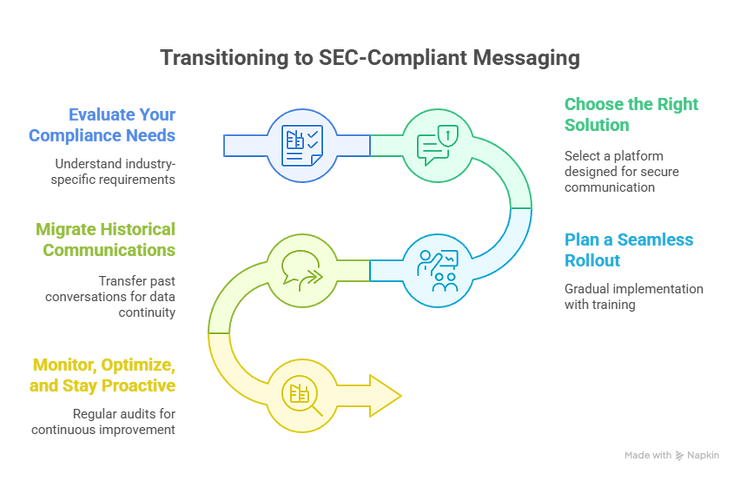
By now, you’ve probably realized why switching to a WhatsApp alternative for SEC compliance is so important. But how do you actually go about making the shift?
Migrating your team to a secure messaging for SEC compliance platform doesn’t have to be complicated. Let’s break it down with this simple roadmap.
Start by understanding your industry’s specific compliance requirements. Are there strict data retention rules? Do you need detailed audit trails or custom governance settings? Identifying these needs upfront will help you choose the right platform that fits like a glove.
Look for a messaging platform designed specifically for secure communication in regulated industries—something built with features like end-to-end encryption, detailed reporting, and tailored governance options.
Tools like MailSPEC are made to meet SEC compliance requirements while ensuring your team’s workflow isn’t disrupted.
Don’t just spring the change on your team overnight. Plan a gradual rollout of the new system. Pair it with clear communication, step-by-step guides, and training sessions to get everyone up to speed. Change can be tricky, but with proper guidance, your team will adapt in no time.
If possible, transfer important past conversations from WhatsApp to your new platform. This ensures that you maintain data continuity and avoid any compliance gaps. Plus, having those records in one place will save you headaches down the line.
The work doesn’t stop after implementation. Regular compliance audits are your best friend—use them to evaluate how the new system is performing and identify any areas for improvement. Staying proactive means staying ahead of potential WhatsApp for business compliance issues.
We specialize in developing messaging tools for regulated industries that simplify compliance without adding extra stress. Our platform offers a perfect mix of robust security, seamless onboarding, and the flexibility your team needs to thrive.
Whether you’re navigating SEC compliance or other industry regulations, MailSPEC is here to support you every step of the way.
Ready to make the switch with confidence?
Don’t leave your business exposed to WhatsApp compliance risks. With regulations becoming more demanding, now is the time to adopt a secure, enterprise-level solution.
MailSPEC is here to help. Our robust messaging tools are designed from the ground up to ensure your business meets SEC communication standards while streamlining operations.
➡️ Learn more about our SEC-compliant messaging solutions.
➡️ Schedule a demo with our team and see how easy it is to migrate.
Your business deserves better—and so do your clients. It’s time to ditch WhatsApp and invest in a messaging platform that protects your data, your clients, and your organization’s future.
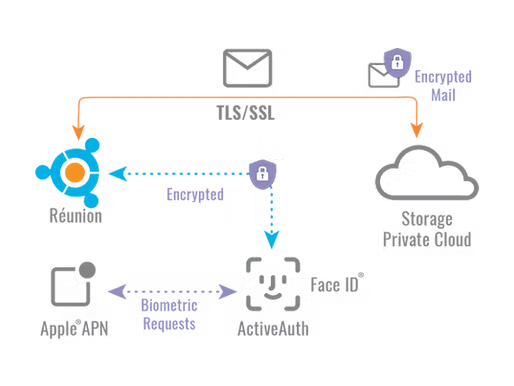
In today’s fast-paced, hyper-connected world, the way employees communicate has shifted dramatically. Gone are those days of clunky desktop software and delayed email chains. The workforce — especially younger employees — now expects mobile-first experiences that mirror the convenience of consumer messaging apps.
But when you are operating in these regulated industries, ease of use cannot come at the cost of compliance. So how can enterprises deliver user-friendly secure messaging without compromising on data security and regulatory standards?
Well, that’s where MailSPEC comes in.
As your trusted partner in regulatory solutions, MailSPEC builds secure mobile communication platforms that prioritize both security and usability. Below, we break down these eight essential principles for designing mobile-first secure messaging platforms that meet user expectations and enterprise compliance needs.
Millennials and Gen Z now make up a large percentage of the workforce. And these employees are digital natives, accustomed to real-time, app-based communication. And even in highly regulated industries like finance, healthcare, and legal, they expect:
Now, ignoring this shift creates friction that actually slows down workflows and even encourages shadow IT — the unauthorized use of apps like WhatsApp or Telegram for business communication.
The solution? Build a secure messaging platform design that aligns with mobile-first behavior while staying within regulatory boundaries.
Smartphones and tablets introduce a unique set of risks, which secure messaging platforms must address from day one:
MailSPEC’s mobile-first communication security approach ensures robust controls such as remote wipe capabilities, secure sandbox environments, and identity-based access protocols tailored for mobile.
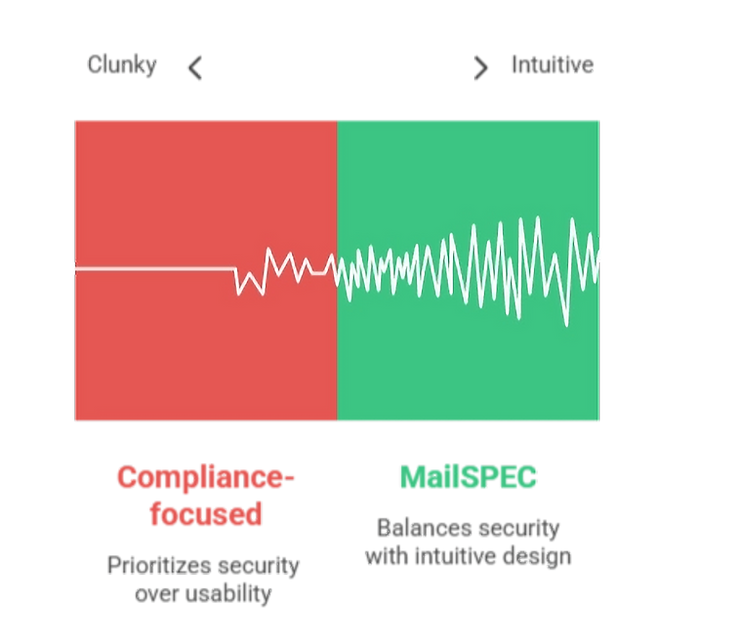
Compliance and cybersecurity cannot be an excuse for clunky software. A good mobile-first secure messaging platform is one that employees want to use.
Key UX principles include:
By following these same principles, MailSPEC ensures user-friendly, secure messaging that balances enterprise-grade protection with intuitive experiences.
Too often, compliance is bolted onto an app after the fact. Well, that never works long-term.
Instead, compliance in mobile messaging must be a foundational element. This means:
MailSPEC's secure mobile communication tools are also built with these features at the core, ensuring your organization remains audit-ready at every step.
Users should never have to think about whether their messages are secure. The best platforms embed these strong protections behind the scenes without actually disrupting the user journey.
For example, MailSPEC:
This "secure-by-default" approach makes mobile-first secure messaging truly seamless for the user, yet uncompromising for the enterprise.
It is no surprise that employees default to apps like WhatsApp, iMessage, or Signal when company tools are too rigid. Now the key here is not to fight that impulse, but to meet it with better tools.
MailSPEC mimics the features users love:
... while enforcing enterprise-grade protections in the background. It is the best of both worlds: mobile secure messaging apps that users enjoy, and security teams can trust.
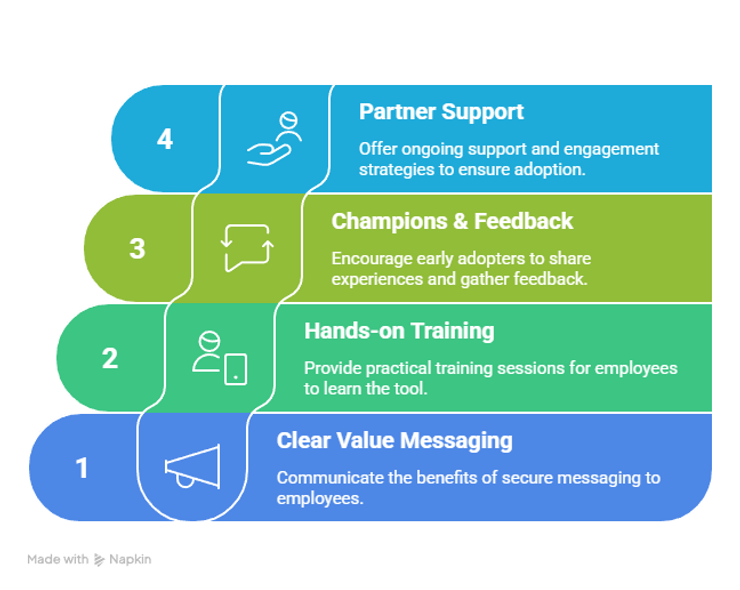
Secure messaging tools only work if employees use them. So that means organizations need an adoption plan that includes:
With MailSPEC, clients get more than just a tool — they get a partner. Our team supports onboarding, change management, and as well as custom user engagement strategies.
Technology evolves fast, and mobile-first secure messaging platforms must keep up. That means building on a flexible architecture that can also adapt to new regulations, devices, and integrations.
MailSPEC’s secure messaging platform design supports:
And as communication norms change, your secure mobile communication infrastructure should evolve with them — not get left behind.
Balancing user-friendly, secure messaging with compliance in mobile messaging does not have to be a losing battle. In fact, with the right design principles and the right partner, it becomes a solid competitive advantage.
MailSPEC delivers mobile-first secure messaging solutions that:
So whether you are securing communication in healthcare, finance, legal, or any other regulated sector, the future is mobile-first. And with MailSPEC, it is also secure-first.
Ready to give your team the tools they want and the protection your enterprise needs?
Contact MailSPEC today to schedule a personalized demo and discover how our mobile-first secure messaging solutions can transform the way your business communicates—safely, compliantly, and confidently.

Executives now chat, message, and collaborate across dozens of platforms, often from mobile devices. While this flexibility boosts productivity, it also introduces a significant challenge: ensuring those communications stay compliant with regulations.
Welcome to the new frontier of compliance—and artificial intelligence is at the center of it.
For C-level leaders navigating risk, security, and compliance, understanding the strategic role of Artificial Intelligence for Compliant Messaging isn’t optional anymore—it’s a business necessity. And at MailSPEC, we’re here to help you unlock that advantage without overwhelming your teams with complexity.
Before we dig into the impact of artificial intelligence, it’s crucial to understand the compliance pain points that organizations face.
Employees increasingly turn to unapproved platforms (like personal messaging apps) for convenience, opening organizations up to “off-channel” risk—a compliance nightmare, especially for regulated industries like finance and healthcare.
Many businesses allow employees to use personal devices for work, a practice known as BYOD. While convenient for users, this significantly complicates data security and compliance monitoring efforts.
Today’s regulatory frameworks place extensive demands on businesses to ensure compliant communication practices. Failing to meet these requirements can result in serious penalties.
Now, think about adding AI into the mix.
With artificial intelligence for compliant messaging, businesses can efficiently address these challenges while simultaneously enabling smarter communication workflows.

Why should executives care about integrating artificial intelligence into communication compliance?
Here’s what sets AI apart as a game-changer for future-ready organizations:
Most traditional compliance systems only step in after mistakes have already happened. That’s where they fall short. Imagine having a system that not only identifies errors but prevents them from happening in the first place. Sounds good, right?
AI tools can analyze communication data across multiple channels in real time, flagging high-risk activities before they escalate into full-blown problems.
And for instance, AI-powered algorithms can detect when sensitive documents are being shared without approval or when employees are using off-channel communication platforms—addressing potential compliance violations before they even occur.
Managing compliance at scale can be a daunting task, especially for enterprises dealing with massive amounts of communication traffic. The good news? AI thrives on data.
It seamlessly scales with your organization, ensuring that all interactions—no matter how many—are monitored effectively. Whether you’re a growing startup or a large enterprise, it adapts to your workflow and ensures your compliance infrastructure grows alongside you.
No more worrying about missing something important in the flood of daily communications. AI’s scalable algorithms have you covered.
Here’s the thing—AI doesn’t just help you stay compliant; it helps you lead smarter.
By analyzing communication trends and identifying risky behaviors, it delivers insights that empower executives to take action. Want to know where your organization is most vulnerable? AI can pinpoint the patterns and help you strengthen your risk strategies.
These insights aren’t just technical details—they’re actionable, real-time data that give you a clear picture of what’s happening and where improvements can be made.
And here at MailSPEC, we take pride in offering AI-powered compliance solutions that not only spot risks but also provide meaningful insights tailored for the C-suite. This means you get more than just an automated tool—you get an intelligent ally in decision-making.
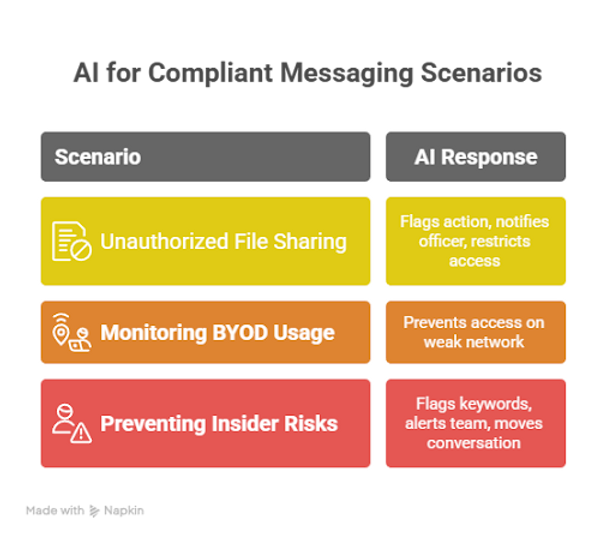
Curious about how AI impacts compliance?
These real-world scenarios illustrate the power of AI for compliant messaging in action:
Scenario: A financial analyst shares a sensitive report using an unapproved personal messaging app.
AI Response: An AI-powered monitoring system detects the file-sharing attempt. It flags the action, notifies the compliance officer, and restricts further dissemination of the document—all in real time.
Scenario: A team member logs into secure messaging on a personal tablet while connected to public Wi-Fi.
AI Response: AI recognizes the weak security context of the connection and prevents access automatically, requiring the employee to switch back to an approved network before proceeding.
Scenario: An employee drafts replies to an off-channel email thread that discusses merger negotiations.
AI Response: AI instantly flags keywords indicating sensitive topics, alerts the compliance team, and ensures the conversation moves to an approved and encrypted platform.
These scenarios demonstrate why MailSPEC’s platform is a trusted solution for artificial intelligence in enterprise compliance. From blocking risky behavior to empowering compliance teams with instant alerts, we take the complexity out of communication safety.
Now, if you’re evaluating solutions, here’s your checklist:
✅ Inline message scanning
✅ Policy-driven content filtering
✅ Integration with your existing platforms (e.g., Microsoft 365)
✅ Automated audit trails
✅ Localization and sovereignty support
✅ Real-time risk scoring and alerts
These features aren’t future luxuries—they’re current necessities.
Investing in AI-powered compliance tools might seem like a significant upfront cost, but it’s one with a measurable return on investment.
Regulatory fines don’t just chip away at your bottom line—they impact your reputation and prevent you from meeting operational goals. With AI reducing compliance errors, businesses can save millions in potential fines and legal fees.
AI handles repetitive risk management tasks, freeing up your compliance team to focus on value-driven initiatives. This increases productivity across the board while ensuring airtight systems for secure enterprise messaging AI.
With audit-ready logs and transparent oversight, AI tools streamline regulatory reviews—cutting down time and costs during investigations.
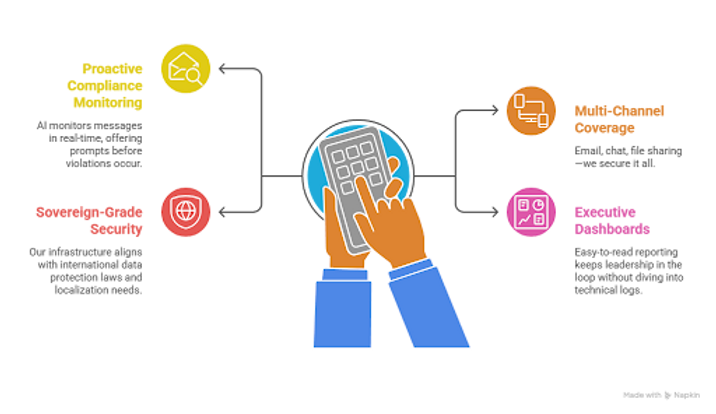
We’re not about throwing complicated tech at your teams. We focus on regulations-first solutions that are simple to use and powerful under the hood.
✔️ Proactive Compliance Monitoring: AI watches messages in real-time, offering prompts before violations occur.
✔️ Multi-Channel Coverage: Email, chat, file sharing—we secure it all.
✔️ Sovereign-Grade Security: Our infrastructure aligns with international data protection laws and localization needs.
✔️ Executive Dashboards: Easy-to-read reporting keeps leadership in the loop without diving into technical logs.
We believe compliant communication for executives should feel effortless—not a burden.
Regulators aren’t slowing down. In fact, rules are tightening across industries and borders. The only way to stay ahead is to embed smart, automated compliance into your operations.
AI makes that possible.
It removes human error, offers real-time guidance, and provides a buffer between your communications and legal risk. And for the executive team, that means fewer headaches, fewer lawsuits, and a much stronger risk posture.
Whether you’re in government, healthcare, or enterprise, MailSPEC helps you:
→ Stop risky messages before they’re sent
→ Gain full visibility into off-channel communication
→ Empower your teams with secure, compliant tools that feel natural to use
Ready to unlock smart, AI-backed compliance?
Contact MailSPEC for a personalized demo and C-level strategy session.

Whether you are in healthcare, finance, legal, or any regulated industry, staying ahead of these ever-changing rules isn't just about avoiding fines. It is about preserving the trust, protecting data, and maintaining operational resilience.
But let’s be honest: manual compliance processes are time-consuming, error-prone, and downright exhausting. But that’s where automated compliance workflows come in.
At MailSPEC, we understand that enterprise messaging compliance can feel like chasing a moving target. Our mission here is to simplify that chase. This guide walks you through ten practical steps to implement automation that keeps you compliant, reduces risk, and frees up your IT team to focus on what they do best.
Before you automate anything, you need to know what you are automating for. Compliance standards vary by industry and geography:
Knowing which regulations apply to your organization is the foundation of smart automation.
Now, from email and instant messaging to file sharing and mobile apps—you need a full picture of how your teams communicate.
Automation starts with visibility. Without it, you’re flying blind.
Automation is only as good as the rules it follows. So, you should better work with compliance officers and legal teams to define:
These become the blueprint for your automated compliance solutions.
One of the major benefits of compliance workflow automation is catching violations before they even become liabilities.
MailSPEC enables real-time policy enforcement, such as:
✔️ Blocking unapproved file transfers
✔️ Flagging use of personal messaging apps for work
✔️ Enforcing retention rules for chat messages and emails
This proactive approach keeps your organization on the right side of compliance.
The best systems don’t just monitor—they act!
MailSPEC automatically detects:
Plus, automated alerts go straight to your compliance team, reducing detection time and improving incident response.
Catching violations is your step one. Then, fixing them is just as important, too!
MailSPEC lets you automate steps like:
Secure enterprise messaging isn’t just about prevention here. It’s about a smart, efficient response.
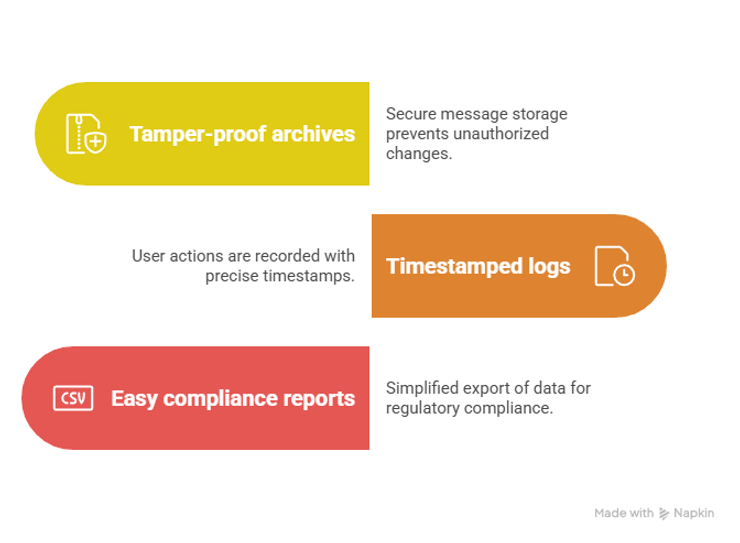
If regulators come knocking, will you be ready?
Manual logs are messy and unreliable. But, automated systems give you:
✔️ Tamper-proof message archives
✔️ Timestamped logs of user actions
✔️ Easy-to-export compliance reports
MailSPEC makes sure your compliance records are always audit-ready.
Automation is powerful—but it’s clearly not infallible. Compliance still needs a human touch.
Our platform empowers teams to step in when nuance is required, while automation handles the heavy lifting.
Let's talk numbers here.
Companies using automated compliance workflows save on:
And according to MailSPEC data:
Organizations can reduce compliance-related administrative workload by up to 60%, while cutting response times by more than half.
So when you automate smartly, compliance becomes an asset—not just a cost center.
Not all automation tools are created equal.
MailSPEC offers:
✔️ Industry-specific compliance automation (HIPAA, GDPR, SEC, SOX)
✔️ Customizable rulesets tailored to your risk profile
✔️ Secure enterprise messaging with end-to-end encryption
✔️ Scalable deployment across cloud, on-premise, and hybrid environments
And most importantly, we focus on regulatory solutions first—not just software.
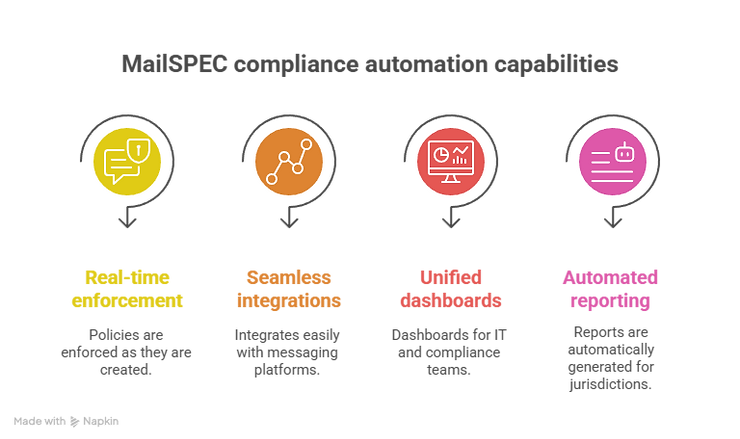
Well, when it comes to enterprise compliance workflows, most platforms bolt on security as an afterthought. Here at MailSPEC, it is built into our DNA.
Our compliance automation capabilities include:
✔️ Real-time policy enforcement
✔️ Seamless integrations with enterprise messaging platforms
✔️ Unified dashboards for IT and compliance teams
✔️ Automated reporting for multiple jurisdictions
All designed to make your job easier, your data safer, and your workflows even smoother.
We get it—compliance can sure feel overwhelming. But with the right tools, the right workflows, and the right partner, you can turn complexity into clarity.
Automated compliance workflows don’t just protect your business. They empower it. So the question isn’t whether you can afford to implement automation.
The real question is: can you afford NOT to?
Let’s talk about what automated compliance looks like for your organization.
Contact us today to schedule a demo or consultation with our compliance specialists.
In today’s global business environment, enterprise messaging is not just about efficiency — it’s now all about compliance, too!
For multinational organizations, staying on the right side of communication laws is not as simple as checking a single box. Different countries and regions have their ideas of what “compliant messaging” looks like.
And navigating these overlapping regulations? It sure can feel like walking a tightrope over international red tape.
But that’s where MailSPEC comes in. We help enterprises like yours simplify the complex, enabling secure, compliant communication across borders without sacrificing usability, speed, or consistency.
In this guide, we will walk you through the challenges of multi-jurisdictional compliance for enterprise messaging and offer practical insights on how to build systems and policies that withstand scrutiny across multiple regulatory environments.
Before we dive into country-by-country specifics, let’s break down what we mean by multi-jurisdictional compliance for enterprise messaging.
In simple terms, it refers to the need for organizations to follow communication and data security laws across every jurisdiction where they operate — and to do so simultaneously.
That includes:
Now, with the rise of remote work, global teams, and cloud-based tools, enterprise messaging is under more scrutiny than ever. What’s considered secure or legal in one country might be restricted or illegal in another.
So how do you keep everyone connected, protected, and compliant — from New York to Tokyo to Berlin? Well, let’s start by looking at what the major global markets expect.
In the U.S., enterprise communication regulations often hinge on industry.
Financial firms, for instance, fall under Financial Industry Regulatory Authority (FINRA) and Securities Exchange Commission (SEC) rules that require retention of all business-related messages — including instant messaging and texts. Healthcare organizations must comply with the Health Insurance Portability and Accountability Act of 1996 (HIPAA), which mandates encryption and secure access.
And there is also a growing crackdown on shadow IT. The SEC has recently issued multimillion-dollar fines to companies for failing to monitor off-channel communications like WhatsApp.
The EU’s General Data Protection Regulation (GDPR) is one of the most influential privacy laws in the world. It also places tight limits on how personal data is collected, stored, and transferred too including through enterprise messaging tools.
And note that penalties for GDPR violations can be up to 4% of global annual revenue. The emphasis in the EU is less on retention and more on individual rights, transparency, and data minimization.
Now, unlike the U.S. or EU, the Asia-Pacific region is not governed by a single framework. Countries like China, Singapore, Japan, and Australia all have unique — and often strict — rules on data handling and enterprise communication.
Note that in many Asian countries, language, culture, and enforcement styles also vary, adding another layer of complexity for global enterprises.
Here is where things get particularly tricky: many jurisdictions now require data localization — meaning certain types of data must be stored within national borders. Yes, and that is a problem for cloud-based or multinational messaging platforms that rely on distributed systems.
Countries like China, Russia, India, and Brazil have implemented these strict data localization laws, which can somehow conflict with the need for centralized data management.
Similarly, cross-border messaging compliance requires enterprises to carefully control where message data travels, who has access to it, and as well as how it’s encrypted or anonymized in transit.
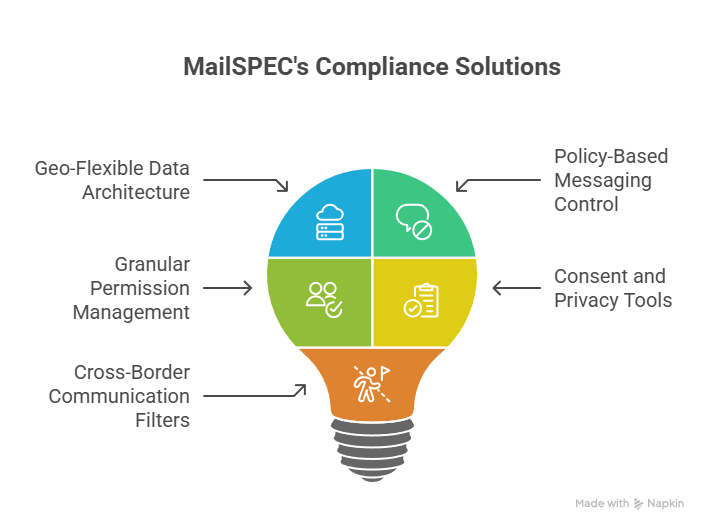
Now, if all of this sounds overwhelming — that’s because it is. But the right partner makes it manageable.
MailSPEC was built with multi-country compliance for enterprise messaging in mind. Here’s how we help:
And no matter where your people are — or how fast regulations evolve — MailSPEC keeps you one step ahead.
While tools like MailSPEC are indeed critical, technology alone is not enough. Enterprises must also create these smart internal policies to support enterprise communication compliance standards worldwide.
✔️ Audit Your Jurisdictional Footprint
Map out where your employees, data centers, and clients are located — and understand the legal obligations in each of those areas.
✔️ Define Local vs. Global Policies
Set base policies that apply globally (e.g., encryption), but allow for local add-ons (e.g., retention rules, language-specific consent notices).
✔️ Establish Approval Workflows
Then, for sensitive or regulated communications, create workflows that ensure legal or compliance teams can review messaging before it’s sent.
✔️ Train and Empower Your People
Give your employees clear guidelines too!— and the tools they need — to communicate securely and compliantly, without slowing down productivity.
✔️ Partner with a Trusted Compliance Platform
MailSPEC provides the foundation for global communication that’s both secure and adaptable to evolving regulatory landscapes.
Enterprise messaging does not happen in a vacuum. A message that’s perfectly compliant in one country could trigger fines in another. And that’s the reality of doing business in a global, digitally connected world.
Multi-jurisdictional compliance for enterprise messaging is not just a legal obligation — it’s a business necessity. And the more proactive and structured your approach, the less likely you are to fall behind.
So whether you are expanding into new markets or shoring up your existing compliance strategy, MailSPEC gives you the control and clarity you need — without the additional complexity for your teams.
Let’s talk about how MailSPEC can support your growth and protect your communications at every level.
MailSPEC、JACE Version 3 (Journaling, Archival, Compliance, and Escrow)を発表
主権に基づくクライアントサイドAIが、規制産業向けに比類なきコンプライアンス、データ主権、監査準備性を提供。
日本、2026年4月6日 – 安全性の高い企業間コミュニケーションおよびインテリジェントコンプライアンスプラットフォームのパイオニアであるMailSPECは、本日、世界で最も規制の厳しいセクター向けに独自設計されたコンプライアンス分類AIエンジン「JACE Version 3」の一般提供を開始したことを発表いたします。クライアント上(エンドツーエンド暗号化)で動作し、クラウドデータ転送ゼロ、多チャネル(メール、チャット、ビデオ、ファイル分類器)対応ソリューションとして構築されたJACEは、強固な規制コンプライアンスを達成しつつ、主権に基づく展開におけるプライバシー保護というジレンマを解決するものです。
JACE 3(Journaling, Archival, Compliance, and Escrow)は、新たなSDKを提供し、「JACE Policy Script」により駆動されるプログラミングインターフェースを搭載しております。これにより、コンプライアンス責任者およびCISOは、各ビジネスプロセスや規制要件ごとにポリシーを細かく調整することが可能となります。Office 365、Oracle NetSuite、SAP、財務アプリケーション、国家安全保障ソフトウェアとのシームレスな統合は他に類を見ず、さまざまな規制ポリシーや業界アプリケーションへの適応力において、本コンプライアンスプラットフォームを際立たせております。
JACE 3は、銀行、医療機関、政府機関、多国籍企業がAIを活用しつつ、最も価値ある資産である内部独自データおよびビジネスの「ノウハウ」の機密性を損なうことなく活用できる環境を提供いたします。内部コミュニケーションには、競争優位性および顧客データセットのプライバシーを支える組織の「秘伝のタレ」が含まれております。
規制監視の強化および地政学上のデータリスクが高まる時代において、JACE 3は、機密情報をクラウドや公開LLMに送信することを受け入れられない組織にとっての最も信頼できるソリューションであります。本プラットフォームは、すべてのAIタスクを完全に端末側または「クライアントサイド」で処理するため、取り込みから監査証跡に至るまで、エンドツーエンド暗号化と完全なデータ主権を保証いたします。
「内部コミュニケーション データは、組織の知的財産、顧客記録、取引戦略、患者履歴、戦略計画など、組織の王冠に輝く宝石であります」とMailSPEC研究開発部長 Tanguy Godquin PhDは述べています。「JACE 3は、単に当該データを保護するだけでなく、ポリシーベースのメタデータ索引により積極的に発見・分類・統治します。他のソリューションでは、企業グレードのAIコンプライアンスをゼロエクスフィルトレーションリスクで実現することはできません。」
JACE 3の主要イノベーション
本リリースの核心は、主権に基づくクライアントサイドAI統治エンジンであります。「クラウド依存型」コンプライアンスツールとは異なり、JACE 3は先進的なポリシーモデルを組織のインフラまたはエンドユーザー端末上で直接実行します。機密情報は決してクライアント環境外へ持ち出されません。このアーキテクチャにより、規制産業における最大のコンプライアンスリスクである、国外の管轄区域や第三者LLMへの意図せぬデータ転送を根本的に排除いたします。
JACE 3は強力なソフトウェア開発キット(SDK)を導入し、以下のミッションクリティカルシステムとの摩擦のない統合を実現します。
• 銀行トレーダーおよびコンプライアンス(KYC/AML)プラットフォーム(通信・取引記録・市場データのリアルタイム監視)
• SAPおよびOracle NetSuite ERP環境(財務ワークフロー全体での自動ポリシー適用)
• 主要医療記録システム(クラウド露出なしでの患者データおよび臨床ノートのコンプライアント分析)
開発者は、暗号化境界を完全に維持したセキュアAPIにより、既存ワークフローへJACEインテリジェンス検知およびポリシーベース統治を数日で埋め込むことが可能です。
JACE 3は、独自の検知アルゴリズムにより、メール、添付ファイル、チャットログ、ERPエントリ、ドキュメントリポジトリ内の独自データおよび規制対象データをリアルタイムで特定いたします。検知後、分類エンジンは組織固有のポリシーを適用し、自動的に以下の処理を実行します。
• 感度レベル、規制タグ、保管ルール、データ所有者などの豊富なメタデータによるコンテンツ索引
• すべてのAIインタラクションに対する不変の監査証跡生成
• eDiscovery、規制審査、内部調査向け記録の準備
• 「今保存して後で復号」脅威に対する静止時量子安全暗号化の提供
この機能により、コンプライアンスは「反応的な負担」から「能動的な戦略優位性」へと変貌します。金融機関はMiFID II、SOX、SEC規則17aおよび日本の規制要件への遵守をワンクリックレポートで証明可能となり、医療機関はHIPAA、GDPR、APPIおよび国内医療規制への適合を容易に達成しつつ、臨床研究ワークフローを加速させることができます。
主権に基づく統制の重要性が高まる背景
主権に基づくAIソリューションの需要はもはやニッチではなく、戦略的必然であります。地政学上の緊張、米国CLOUD Actなどの域外法、厳格な地域規制により、データローカライズ技術の採用が加速しております。Grokipediaの[1]「2026 in Information Technology」によると、組織はデータ主権およびプライベートAI展開を優先し、第三者インフラへの制御委譲を避ける動きを強めております。Deloitteは2026年単年で主権に基づくAIコンピュートへの世界投資額が約1,000億米ドルに達すると予測しております。
欧州連合では、EU AI Act[2](2026年8月完全施行)およびEU Data Act[3]により、デジタル主権が産業政策の要石となっております。違反時には世界売上高の最大7%の罰金が科され、Gaia-X[4]などの取り組みがEU中心の連合型インフラを推進しております。Gartnerの予測[5]によれば、2030年までに欧州・中東企業の75%以上が「geo repatriation戦略」を採用し、ワークロードを主権に基づくまたは地域クラウドへ移行すると見込まれております。
GCC地域も同様の動きを進めております。サウジアラビア、UAE、カタールでは、政府・医療・金融データのローカライゼーションを国家戦略で義務付けております。PwCの2026年経済見通し[6]では、データ主権がAI展開の鍵となり、規制当局は機密ワークロードに国内インフラを要求すると指摘されております。
日本は、個人情報保護法(APPI)[7]の下で技術的自立を着実に推進しております。欧州連合と日本のEU-Japan Digital Week[8]やEU-Japan Digital Partnership[9](2022年開始)は、データ主権およびFAIRデータ原則を信頼できる国境を超えたパートナーシップの基盤として位置づけております。
日本における主権に基づくクライアントサイドAIの緊急的必要性:国家安全保障および機密データ保護のための戦略的必須事項
日本にとって、MailSPECのJACE Version 3のような主権に基づくクライアントサイドAIソリューションの採用は、単なる技術的アップグレードではなく、国家安全保障、規制遵守、経済レジリエンスのための戦略的必然であります。2025年12月、内閣は新たな5か年サイバーセキュリティ戦略[10]を採択し、国家支援型サイバー攻撃を「深刻な安全保障上の脅威」と明示するとともに、能動的サイバー防御(ACD)を含む積極的防衛・抑止へと舵を切りました(国家サイバーセキュリティオフィス、内閣官房、サイバーセキュリティ戦略概要、2025年12月23日)[10]。これは2025年5月16日成立の画期的な能動的サイバー防御法[10]を直接的に踏まえたもので、2027年までに段階的完全施行が予定されており、警察・自衛隊による脅威の事前無力化、通信データの安全な利用、公私連携の強化、新たなサイバー協議会の設置、組織再編などを含みます(能動的サイバー防御法成立関連報告、2025年5-8月;Baker McKenzie分析、2026年1月22日)[10]。
同時に、日本は個人情報保護法(APPI)の強化を継続しております。2026年の改正見直しでは、個人の権利強化、執行力向上(行政制裁金の導入可能性)、越境データ移転ルールの精緻化、AIリスク対応が焦点となっており、域外露出およびサプライチェーン脆弱性への懸念に対応しつつ、責任あるデータ活用を促進しております(個人情報保護委員会、APPI三年に一度の見直し方針、2026年1月9日)[11]。
日本の最も価値ある資産である金融取引データ、医療記録、知的財産、政府機密は、外国からの召喚状、地政学上の強制、産業スパイ活動から守るため、絶対的な日本統制下に置かれなければなりません。クラウドベースAIは機密情報を外部システムへアップロードする必要があり、許容し難いエクスフィルトレーション経路を生み出します。JACEの端末側または完全クライアントサイドアーキテクチャはこのリスクを排除します。組織境界外へ機密データが一切流出せず、エンドツーエンド暗号化およびポリシーベースメタデータ索引により、独自コンテンツの自動検知、保管・監査ルールの適用、不変の監査証跡生成を実現します。JACE 3はAPPIおよび新たなサイバーセキュリティ要件に完全に適合しております。
この必要性は、富士通が2026年2月に発表した「Made in Japan」主権に基づくAIサーバーの鹿島工場での製造開始(2026年3月稼働、最新プロセッサおよび機密計算機能搭載)[12]など、産業界の動きからも明らかであります。銀行、医療、国家防衛などの規制セクターでは、クライアントサイドAIのみが強力なインテリジェンスを主権を譲渡することなく提供可能です。日本がAI駆動型サイバーリスクおよび国家レベルの脅威の中で技術的自立を加速させる中、JACEは国家のデータ王冠に輝く宝石を守りつつ、責任あるAIイノベーションを可能にするセキュアかつ監査可能な基盤を提供いたします。これはまさに日本のサイバーセキュリティ・データ保護・経済安全保障枠組みが求めるバランスであります。
クライアントサイドAIおよびエンドツーエンド暗号化が最優先される理由
規制産業、政府機関、国家安全保障分野において、クライアント上で真のエンドツーエンド暗号化を伴うAI処理は選択肢ではなく、唯一責任あるアーキテクチャであります。クラウドベースAIは、召喚状、侵害、インサイダー脅威を通じてデータエクスフィルトレーションのベクターを生み出します。クライアントサイド処理は、平文データを組織のセキュリティ境界内に常時留め置きます。
エンドツーエンド暗号化により、AIモデル自体がコンテンツを開示するよう強制されることもありません。この手法は、先進的分析で指摘される「主権危機」に直接対応します。集中型クラウドアーキテクチャは組織が最も機密性の高い資産の制御を放棄せざるを得なくします。これに対し、JACE 3は絶対的な機密性を維持しつつ強力なインテリジェンスを提供いたします。これは機密情報を扱う国家安全保障機関、患者プライバシーを守る医療提供者、顧客および競争データを保護する金融機関にとって極めて重要です。
業界専門家も一致しております。Grokipedia[13]が示すように、2026年にはプライベートAI展開およびデータ主権の重要性が一層高まっており、公開クラウド依存および規制要件に伴うリスクを軽減するために不可欠となっております。クライアントサイド暗号化、機密計算、顧客管理キー は、高セキュリティおよび規制産業における標準要件となっております。
実績と提供状況
JACE 3の早期導入企業からは以下の劇的な成果が報告されております。
• コンプライアンスeDiscovery時間の94%削減
• パイロット展開におけるデータ転送インシデントゼロ
• 規制審査向け完全監査準備完了
• JACE Policy ScriptによるAIおよび分類のチューニング
• SDKによるKYC/AMLプラットフォームへのシームレス統合
JACE Version 3は、オン-premise、エアギャップ、ハイブリッド主権展開向けに即時提供可能です。SDKは主要プログラミング言語をサポートし、包括的なドキュメント、リファレンス実装、エンタープライズサポートパッケージを同梱しております。
MailSPECについて
MailSPECは、コミュニケーションチャネル向けAI統治およびコンプライアンス技術を提供し、世界で最もセキュリティ意識の高い規制組織から信頼を得ております。主権、データプライバシー、規制卓越性への揺るぎない取り組みにより、MailSPECは企業および公共サービス機関が、ますます複雑化する規制環境において自信を持ってイノベーションを推進できる環境を整えます。
詳細は www.mailspec.com をご覧ください。
メディアお問い合わせ先
Director of Investor relations and public communications, MailSPEC
+81-46-872-4950 又は japan@mailspec.com
引用文献(Wordで各URLをハイパーリンクに設定し、番号をブックマークとしてご利用ください)
1. Grokipedia. (2026). 2026 in Information Technology. Retrieved March 14, 2026, from https://grokipedia.com/page/2026_in_information_technology Deloitte. (2025). Technology, Media & Telecommunications Predictions 2026: A new era of self-reliance – Navigating technology sovereignty. Deloitte Insights. https://www.deloitte.com/us/en/insights/industry/technology/technology-media-and-telecom-predictions/2026/tech-sovereignty.html Deloitte Global. (2025). Deloitte 2026 Technology, Media & Telecommunications Predictions. Press release, November 2025. https://www.deloitte.com/global/en/about/press-room/2026-tmt-predictions.html
2. EU AI Act text (eur-lex.europa.eu), Article 99.
3. (2023). Regulation (EU) 2023/2854 of the European Parliament and of the Council of 13 December 2023 on harmonised rules on fair access to and use of data (Data Act). Official Journal of the European Union. https://eur-lex.europa.eu/eli/reg/2023/2854/oj
4. Gaia-X European Association for Data and Cloud AISBL. (n.d.). Gaia-X: A Federated Secure Data Infrastructure. Official website. https://gaia-x.eu/
5. Gartner, Inc. (2025, November 12). Gartner Survey Reveals Geopolitics Will Drive 61% of CIOs and IT Leaders in Western Europe to Increase Reliance on Local Cloud Providers. Press release. https://www.gartner.com/en/newsroom/press-releases/2025-11-12-gartner-survey-reveals-geopolitics-will-drive-61-percent-of-cios-and-information-technology-leaders-in-western-europe-to-increase-reliance-on-local-cloud-providers
6. PwC. (2026, January 6). Five GCC economic themes to watch in 2026. PwC Middle East. https://www.pwc.com/m1/en/blog/five-economic-themes-to-watch-2026-gcc.html
7. https://www.japaneselawtranslation.go.jp/en/laws/view/4241/en
8. EURAXESS (European Commission). EU-Japan Digital Week events listing: https://euraxess.ec.europa.eu/worldwide/japan/events/eu-japan-digital-week-2025 (for the 2025 edition, with similar framing).
9. Factsheet on the Japan-EU Digital Partnership (from the launch in 2022): https://digital-strategy.ec.europa.eu/en/library/japan-eu-digital-partnership-factsheetJoint Statement of the Third Meeting of the EU-Japan Digital Partnership Council (May 12, 2025): https://digital-strategy.ec.europa.eu/en/library/joint-statement-third-meeting-european-union-japan-digital-partnership-council
10. National Cybersecurity Office (NCO), Cabinet Secretariat, Japan. (2025, December 23). Outline of the Cybersecurity Strategy (Tentative English translation). https://www.cyber.go.jp/pdf/policy/kihon-s/cs_strategy2025_abstract_english.pdf Cabinet Secretariat, Japan. (2025, December 23). サイバーセキュリティ戦略 [Cybersecurity Strategy]. https://www.cyber.go.jp/pdf/policy/kihon-s/cs_strategy2025.pdf House of Representatives, National Diet of Japan. (2025). Bill on the Development of Active Cyber Defense (Enacted May 16, 2025). https://www.shugiin.go.jp/internet/itdb_gian.nsf/html/gian/honbun/houan/g21306007.htm Cabinet Secretariat, Japan. (2025). サイバー安全保障に関する取組(能動的サイバー防御の実現に向けた検討など). https://www.cas.go.jp/jp/seisaku/cyber_anzen_hosyo_torikumi/index.html Baker McKenzie – Connect On Tech. (2026, January 22). Japan’s New Active Cyber Defense Law: Impact on Businesses. https://connectontech.bakermckenzie.com/japans-new-active-cyber-defense-law-impact-on-businesses
11. Personal Information Protection Commission (PPC), Japan. (2026, January 9). System Reform Policy under the Triennial Review of the Act on the Protection of Personal Information Has Been Decided (January 9, 2026). https://www.ppc.go.jp/en/topix/triennial_review_2026_02/
12. Fujitsu Limited. (2026, February 12). Fujitsu Group starts manufacturing sovereign AI servers in Japan to enhance digital sovereignty. Fujitsu Global. https://global.fujitsu/en-global/pr/news/2026/02/12-01
13. Grokipedia. (2026). 2026 in Information Technology. Retrieved [current date, e.g., March 14, 2026], from https://grokipedia.com/page/2026_in_information_technology