What is Sovereign-Based Messaging and Why Does it Matter for Security in Japan?

For many organizations operating in Japan, secure communication is no longer just a technical discussion. It is now a matter of corporate responsibility, national compliance, and long-term trust.
Every internal message, shared document, or executive conversation carries more than information. It carries personal data, business intelligence, and in many cases, legally protected records.
Also, as Japan continues to strengthen its regulatory expectations around data protection and digital sovereignty, companies are being forced to re-examine a basic assumption they once took for granted: Who actually controls their messages once they are sent?
Now this question sits at the heart of sovereign-based messaging.
MailSPEC works with Japanese enterprises and public service organizations that are navigating this exact challenge. And these organizations are not simply looking for stronger encryption. They are looking for certainty.
Certainty about where their data lives. Certainty about who holds the keys. Certainty that their most sensitive communications remain fully under Japanese legal authority.
And that is why sovereign messaging in Japan is rapidly becoming the preferred model for security-conscious firms.
Understanding Sovereign-Based Messaging in Plain Language
Before diving into regulations and risk, it helps to clearly define what “sovereign-based messaging” actually means.
At its simplest, sovereign-based messaging is a communication model where:
- The organization owns or directly controls the servers
- The data is stored within a specific national jurisdiction
- The encryption keys are held by the organization, not a third party
- Access is governed by local law, not foreign regulations
In other words, the company sending the message does not hand control to an external platform once communication begins.
This is very different from traditional cloud messaging services, where data may be encrypted but still processed, stored, or managed by providers operating under foreign legal frameworks.
And for Japanese businesses, that distinction matters deeply.
Why Sovereign Messaging in Japan Is Becoming the Security Standard
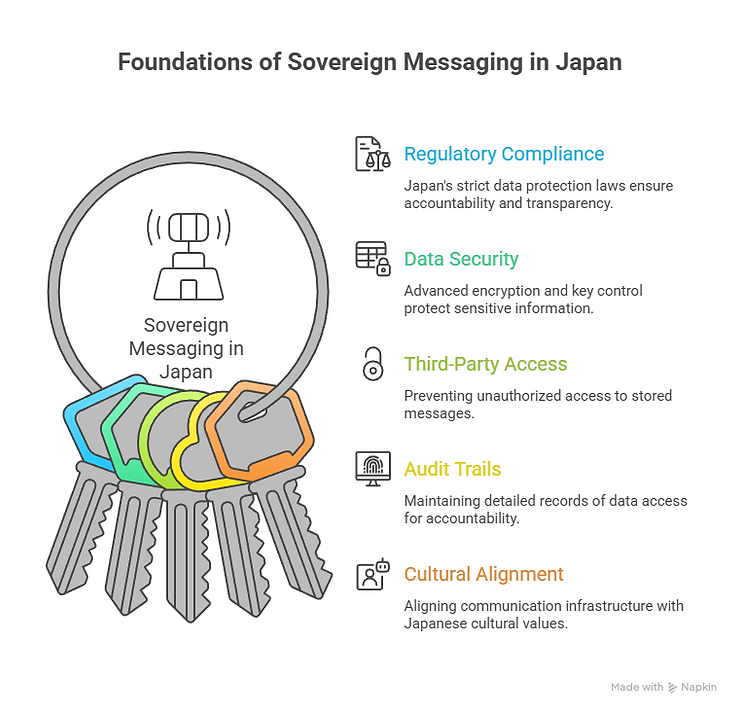
Japan’s regulatory environment places a strong emphasis on accountability, transparency, and protection of personal information. Under the Act on the Protection of Personal Information, organizations are expected to maintain strict oversight over how personal data is handled, stored, and shared.
This expectation extends beyond just basic encryption.
Japanese regulators and compliance teams increasingly look at:
- Whether data leaves Japan without a clear justification
- Whether third parties can technically access stored messages
- Whether encryption keys are controlled domestically
- Whether audit trails can prove who accessed information and when
This is why data sovereignty messaging in Japan is no longer a niche requirement. It is becoming a baseline expectation for regulated industries, large enterprises, and public-facing organizations.
Sovereign-based messaging allows Japanese firms to align their communication infrastructure with both legal requirements and cultural expectations around trust and responsibility.
The Hidden Risk of Black Box Encryption
Many companies believe they are protected simply because their messaging tools advertise “strong encryption.”
But encryption alone does not equal control.
In many popular messaging platforms, encryption is implemented inside what can only be described as a black box.
Messages may be encrypted, but the platform provider:
- Manages the encryption keys
- Controls the infrastructure
- Operates under foreign legal authority
- Can be compelled to provide access under external laws
From a technical standpoint, this means the organization does not have absolute authority over its own communications.
From a regulatory standpoint? This creates exposure.
Japanese compliance leaders increasingly recognize that secure sovereign messaging requires more than trusting a vendor’s promise. It requires architectural ownership.
Why Data Ownership Matters in Japanese Business Culture
Trust plays a central role in Japanese business relationships.
Customers trust companies to protect their information. Partners trust organizations to handle shared data responsibly. Employees trust leadership to safeguard internal communication.
So, when data control is outsourced to foreign platforms, that trust becomes fragile.
Japanese organizations place high value on:
- Predictability
- Accountability
- Long-term responsibility
- Clear lines of authority
Sovereign communication platforms align naturally with these values. They ensure that responsibility for data protection remains where it belongs: with the organization itself.
This cultural alignment is one reason secure messaging for Japanese enterprises is increasingly built around sovereign principles rather than convenience-driven cloud services.
How APPI Reinforces the Need for Sovereign-Based Messaging
The Act on the Protection of Personal Information requires organizations to implement appropriate safeguards to prevent unauthorized access, leakage, or misuse of personal data.
In practice, this means companies must be able to demonstrate:
- Where personal data is stored
- Who has access to it
- How is it protected
- How long is it retained
- How can it be audited
Sovereign-based messaging Japan solutions make these requirements easier to meet by design. Here, instead of layering compliance controls on top of a generic platform, sovereign systems embed compliance into the communication flow itself.
How MailSPEC Supports Sovereign Messaging in Japan
MailSPEC was built specifically to address the challenges that arise when security, compliance, and sovereignty intersect.
For Japanese enterprises, MailSPEC provides sovereign communication platforms that ensure:
✔️ Data remains within Japan
✔️ Encryption keys are controlled by the organization
✔️ Communication is protected end-to-end
✔️ Compliance policies are enforced automatically
MailSPEC’s architecture is designed to support organizations that cannot afford ambiguity around data ownership.
Sovereign-Based Messaging in Practice: Core Capabilities
Rather than relying on one single tool, MailSPEC delivers sovereign control across multiple communication channels.
Secure Messaging with Pulse
Pulse provides encrypted, real-time messaging designed for internal teams and regulated environments. Conversations remain fully under organizational control, with access governed by role-based policies and audit-ready logs.
This allows Japanese enterprises to replace consumer chat tools without sacrificing speed or usability.
Secure Email with EasyCrypt
EasyCrypt ensures that email communication remains encrypted both in transit and at rest, while keeping encryption control within Japan. Messages never become exposed to foreign cloud systems, even when communicating externally.
Secure File Sharing with PassLink
PassLink allows organizations to share sensitive documents through encrypted links with verified access. Files remain stored within sovereign infrastructure, with full visibility into who accessed them and when.
Compliance Oversight with JACE
JACE acts as the policy and compliance backbone across all MailSPEC tools. It automatically journals communications, tags data for retention, and provides escrow capabilities for audits and legal requests.
Together, these tools create a unified sovereign messaging environment rather than isolated security features.
Why Sovereign-Based Messaging Reduces Long-Term Risk
Security incidents are rarely caused by malicious intent. More often, they happen because systems were not designed for the realities of modern communication.
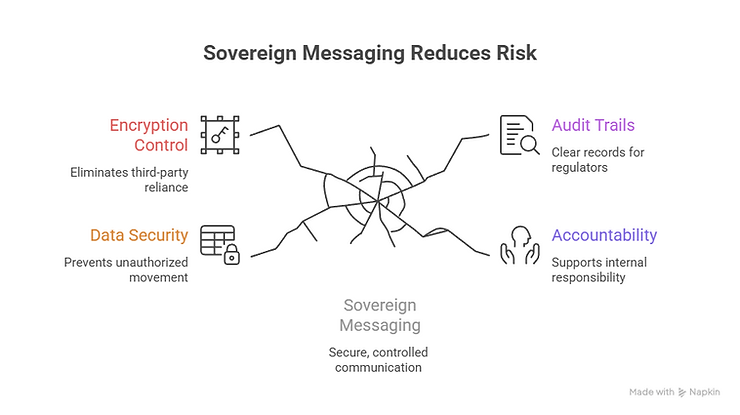
Sovereign-based messaging reduces risk by:
- Preventing unauthorized cross-border data movement
- Eliminating reliance on third-party encryption control
- Providing clear audit trails for regulators
- Supporting internal accountability
For Japanese firms operating in global markets, this approach offers stability in an increasingly complex regulatory landscape.
BONUS: Choosing the Right Sovereign Messaging Strategy
When evaluating sovereign-based messaging Japan solutions, organizations should ask:
- Who controls the encryption keys?
- Where is the data physically stored?
- Which legal jurisdiction governs access?
- Can we prove compliance if asked?
- Does the system align with how our teams work?
MailSPEC addresses these questions directly, without forcing organizations to compromise usability for security.
The Future of Secure Messaging in Japan
As regulatory expectations continue to rise and global data flows become more scrutinized, sovereign control will only grow in importance.
Japanese enterprises that adopt sovereign-based messaging today are not just solving current compliance needs. They are also future-proofing their communication infrastructure against evolving regulations and emerging risks.
Sovereignty is no longer a theoretical concept. It is a practical requirement.
Take Control of Your Communications with MailSPEC
If your organization operates in Japan or handles Japanese personal data, now is the time to evaluate whether your messaging systems truly reflect your security and compliance obligations.
MailSPEC helps Japanese enterprises move beyond surface-level encryption and toward genuine sovereign control.
To learn how sovereign-based messaging can strengthen your security posture while supporting APPI compliance, connect with MailSPEC today.
Start building a communication environment you fully own and control.