7 Ways to Mitigate Third-Party Vendor Risks Through Granular Access Controls

When it comes to enterprise communications, third-party vendor risks are often the hidden cracks in an otherwise solid compliance foundation.
Sure, you could have the most secure internal systems in place, but the moment you bring in an outside contractor, cloud-based partner, or freelance consultant who uses a different communication platform? The attack surface expands—and so does your liability, too.
Regulators are not cutting any slack for data breaches that stem from external collaborators. And if sensitive information is mishandled, exposed, or leaked through a vendor interaction, it’s your organization that pays the price.
And that is where MailSPEC comes in.
As a leading provider of secure, compliant communication solutions, MailSPEC is designed to help enterprises stay in control—even when information leaves your direct perimeter. With built-in tools like granular access controls, guest account monitoring, and audit trails, we ensure third-party communication does not put your entire business at risk.
Now, here are seven actionable ways to mitigate third-party vendor risks through granular access controls.
1. Audit Your Vendor Communication Ecosystem
Before you can secure vendor access, you need visibility into how third parties are currently engaging with your organization.
Are they using personal emails? Messaging apps? Do they have persistent access to internal systems, even after a contract ends?
So, start with a communication audit:
- Identify all external users interacting with your teams.
- Catalog the tools and platforms they’re using.
- Map out what data they can currently access—and for how long.
This process reveals those weak points, like excessive permissions, lack of expiration dates, and even inconsistent protocols between departments. It also helps you prioritize where vendor access management needs to be tightened immediately.
Third-party cybersecurity risks often stem from overly broad or poorly tracked communication access—so the first step is knowing exactly where you stand.
2. Limit Access Based on Role, Not Relationship

It is easy to grant too much access when a trusted vendor “just needs to get something done.” But relationships? Those are not security strategies.
Granular access controls let you assign permissions based on specific roles or project needs, not just any vague partnerships. That is why, instead of giving a freelance designer full access to your shared drive, for example, limit them to just the files required for the job.
With MailSPEC, you can:
- Assign user-level access by job function.
- Control visibility into messages and attachments.
- Restrict internal threads from third-party view.
Now, this ensures access control for vendors aligns with real-time necessity, not convenience.
3. Enforce Time-Limited Permissions to Prevent Third-Party Vendor Risks
Vendor relationships should come with expiration dates—literally.
Whether it is a seasonal contractor or that one-off partnership, long-term access to communication platforms poses a major threat. Left unchecked, ex-vendors may retain access to that sensitive data even months after their work ends.
MailSPEC’s time-limited access controls solve this with:
- Auto-expiring guest credentials.
- Scheduled permission reviews.
- Real-time usage monitoring.
These features help mitigate vendor risk by ensuring access is as temporary as the business need. Remember, once the contract ends, so does the access, too.
4. Create Isolated Communication Channels for Vendors
If your third-party vendors are communicating in the same channels as internal staff, well... that’s a recipe for accidental exposure.
Secure third-party access starts with isolation. MailSPEC lets you create segmented environments specifically for external collaborators. These controlled spaces limit the chance of:
- Internal data is being shared unintentionally.
- Vendors are seeing confidential strategy discussions.
- Cross-contamination of regulated and non-regulated communications.
Think of it like building a guest house instead of giving vendors a key to your home.
5. Ensure Regulatory Alignment with External Parties
Here’s where things get tricky: many of your vendors are not held to the same compliance standards you are.
For example:
- A healthcare provider using HIPAA-compliant systems may partner with a vendor who is not.
- A financial firm may share data with a consultant unfamiliar with Financial Industry Regulatory Authority (FINRA) regulations.
Hence, third-party vendor risk management is not just about securing access—it is also about aligning expectations.
MailSPEC ensures compliance through:
- Customizable data sharing policies.
- Built-in warnings before sending sensitive data.
- Detailed audit logs of every vendor interaction.
These features not only enforce secure practices—they also provide documentation in case of a compliance audit or any breach investigation.
6. Monitor and Log All Vendor Communications
Visibility is everything when it comes to third-party cybersecurity risks. Meaning, you can’t protect what you cannot see.
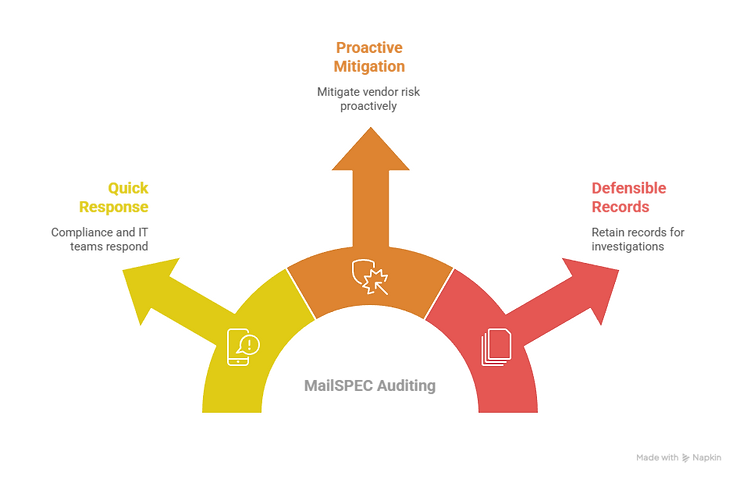
MailSPEC’s robust auditing tools provide:
- Real-time tracking of vendor activity.
- Immutable communication logs.
- Alerts for suspicious behavior or unusual access patterns.
This lets your compliance and IT teams respond quickly, mitigate vendor risk proactively, and as well as retain defensible records in case of an investigation.
You will not let a third-party walk into your server room without signing a logbook, right? Then, apply that same vigilance to digital communications.
7. Learn from Past Breaches: Third-Party Vendor Risks, The Real-World Cost of Inadequate Vendor Controls
Let’s talk reality here.
Several high-profile data breaches in recent years were traced back to vendors.
In one case, a national retail chain suffered a massive customer data breach because its HVAC vendor had unrestricted access to the internal network. Then, in another case, a law firm working with a government agency failed to use encrypted channels, exposing sensitive documents.
And these were not tech companies cutting corners. They were simply businesses that assumed their partners were operating with the same level of security and compliance.
The lesson? Never assume. Build controls that verify.
With MailSPEC, even when communications extend beyond your organization, your standards don’t have to.
MailSPEC: Built to Secure Your Extended Enterprise
In today’s interconnected digital landscape, the definition of “your organization” has completely changed. It now also includes vendors, partners, contractors, and even short-term collaborators. But your obligation to protect data and remain compliant has not changed.
That’s why MailSPEC was built with secure external collaboration in mind. We provide:
- Granular access controls that adapt to any relationship.
- Time-bound permissions that end when the project does.
- Vendor access management that integrates compliance at every step.
- Audit trails and logging to keep you accountable and protected.
You do not have to choose between agility and control here. With MailSPEC, you can have both.
Ready to Take Control of Third-Party Vendor Risks?
If your current communication tools weren’t built with compliance in mind, it is only a matter of time before a vendor-related slip becomes a full-blown security incident.
Do not wait for that breach or regulatory penalty to expose the gap.
MailSPEC gives you the visibility, control, and protection needed to mitigate third-party vendor risks before they become real problems.
Connect with our team to learn how you can secure your enterprise communications—without slowing down your business.