
Compliance Officers Can Balance Employee Privacy with Regulatory Oversight Through the Use of Policy-Based Messaging Controls

There is a quiet tension inside every regulated organization.
On one side, employees expect privacy. Not absolute secrecy, but a reasonable sense that their day-to-day communication is not constantly being watched, dissected, or misinterpreted.
On the other side, regulators expect accountability. They want organizations to prove that communication is controlled, auditable, and compliant with strict legal frameworks, especially under laws like the General Data Protection Regulation.
At MailSPEC, we work with organizations that sit right in the middle of that tension. Compliance officers are not trying to spy on employees. They are trying to protect the organization while respecting the people inside it.
This is exactly where policy-based messaging controls come into play. Instead of choosing between privacy and oversight, the right system allows both to coexist, intelligently, transparently, and without friction.
Policy-Based Messaging Controls: A Smarter Way to Approach Oversight
Traditional monitoring tools operate on a broad principle: capture everything, analyze everything, and store everything.
That approach creates two immediate problems:
- it feels intrusive to employees
- it generates massive amounts of irrelevant data
Policy-based messaging, on the other hand, flips that model.
Instead of scanning everything indiscriminately, it focuses on:
- predefined compliance rules
- context-aware triggers
- role-specific policies
- event-driven monitoring
In practical terms, this means the system only pays attention when something relevant happens. Not before. Not constantly. Only when it matters. This is the foundation of modern messaging compliance controls.
The GDPR Challenge: Privacy Rights vs. Regulatory Responsibility

The General Data Protection Regulation introduced a powerful idea: individuals have rights over their personal data.
That includes:
- the right to access their data
- the right to correct inaccuracies
- the right to request deletion
- the right to understand how their data is used
For compliance officers, this creates a balancing act.
Because at the same time, organizations are required to:
- monitor communication for compliance risks
- retain records for audits
- investigate potential violations
- respond to regulatory inquiries
So how do you monitor communication without violating privacy? The answer lies in employee privacy messaging compliance, and more specifically, in how monitoring is implemented.
Automated Violation Detection: Precision Instead of Surveillance
Here is where many systems go wrong. They treat monitoring as a blanket activity. reviewing all messages, regardless of relevance. That is not just inefficient. It can also conflict with privacy expectations.
MailSPEC takes a different approach through automated violation detection.
Instead of scanning every conversation indiscriminately, the system:
- applies predefined compliance rules
- identifies specific risk patterns
- flags only relevant messages
- ignores unrelated communication
Think of it like a smoke detector. It does not analyze every movement in the room. It only reacts when there is smoke. This makes regulated communication monitoring tools far more targeted and far less intrusive.
Employees are not being watched constantly. The system simply ensures that when something risky occurs, it does not go unnoticed.
Real-Time Guidance: The Power of Templated Warnings
Let’s be honest. Most compliance violations are not intentional.
They happen because someone:
- sends information to the wrong recipient
- shares more data than necessary
- misunderstands a policy
- acts quickly without thinking through the implications
What if the system could step in—right at that moment?
This is where templated warnings make a real difference.
When a potential issue is detected, the system can:
- alert the user before the message is sent
- explain what the issue is
- suggest corrective action
- allow the user to adjust the message
For example: “Are you sure you want to send this file externally? It may contain sensitive personal data.”
This turns compliance into a learning process. Instead of punishing mistakes after the fact, the system helps prevent them in real time. And over time, this builds better habits across the organization.
Role-Based Rights: Who Gets to See What—and Why
One of the biggest concerns employees have is visibility.
Who can see their messages?
Who has access to archived communication?
How is that access controlled?
This is where role-based rights become essential. With properly designed policy-driven messaging platforms, access is not open-ended. It is carefully structured.
For example:
- compliance officers may have access to specific flagged communications
- auditors may retrieve records only within defined parameters
- managers may see only operationally relevant data
- general employees have no access to archived conversations beyond their own
MailSPEC enforces this through strict role-based controls.
Every action is:
- permission-based
- logged
- auditable
This ensures that sensitive communication is only visible to those who genuinely need access—and only within defined boundaries.
Secure Messaging as the Foundation of Trust
All of this sits on top of a critical layer: secure messaging. Because if communication is not secure to begin with, no amount of policy control will fix that.
MailSPEC ensures that all communication—across email, chat, and file sharing—is:
- encrypted end-to-end
- stored in controlled environments
- protected from unauthorized access
- shielded from third-party processing
Again, this is not just about compliance. It is about creating a communication environment where employees feel safe, and organizations remain protected.
The Cultural Impact: Respecting the User While Protecting the Business
Let’s step away from technology for a moment. Because the real success of any system comes down to how people feel about using it.
If employees believe they are being constantly monitored, they will:
- avoid official channels
- move conversations to unmanaged platforms
- create new risks for the organization
But if they understand that:
- monitoring is targeted and policy-driven
- privacy is respected
- access is controlled and transparent
- the system exists to protect everyone
Then something interesting happens. Compliance becomes part of the culture—not a burden.
This is one of the most overlooked benefits of policy-based messaging controls. They do not just enforce rules. They build trust.
How MailSPEC Brings It All Together
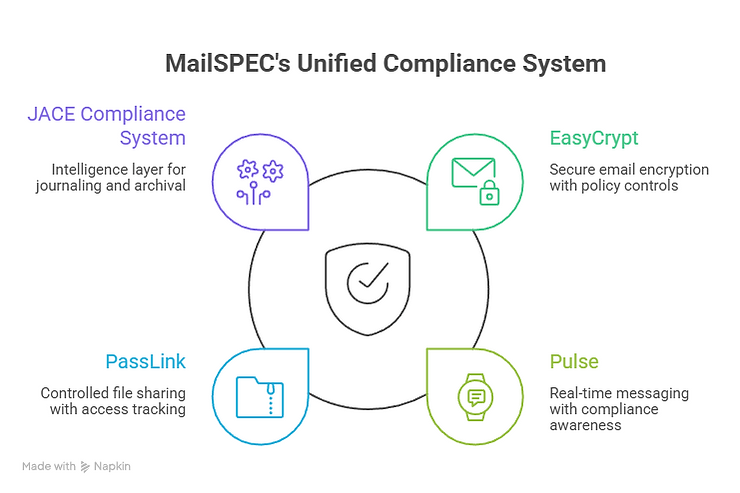
MailSPEC’s platform is designed to make this balance practical, not theoretical.
Here is how the core components work together:
EasyCrypt – Secure Email with Built-In Policy Controls
- Automatically encrypts sensitive communication
- Detects potential policy violations before sending
- Integrates into existing email environments
Pulse – Real-Time Messaging with Compliance Awareness
- Provides chat functionality with built-in controls
- Applies policy-based monitoring without disrupting conversations
- Ensures all messages are securely stored and auditable
PassLink – Controlled File Sharing
- Enables secure transfer of sensitive documents
- Tracks access and usage
- Applies policy rules to file distribution
JACE Compliance System – The Intelligence Layer
- Handles journaling, archival, and metadata tagging
- Applies compliance policies in real time
- Enables fast, structured retrieval for audits
Together, these tools create a unified system where messaging compliance controls operate quietly in the background. No extra steps. No disruption. Just consistent, reliable protection.
A Day in the Life: Compliance Without Friction
Imagine a typical day inside a regulated organization.
An employee drafts a message that includes customer data. Before sending, the system detects potential sensitivity and prompts a warning. The employee reviews the message, removes unnecessary details, and proceeds.
Later, a compliance officer needs to review communication related to a specific transaction. Using metadata tagging, they locate the relevant messages within minutes—without accessing unrelated data.
At no point does the system feel intrusive. But at every point, it is doing its job. That is what effective policy-based messaging looks like in practice.
Why “One-Size-Fits-All Monitoring” No Longer Works
The old approach to compliance was simple: capture everything and hope for the best.
That approach does not scale.
It creates:
- unnecessary data storage
- privacy concerns
- inefficiencies in auditing
- frustration among employees
Modern organizations need something more precise.
They need systems that understand context and that apply rules intelligently as well as respect both regulation and human behavior. That is exactly what policy-driven messaging platforms are designed to do.
Final Thoughts: You Do Not Have to Choose Between Privacy and Compliance
For a long time, organizations treated privacy and compliance as opposing forces. You could have one—but not both. That is no longer true.
With the right approach, you can:
- protect employee privacy
- meet regulatory requirements
- reduce compliance risk
- improve operational efficiency
And perhaps most importantly, you can do it without creating friction for your teams. That is the promise of policy-based messaging controls.
Ready to Build a Smarter Compliance Environment?
MailSPEC helps organizations implement secure, policy-driven communication systems that balance privacy with oversight—without compromise.
So, if your team is navigating the challenges of modern secure messaging and compliance, it is time to move beyond outdated monitoring approaches.
Connect with MailSPEC Today
Create a communication environment that respects your people, protects your data, and stands up to regulatory scrutiny.