EasyCrypt Ensures the Sovereign Integrity of Email for Organizations That Must Move Beyond Standard Office 365 Compliance
.png)
For most employees, an email inbox is simply where work happens. Contracts arrive there. Customer information is exchanged there. Financial discussions, product plans, legal documents, and internal decisions all pass through the same familiar interface.
For a regulated organization, however, the mailbox is much more than a productivity tool. It is a repository of sensitive corporate information, and potentially one of the largest concentrations of confidential data in the business.
That creates an uncomfortable question: Who ultimately controls the information sitting inside those mailboxes?
Standard cloud compliance features can address important regulatory requirements, but compliance and sovereignty are not necessarily the same thing. An organization may surely have encryption, retention policies, access controls, and auditing while still depending on infrastructure and legal jurisdictions outside its direct control.
This distinction is becoming increasingly important for organizations handling sensitive customer, financial, commercial, or strategic information. MailSPEC approaches the problem differently through EasyCrypt, a secure email solution designed to help organizations establish greater control over how sensitive communications are protected, managed, and retained.
The objective is not simply to make email compliant. It is to establish what can be thought of as the sovereign integrity of email.
Why Office 365 Compliance Is Not the Same as Sovereign Email Control
Compliance is often treated as the finish line. For organizations operating across multiple jurisdictions, it is better understood as one layer of a much larger governance question.
A cloud email platform can provide extensive security and compliance functionality. Yet the organization may still need to consider where information is stored, which entities operate the underlying infrastructure, how administrative access is governed, and which legal jurisdictions could potentially apply to the data.
That matters because sensitive information does not stay neatly inside the message body.
An employee mailbox may contain:
- Customer and partner information
- Contracts and commercial agreements
- Pricing discussions
- Financial information
- Product and research plans
- Legal correspondence
- Internal strategic decisions
- Personal information
- Credentials, links, and supporting documents
Over time, the mailbox becomes an informal corporate archive.
This is why a Microsoft 365 compliance alternative should not simply be evaluated by asking whether it has more security features. The more important question is whether the underlying communication environment gives the organization the degree of control its risk profile requires.
For some regulated organizations, that means moving beyond compliance controls layered onto shared infrastructure and considering a more sovereign model.
Sovereign Integrity of Email Starts With Data Sovereignty
Data sovereignty is ultimately about control.
Where does information reside? Who controls the infrastructure? Who can administer it? Which laws potentially apply? Can the organization determine where sensitive information is processed and retained?
These questions become particularly significant for global brands that operate across financial, commercial, and regulatory boundaries.
The principle is straightforward:
Sensitive corporate information should remain within an environment whose ownership, jurisdiction, and access rules the organization understands and can govern.
That is the difference between simply protecting data and establishing sovereign control over it.
A sovereign email solution can provide an additional layer of assurance by allowing communication infrastructure to operate within a controlled private environment rather than depending entirely on a shared public cloud architecture.
And for regulated organizations, that distinction can be significant.
The Difference Between a Shared Cloud and a Controlled Private Environment

There is nothing inherently wrong with cloud computing. The issue is architectural dependency.
A shared public cloud model means an organization relies on infrastructure operated by another entity. Security controls can be strong, but the customer does not necessarily control every underlying component of the environment.
A sovereign private environment takes a different approach.
The organization has greater authority over:
- Where information is stored
- Who administers the environment
- How access is governed
- Which jurisdictions apply
- How communication records are retained
- How sensitive information moves through the system
EasyCrypt is designed around this controlled approach.
Rather than asking employees to abandon the email workflows they already understand, EasyCrypt can provide secure email capabilities while allowing organizations to move sensitive communication into an environment designed around sovereignty and compliance. Now, that distinction is important.
Security that requires employees to completely change their habits tends to encounter resistance. Security that fits naturally into existing workflows has a much better chance of becoming part of everyday behavior.
Moving Sensitive Email Without Turning the Workplace Upside Down
The technical challenge is obvious. If an organization decides that sensitive email should be handled differently, it cannot simply tell thousands of employees to stop using email tomorrow. Email is too deeply embedded in business operations.
Executives need it. Sales teams need it. Legal departments need it. Customer service teams need it. Finance departments need it.
The practical solution is therefore not disruption. It is controlled transition.
EasyCrypt is designed to work with familiar email environments, including Office 365 and Outlook, allowing organizations to introduce secure and compliant communication without forcing employees into an entirely unfamiliar workflow.
That approach matters for one simple reason: people are part of the security architecture.
If the secure option is cumbersome, users may find workarounds. If the secure option feels like normal email, adoption becomes much easier.
A strong email compliance solution should therefore protect the organization without creating unnecessary friction for the people who use it every day.
Secure Email Compliance Must Consider What Happens Inside the Mailbox
One of the less discussed risks in enterprise email is accumulation. A sensitive message sent three years ago may still be sitting in an employee's mailbox today.
The employee may have changed roles. The company may have changed policies. The business relationship may have ended. Yet the information remains. This now creates a data classification challenge.
Not every email carries the same level of sensitivity, and organizations need to understand what information is moving through their communication systems before deciding how it should be protected.
A practical classification model might distinguish between:
Routine information — everyday correspondence with limited sensitivity.
Confidential information — business information that should only be accessible to authorized personnel.
Highly sensitive information — strategic, financial, legal, customer, intellectual property, or regulated information requiring stronger controls.
Restricted information — information subject to particularly strict handling requirements based on regulation, contractual obligations, or organizational policy.
The point is not to create another complicated administrative exercise. It is to recognize that an employee mailbox can contain a mixture of all four. That makes communication infrastructure an important part of enterprise information governance.
Why Sensitive Email Should Not Automatically Become Artificial Intelligence Input
There is another issue emerging alongside data sovereignty: artificial intelligence.
Generative artificial intelligence tools can be extremely useful for drafting, summarizing, analyzing, and searching information. But convenience does not eliminate governance obligations.
An employee may see a long customer email and think, "I wi'll just put this into an artificial intelligence tool and ask for a summary."
Sure, that seemingly harmless action can become a data governance concern if the message contains confidential information, personal information, proprietary material, or regulated data.
The question here is not whether artificial intelligence is good or bad.
The question is whether an organization knows what information is being submitted, where it goes, who can process it, how long it is retained, and whether that transfer is permitted under applicable policies or regulations.
For regulated organizations, confidential email content should not automatically be treated as acceptable input for external artificial intelligence services.
This is where data classification and communication sovereignty intersect. An organization cannot meaningfully govern sensitive information if it does not know where that information is going.
The better approach is to establish clear policies around sensitive information, restrict inappropriate transfers, and keep confidential communication inside controlled environments whenever required.
That turns data sovereignty from an abstract technology concept into a practical governance mechanism.
Protecting Email From Third-Party Access and Legal Overreach
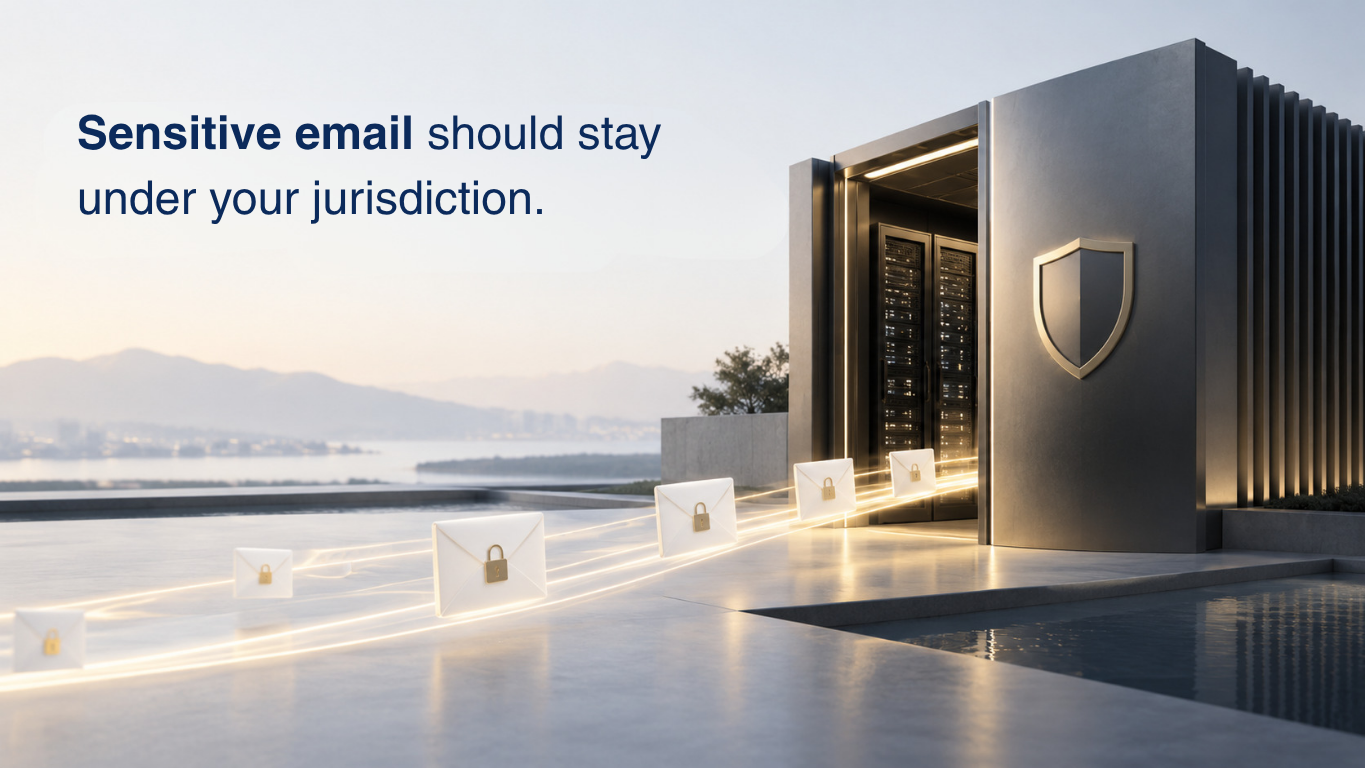
Sovereignty also addresses a difficult question that traditional security conversations sometimes overlook: legal access.
Data may be protected with strong encryption while still residing within infrastructure subject to laws or legal processes outside the organization's preferred jurisdiction.
That does not mean every external provider will misuse information. It means the organization needs to understand its exposure.
A sovereign architecture gives the organization greater control over where its communication environment operates and how access is governed.
For multinational companies, this can reduce ambiguity around cross-border data handling and help establish clearer boundaries around sensitive information. That is particularly valuable when a business operates across several legal systems at once.
The goal is not to make information inaccessible. It is to make access deliberate, authorized, traceable, and governed.
EasyCrypt and the Move Toward Compliant Business Messaging
Email cannot be separated from the wider communication environment.
A conversation may begin in email, move into a chat application, continue through a shared document, and eventually become part of a video meeting. That is why organizations should think about compliant business messaging as an ecosystem rather than a collection of disconnected applications.
EasyCrypt forms part of the MailSPEC approach to secure communication by bringing encryption, compliance, and controlled communication into established business workflows.
The wider MailSPEC portfolio can extend that approach through secure chat, file sharing, authentication, and communication infrastructure designed around sovereignty and regulatory requirements.
The underlying principle remains consistent: Protect the information where it is created and exchanged rather than trying to repair the compliance problem afterward.
Local Support Matters When Communication Infrastructure Is Mission-Critical
There is also a human element to communication sovereignty that should not be overlooked.
Infrastructure decisions do not happen in isolation. When organizations are dealing with regulated information, cross-border requirements, security questions, or architectural changes, they often need to speak with people who understand the environment and can help them work through the practical details.
MailSPEC provides localized support through offices in California, and France.
For organizations operating internationally, that geographic presence can be valuable when discussing deployment requirements, regulatory considerations, and communication architecture across different regions.
Technology may provide the foundation. Support helps organizations actually operate it.
Compliance Should Reduce Risk, Not Simply Document It
There is a temptation to think of compliance as a checklist.
Encryption? Checked.
Retention? Checked.
Audit trail? Checked.
Access controls? Checked.
But the more important question is whether those controls create meaningful ownership over sensitive information.
For organizations with significant regulatory responsibilities, the future of email governance is likely to involve a deeper combination of security, data classification, sovereignty, and operational control.
That is why an Office 365 compliance alternative should be evaluated on more than feature comparisons.
The real issue is architectural.
Where does sensitive information live?
Who controls it?
How is it classified?
Can employees communicate securely without abandoning familiar workflows?
Can the organization demonstrate who had access?
And perhaps most importantly, can it prevent sensitive information from drifting into environments that were never approved to handle it?
Those are the questions that define sovereign email.
Sovereign Email Is Becoming a Strategic Business Decision
The enterprise mailbox is no longer just an inbox. It is a record of relationships, decisions, transactions, strategies, and institutional knowledge.
And for regulated organizations, protecting that information requires more than adding another compliance feature to an existing platform. It requires thinking about control from the beginning.
EasyCrypt offers organizations a path toward that model by combining secure email capabilities with a private, controlled environment designed around compliance and sovereignty. It allows organizations to protect sensitive communication while maintaining the familiar workflows employees already depend on.
That is the real value of sovereign integrity of email. It is not about rejecting cloud technology simply because it is cloud technology. It is about recognizing that some information deserves a higher level of control.
When sensitive data is classified properly, protected within a sovereign environment, and kept out of unauthorized third-party systems—including inappropriate artificial intelligence services—compliance becomes part of the communication architecture rather than a repair job after the fact.
For organizations evaluating how much control they truly have over their most sensitive communications, MailSPEC can help start that conversation.
Connect with MailSPEC
Explore a secure, compliant, and sovereign approach to enterprise email that aligns communication infrastructure with the realities of modern regulatory risk.