Board Members of Regulated Entities Require a ‘Dark-Grid’ Communication Strategy to Protect the Highest Levels of Corporate Governance
.png)
It usually starts with a single email.
A board packet is sent before a quarterly meeting. It contains acquisition plans, executive compensation discussions, financial projections, or details about a pending regulatory investigation. The message reaches every intended recipient. Nothing appears unusual.
Yet that email may become the most valuable target inside the organization.
For cybercriminals, activist groups, and even state-sponsored intelligence operations, board-level communication is where the highest-value information lives. A single compromised inbox can reveal strategic decisions months before they become public, influence stock prices, or expose negotiations worth billions.
That reality is changing how organizations think about governance.
At MailSPEC, conversations with regulated enterprises increasingly begin with one question: Is confidential communication enough, or does the board require an entirely different communication strategy?
For many organizations, the answer is becoming clear. The highest levels of leadership need communication systems designed specifically for resilience, sovereignty, and accountability, not simply another encrypted email service.
Why Secure Board Communication Requires a Different Mindset
Many security investments focus on protecting employees at scale. Thousands of accounts receive stronger passwords, multi-factor authentication, and endpoint protection.
Board members are different.
They represent a very small group, but they possess the organization's most sensitive information. Their communications often include merger discussions, litigation strategies, earnings forecasts, regulatory correspondence, and decisions that could materially affect investors.
That concentration of information changes the threat model completely.
Attackers rarely need to compromise an entire enterprise if they can gain visibility into a handful of executive conversations.
The risk is not only unauthorized disclosure. It is manipulation.
A fraudulent message sent to a board member, a modified meeting document, or a compromised voting discussion can influence corporate decisions long before anyone realizes something has gone wrong.
That is why secure board communication should be viewed as a governance issue rather than simply another cybersecurity initiative.
Standard Corporate Email Has Become an Attractive Target
Corporate email remains one of the most productive business tools ever created. It is also one of the most heavily attacked.
The reason is surprisingly simple. Email reflects how leadership thinks.
A board chair discussing a potential acquisition. A finance committee reviewing earnings guidance. A chief executive preparing for a regulatory announcement. These conversations carry enormous financial value.
Even unsuccessful attacks can create disruption.
Imagine receiving what appears to be a revised board presentation just hours before an important meeting. Under pressure, someone downloads the attachment without verifying its origin.
Now imagine that same scenario unfolding days before earnings are released.
This is precisely why board communication security extends beyond encryption. It requires confidence that messages, files, identities, and access rights all remain trustworthy throughout the communication process.
Protecting executive correspondence is no longer about secrecy alone. It is about preserving the integrity of corporate decision-making.
A Communication Strategy Should Assume That Sensitive Information Will Be Shared
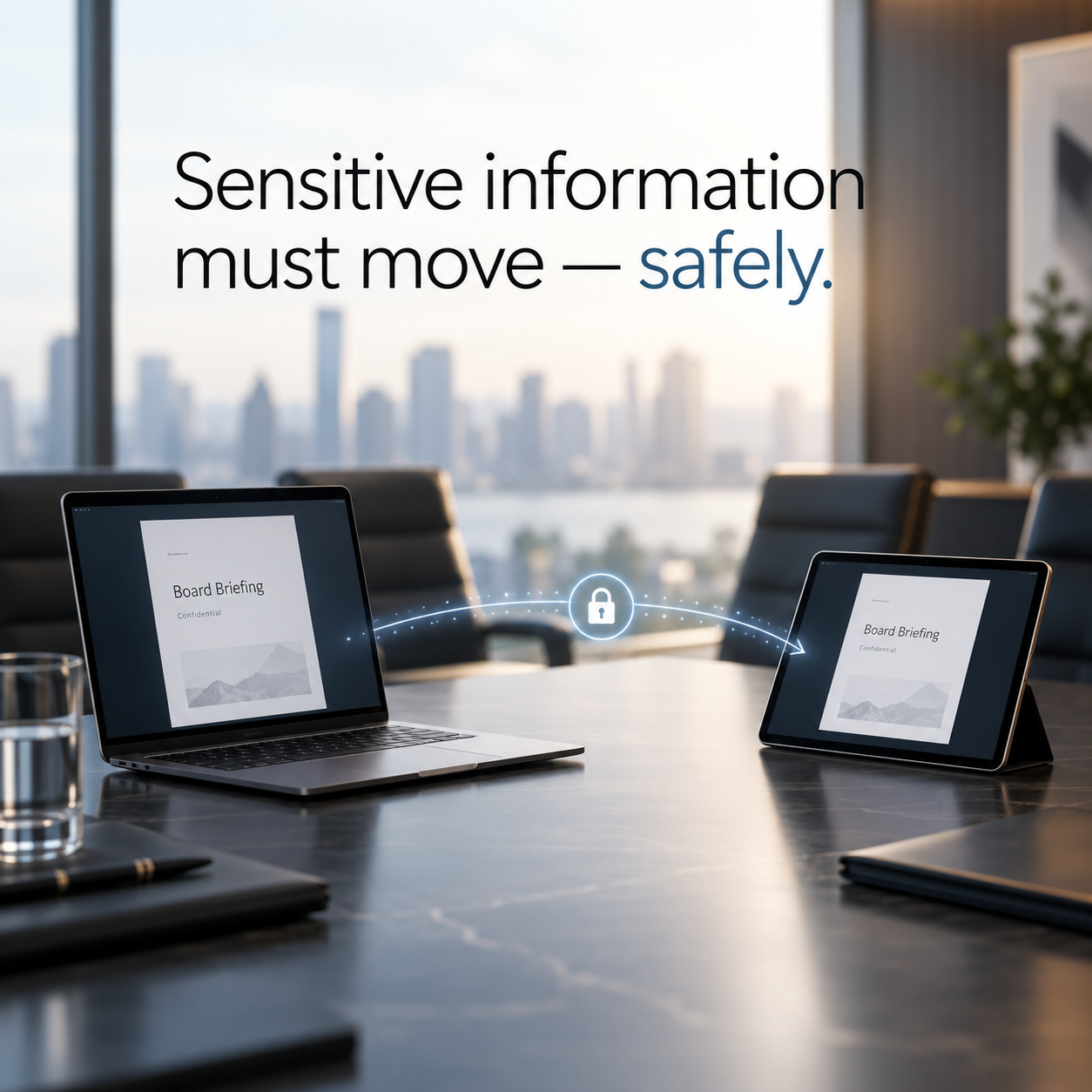
Many organizations still build security around preventing information from moving. Boards operate differently. Their role requires constant information exchange between executives, legal advisers, auditors, regulators, and external directors.
Sensitive documents must move. The challenge becomes controlling how they move.
This is where a mature communication strategy differs from traditional security thinking.
Instead of restricting collaboration, it creates trusted channels where confidential information can flow safely, with governance embedded into every interaction. That philosophy aligns with broader trends in enterprise governance.
Communication systems are no longer passive tools. They have become part of an organization's control framework.
Secure Executive Communications Depend on Visibility, Not Just Encryption
Encryption often receives the most attention, but governance professionals frequently ask another question.
Who actually viewed the information?
That distinction matters.
Knowing that a document was encrypted is useful. Knowing exactly who opened it, when they accessed it, and whether additional copies were created is often far more valuable during an investigation.
Comprehensive access logs provide that visibility.
For board communications, detailed logging creates several important benefits:
- Verification of authorized access
- Clear evidence during regulatory reviews
- Faster internal investigations
- Reduced uncertainty after suspected incidents
- Greater confidence when handling confidential transactions
Visibility creates accountability. Accountability strengthens governance.
Governance Improves When Sensitive Files Travel Through Trusted Channels
Board meetings rarely involve simple email conversations. Directors exchange financial models, legal opinions, acquisition documents, contracts, and strategic presentations that cannot safely circulate through uncontrolled file-sharing services.
This is where MailSPEC's PassLink naturally fits within a broader governance strategy.
Rather than relying on public file-sharing platforms, PassLink enables encrypted document exchange with authenticated access, detailed audit records, and controlled permissions. More importantly, organizations retain visibility over the document throughout its lifecycle.
That changes the conversation from "Did we send the file securely?" to "Can we demonstrate complete governance over how it was accessed?"
And for regulated enterprises, that distinction can significantly simplify legal reviews and regulatory inquiries.
Sovereignty Has Become Part of Board Governance
Corporate governance once focused primarily on financial oversight. Today, it increasingly includes jurisdiction.
Where does sensitive information reside?
Who has administrative access?
Which legal systems could potentially compel access to executive communications?
These questions matter because communication infrastructure increasingly spans multiple countries, cloud providers, and regulatory environments.
A board discussing strategic investments may unknowingly rely upon infrastructure subject to foreign legal authority. That possibility introduces unnecessary uncertainty.
Organizations adopting Communication Sovereignty seek to reduce that uncertainty by maintaining greater control over where executive communications are processed, stored, and governed.
The objective is not isolation. It is predictability.
And when storage remains under organizational control within clearly defined jurisdictions, leaders gain confidence that confidential governance discussions remain governed by the legal frameworks they expect—not unexpected external authorities.
Executive Communication Is Becoming Operational Infrastructure

Boards increasingly treat communication infrastructure with the same seriousness as financial systems or operational technology.
Why? Because governance depends upon reliable communication.
A major cyber incident, cloud outage, or geopolitical disruption cannot be allowed to interrupt executive decision-making. Many organizations now maintain secondary communication capabilities reserved specifically for senior leadership during extraordinary events.
Sometimes these environments are described informally as "dark-grid" communication channels—isolated, secure communication environments available when conventional systems become unavailable or untrustworthy.
Their value is not measured by daily usage. It is measured by readiness.
Just as emergency generators rarely produce electricity during normal operations, secure executive communications become invaluable precisely when ordinary infrastructure cannot be trusted.
The Future of Board Communication Is Quietly Changing
For years, board communication focused on convenience.
Mobile access. Faster collaboration. Digital board books. Electronic voting.
Those capabilities remain important. Yet expectations are shifting.
Regulators increasingly expect stronger governance. Investors expect responsible stewardship of confidential information. Boards themselves recognize that communication infrastructure has become part of enterprise risk management.
This changes how organizations evaluate technology investments.
The conversation is no longer limited to usability or productivity. It now includes Digital Sovereignty, Immutable Audit Trails, Policy Enforcement, and operational resilience.
Communication becomes governance infrastructure rather than productivity software. That represents a meaningful shift in executive thinking.
Secure Messaging for Board Members: Looking Beyond Confidentiality
Protecting board discussions has never been solely about keeping secrets. It is about protecting judgment.
Every major corporate decision begins as a conversation before it becomes a strategy, an acquisition, or a public announcement. The systems supporting those conversations deserve the same attention organizations already devote to financial controls and operational resilience.
MailSPEC approaches this challenge by treating secure board communication as part of enterprise governance rather than simply another security feature.
Through trusted technologies such as PassLink for data room collaboration with data classification designed around sovereignty, auditability, and controlled collaboration, organizations can strengthen governance without creating unnecessary complexity for their leadership teams.
So, if your leadership team is evaluating how to strengthen governance through more secure communications, CONTACT US.