The Psychology of a Successful WhatsApp Replacement Relies on a Mobile-First Design That Prioritizes User Experience Alongside Security

Every information technology leader has seen the pattern. A company rolls out a secure messaging tool with strong encryption, detailed policies, and every compliance feature imaginable. Six months later, employees are back on WhatsApp.
Not because they dislike security. Because they dislike friction.
The uncomfortable truth is that unauthorized communication rarely begins as an act of defiance. More often, it starts with someone trying to answer a colleague quickly while standing in an airport, walking into a meeting, or working from home after hours. And when the approved tool feels slow or complicated, convenience almost always wins.
That is one reason MailSPEC believes the conversation about enterprise messaging needs to evolve. Choosing a WhatsApp replacement is no longer just a security decision. It is a behavioral one. The organizations seeing the greatest success are designing communication systems around how people naturally work instead of expecting people to change how they communicate.
The result is stronger compliance because employees actually use the approved platform.
A WhatsApp Replacement Succeeds Only When It Solves Human Behavior
Security professionals often describe unauthorized messaging as a technology problem. It is actually a psychological problem. People gravitate toward tools that reduce effort.
A quick message. An easy file share. A familiar interface.
Consumer applications have spent years perfecting these experiences. Every button, swipe, and notification has been refined to reduce hesitation.
Corporate communication software has not always kept pace. Many enterprise platforms still feel like they were designed primarily for auditors rather than everyday users. That gap matters.
Employees rarely wake up intending to violate company policy. They simply choose the fastest path to getting work done.
This is why the most successful enterprise WhatsApp alternative is not necessarily the one with the longest feature list. It is the one that removes enough friction that employees no longer feel tempted to leave approved communication channels.
Security adoption begins with user experience.
The Hidden Cost of Off-Channel Communication
When employees move conversations onto personal messaging applications, organizations lose more than visibility. They lose governance.
A discussion about customer contracts may happen outside approved systems. A project update may disappear when someone changes phones. A confidential file might be forwarded without any audit trail.
For regulated industries, those missing records create operational challenges long before regulators become involved.
Without On-Channel Communication, organizations struggle to answer simple questions.
Who received the document?
Who opened it?
Was it modified?
Can it be retrieved months later?
These are governance questions, not just security questions. And the more communication happens outside managed environments, the greater the Off-Channel Communication Risk becomes.
Great Security Should Feel Surprisingly Lightweight
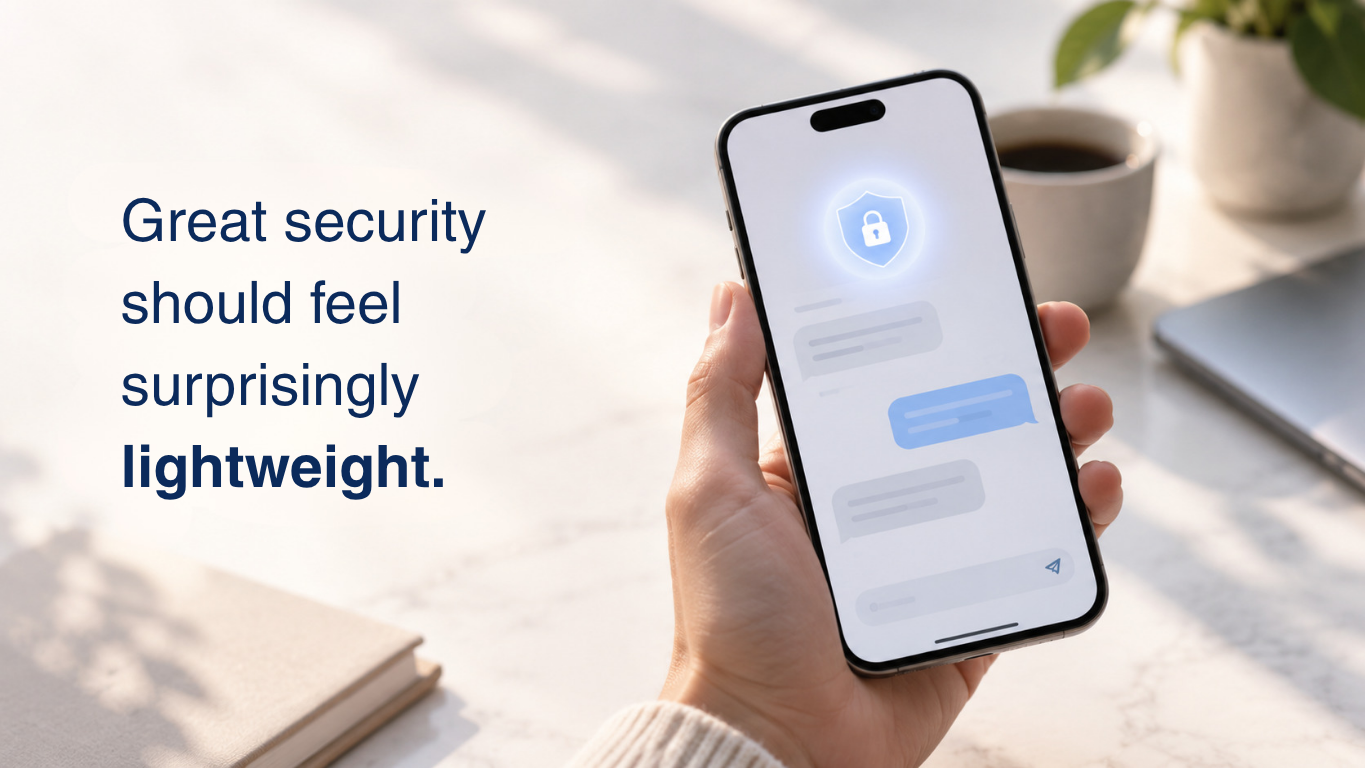
There is a common misconception that stronger security automatically means a more complicated experience. It does not have to.
The most effective secure messaging app is often the one users barely think about.
Messages send quickly. Files open instantly. Navigation feels familiar. Authentication happens quietly in the background. Employees remain focused on conversations rather than technology.
This balance between fortified sovereign control and an intuitive interface represents one of the biggest shifts happening in enterprise communication. Organizations are beginning to understand that usability is not separate from security. Usability is security.
If employees willingly stay inside approved communication channels, compliance improves almost automatically.
Why a Unified Experience Matters More Than Individual Features
Communication has become fragmented.
Email lives in one application. Chat exists somewhere else. Video meetings require another platform. File sharing depends on yet another service.
Every transition interrupts workflow. Every new interface introduces another opportunity for employees to return to consumer applications they already know.
MailSPEC addresses this challenge with the Pronto! Web Client, which brings multiple communication capabilities together within a unified experience.
Instead of asking users to learn separate systems for secure email, collaboration, encrypted file sharing, and video communication, Pronto! reduces the number of environments employees must navigate throughout the day.
That simplicity is more important than it first appears.
People generally resist changing habits. They are far more willing to embrace tools that simplify existing ones.
Communication Should Feel Familiar Without Sacrificing Governance
One of the biggest mistakes organizations make during digital transformation is assuming employees value new features above familiar workflows.
Most people simply want communication to feel predictable.
Open the application. Send the message. Share the document. Continue working.
Behind that straightforward experience, however, enterprise requirements remain remarkably complex.
Organizations still need:
- Secure collaboration
- Compliance Automation
- Data Residency controls
- Immutable Audit Trails
- Policy Enforcement
- Digital Sovereignty
The challenge is making sophisticated governance almost invisible to everyday users.
When security becomes effortless rather than disruptive, adoption rises naturally. That is precisely where many organizations discover the difference between deploying technology and changing behavior.
Reviews Become Easier When Records Already Exist
Internal reviews are rarely scheduled at convenient times.
A legal request arrives. A compliance officer needs communication history. An investigation requires access to project discussions spanning several months.
If communication has been scattered across personal applications, recovering accurate records becomes difficult.
A well-designed business messaging platform changes that experience. Instead of reconstructing fragmented conversations, authorized teams can retrieve organized communication records through structured reporting and searchable archives.
MailSPEC supports this operational need by making communication records straightforward to export when appropriate permissions exist.
The goal is not simply to retain information. The goal is to make legitimate reviews less disruptive for everyone involved. That distinction matters because governance should reduce administrative effort rather than create more of it.
Trust Grows When Employees Feel Protected, Too

Security discussions often focus entirely on protecting organizations. Employees deserve protection as well.
Clear communication policies remove uncertainty. Approved communication channels eliminate guesswork. Reliable audit records reduce misunderstandings.
People work with greater confidence when they know the approved platform protects both the business and the individual. This represents an often-overlooked cultural benefit.
Instead of positioning compliance as surveillance, organizations can position it as shared accountability. Everyone operates within the same trusted environment. Everyone benefits from the same protections.
The Future of Enterprise Messaging Will Be Won Through Experience
There is an interesting lesson hidden inside the popularity of consumer messaging applications. People rarely recommend them because of the encryption algorithms. They recommend them because they are pleasant to use.
Enterprise communication should learn from that observation rather than dismiss it.
Employees expect mobile-first experiences. They expect an intuitive design. They expect conversations to continue naturally across desktop, web, and mobile devices.
Meeting those expectations while maintaining Communication Sovereignty, Zero Sensitive Data Transfer, and regulatory readiness is becoming one of the defining challenges for enterprise technology providers.
Organizations that solve both sides of the equation—security and usability—will dramatically reduce shadow information technology without relying on constant enforcement.
Technology Only Protects an Organization When People Choose to Use It
Perhaps the most important lesson is also the simplest.
No communication platform creates value if employees avoid it.
The strongest encryption cannot protect conversations taking place elsewhere. The most sophisticated compliance engine cannot monitor channels it never sees. The most detailed governance policies become irrelevant when people abandon approved tools for easier alternatives.
That is why selecting a WhatsApp replacement should never be viewed as replacing one chat application with another. It is an opportunity to rethink how secure communication fits naturally into everyday work.
Secure WhatsApp Alternative
As enterprise communication continues evolving, the organizations that succeed will not necessarily deploy the most restrictive systems. They will deploy the systems that employees willingly adopt.
Evaluating a more secure alternative to consumer messaging while preserving a familiar user experience?
Contact Us